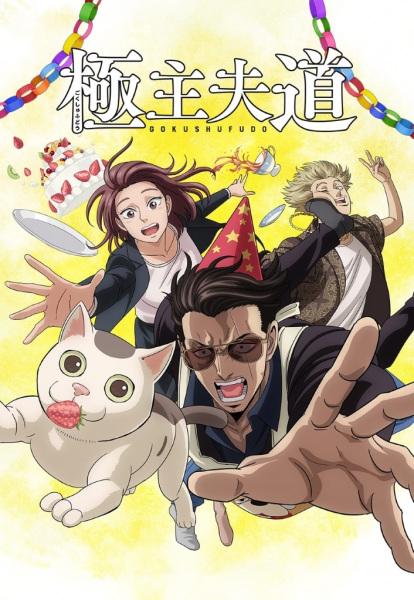
The Way of the Househusband Season 2
極主夫道 (Gokushufudou Season 2)
- Comedy
- Adult Cast
- Gag Humor
- Organized Crime
- Episodes
- 5
- Duration
- 17 min per ep
- Aired
- Jan 1, 2023
- Status
- Finished Airing
Synopsis
Sporting a menacing stare, a fearsome scar, and a teddy-bear apron, former yakuza Tatsu continues to devote himself wholeheartedly to life as a full-time househusband. Having already tackled the basics like grocery runs, he takes on new domestic frontiers by getting involved with a women’s association—where fitting in means first learning the finer points of flower arranging and proper housekeeping.
True to habit, Tatsu treats every household task with the intensity and mindset of his past, turning everyday situations into high-stakes showdowns. Between haiku face-offs, typhoon warnings, and run-ins with costumed troublemakers, his efforts to support his beloved wife, Miku, are frequently complicated by old acquaintances who refuse to leave his former life behind. Even so, Tatsu meets each new challenge head-on, finding that “peaceful” domesticity can be just as chaotic as the underworld.
Otaku Consensus
Otaku Consensus: Season 2 confirms The Way of the Househusband as a strong gag adaptation when Chiaki Kon’s direction lets Kousuke Oono’s deadpan contrasts land in short, punchy bursts. Critics and fans consistently praise Kenjirou Tsuda’s intensity, the warm adult-cast comedy, and skits like Masa’s housewife-yakuza epiphany, while the genuine sticking point remains J.C.Staff’s motion-light, manga-panel animation style and the segmented episode structure that can feel more like a comedy reel than a fully shaped TV episode.
Why You Should Watch
Watch this if you want adult-life gag comedy without school-club padding, power-scaling, or romance melodrama. Season 2 is built for viewers who like the joke density of The Disastrous Life of Saiki K. but want something more domestic and deadpan: yoga classes, balcony herbs triggering police suspicion, crepe-truck ex-gangsters, a cockroach treated like a crisis operation, and a kids’ Christmas party invaded by “The Immortal Claus.” The appeal is not narrative escalation; it is watching one comic idea get sharpened from every angle. Kenjirou Tsuda’s baritone turns routine errands into theatrical threats, while the five-episode format makes it easy to burn through in one sitting. If you can accept limited animation as a deliberate manga-like presentation, this season is a tight, low-commitment comedy hit.
Key Characters
- TTatsu(VA: Kenjirou Tsuda)
Tatsu is the show’s central comic weapon: Kenjirou Tsuda delivers household vocabulary with the menace of a crime drama, making even minor chores sound like ritualized underworld business.
- MMiku
Miku works as the grounded domestic counterweight, and her ordinary needs give Tatsu’s hyper-serious methods the friction that makes the comedy click.
- MMasa
Masa is funniest when he starts seeing the overlap between housework culture and yakuza hierarchy, turning the show’s central joke into a second perspective rather than a repeated punchline.
- TTorajiro
Torajiro’s crepe-truck reinvention gives Season 2 one of its clearest examples of ex-underworld characters treating peaceful work like a new turf war.
What Makes It Stand Out
- 1
The season is only five episodes, released on January 1, 2023, and uses a sketch-driven structure rather than conventional half-hour plotting. Reviews specifically noted the episodes being divided into multiple smaller acts, which boosts gag turnover but left some viewers wanting more focused episodes.
- 2
J.C.Staff retains the divisive limited-animation approach associated with the Netflix adaptation, emphasizing posed panels, hard comic timing, and ornate character drawings over fluid movement. This choice is central to the show’s identity and also its most common criticism.
- 3
Chiaki Kon is credited not only as director but also for episode direction and storyboards, giving Season 2 a notably unified comic rhythm across its quick vignettes.
- 4
The comedy leans into an adult-cast seinen lane rather than teen ensemble humor, matching AniList’s high Yakuza, Food, Episodic, Urban, and Slapstick tags. That combination explains why the show can move from yoga to crepes to police suspicion without feeling like a genre detour.
- 5
Both the opening and ending themes are performed by Uchikubi Gokumon Doukoukai, keeping the season’s musical identity tied to one act instead of splitting the OP and ED between separate performers.
Fun Facts & Trivia
- Fun fact 1
- Kousuke Oono, the original creator, is still the core source behind the adaptation’s humor; critics who were mixed on the animation still singled out the source material’s warmth and joke construction as a major strength.
- Fun fact 2
- Susumu Yamakawa handled series composition, with Asuka Hino on color design, Yurina Yagi as director of photography, and Kousuke Matsuo as animation producer, a compact production credit set that reflects the show’s tightly packaged Netflix format.
- Fun fact 3
- The English-language version lists Michele Knotz as ADR adapter, a role that matters for a series built on punchline timing, domestic wordplay, and exaggerated tough-guy phrasing.
- Fun fact 4
- Across database reception, Season 2 sits in a solid approval zone: MAL lists it at 7.56 from 50,917 votes, while AniList records a 75/100 score and 427 favourites.
- Fun fact 5
- Netflix’s own episode listings highlight how specific the season’s gag scenarios get, including Tatsu’s yoga class, Torajiro’s crepe truck, a suspicious balcony herb garden, and the kids’ party appearance of The Immortal Claus.
Studios
- J.C.Staff