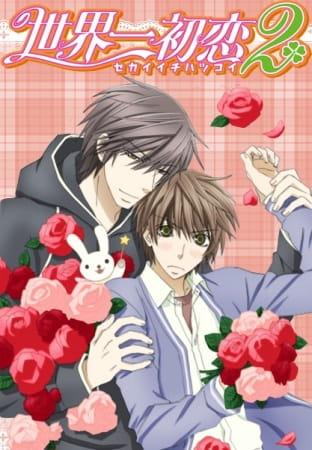
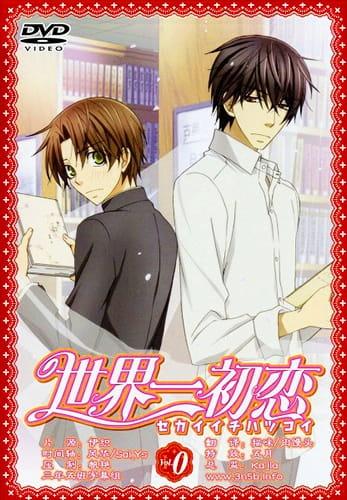
Sekai Ichi Hatsukoi - World's Greatest First Love
世界一初恋 TV (Sekaiichi Hatsukoi)
- Boys Love
- Adult Cast
- Otaku Culture
- Workplace
- Episodes
- 12
- Duration
- 23 min per ep
- Aired
- Apr 9, 2011 to Jun 25, 2011
- Status
- Finished Airing
Synopsis
Determined to prove he can succeed on his own merits after facing resentment for being tied to his father’s publishing name, literary editor Ritsu Onodera leaves his old company and joins Marukawa Publishing. His fresh start takes an unexpected turn when he’s assigned not to novels, but to the Emerald manga editorial department—an intense workplace where rookie editors race against unforgiving deadlines. There, he meets the feared editor-in-chief Masamune Takano, a relentless professional known for demanding results.
The shock runs deeper when Ritsu realizes Takano is the boy he loved in high school, a relationship whose painful end left him wary of falling in love again. Reunited years later in the same office, their unresolved past resurfaces as Takano openly declares his intention to make Ritsu admit his feelings once more. Alongside their story, Sekai Ichi Hatsukoi weaves in the connected romances of three couples working within the manga industry, each confronting the stirrings of first love.
Otaku Consensus
Sekai Ichi Hatsukoi endures as one of the defining early-2010s BL anime because Chiaki Kon’s brisk direction and Rika Nakase’s series composition turn manga-editing deadlines into romantic pressure, with Studio Deen’s clean TV presentation and the cast chemistry frequently praised by fans. Its anthology-like “case” structure gives the Kisa/Yukina material a reputation as the softer, more immediately charming arc, while the most persistent criticism is the series’ reliance on coercive old-school BL dynamics, reflected in AniList’s high “Rape” content tag and reviewer discomfort with forceful romance beats.
Why You Should Watch
Watch Sekai Ichi Hatsukoi if you want adult-cast BL built around manga-industry labor rather than school melodrama: editorial meetings, impossible schedules, professional pride, and the awkwardness of mixing romance with office hierarchy. It scratches a niche between Bakuman’s publishing-world stress and Wotakoi’s adult otaku setting, but with the heightened emotional grammar of josei boys-love. The appeal is not subtle realism; it is the way deadlines, page proofs, and workplace rivalries become accelerants for unresolved attraction. Viewers who like multi-couple structures get more than one romantic temperature, from the thornier Ritsu/Takano dynamic to the more warmly received Kisa/Yukina material. The caveat is important: if coercive romantic framing ruins BL for you, this is a historically influential title to approach critically, not blindly.
Key Characters
- RRitsu Onodera
Ritsu is compelling because his professional insecurity is not decorative; it shapes how he reads praise, pressure, and romance inside a workplace where reputation matters.
- MMasamune Takano
Takano is the series’ most polarizing force, admired as a razor-sharp editor and criticized as the embodiment of the pushy romantic conventions that define much of its era of BL.
- CChiaki Yoshino
Chiaki broadens the show beyond one office romance by bringing in another “case” of first love tied to creative work and emotional misreading.
- YYoshiyuki Hatori
Hatori’s appeal lies in the contrast between professional steadiness and private attachment, a dynamic that fans often connect with the series’ adult-cast identity.
What Makes It Stand Out
- 1
Studio Deen produced the 12-episode Spring 2011 TV series, giving it the polished, character-focused look that contemporary reviewers singled out when praising the drawings and animation quality.
- 2
The adaptation uses a “case” structure drawn from the source’s title format, including The Case of Ritsu Onodera, Yoshino Chiaki no Baai, and Hatori Yoshiyuki no Baai, which lets the anime function as a linked BL ensemble rather than a single-couple show.
- 3
Its workplace angle is unusually specific for TV BL of its period: the romantic drama is tied to manga editorial culture, otaku publishing, and the pressure of producing serialized work under deadlines.
- 4
The Kisa/Yukina relationship is often cited as one of the more approachable parts of the series because reviewers noted it as comparatively adorable and less forceful, even while criticizing how fast the emotional escalation happens.
- 5
The show’s reputation is split between genre affection and content discomfort: it holds a solid 7.6 MAL score from more than 124,000 votes, while AniList’s tag data also flags coercive material strongly enough to mark “Rape” at 56%.
Fun Facts & Trivia
- Fun fact 1
- The anime is based on Shungiku Nakamura and Miyako Fujisaki’s boys-love source material, whose English branding includes The World’s Greatest First Love and the subtitle No love’s like to the first.
- Fun fact 2
- Chiaki Kon directed the series, with Rika Nakase on series composition, Youko Kikuchi on character design, Junko Shimizu as art director, and Masahiro Matsumura handling editing.
- Fun fact 3
- The music was composed by Hijiri Anze, while Shuhei Kita is credited for theme song performance, giving the TV version a dedicated production identity beyond its manga origins.
- Fun fact 4
- The franchise continued beyond this 2011 TV season with The World’s Greatest First Love: The Case of Takafumi Yokozawa, released as a 2014 anime film.
- Fun fact 5
- Across database reception, the series sits in an interesting middle ground: MAL lists it at 7.6/10 with a popularity rank of #1243, while AniList records a 70/100 score and 787 favourites.
Studios
- Studio Deen