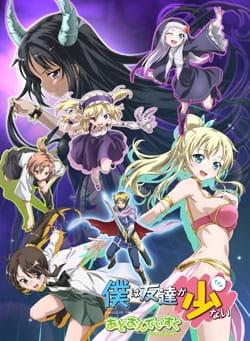
Haganai: I don't have many friends
僕は友達が少ない (Boku wa Tomodachi ga Sukunai)
- Comedy
- Ecchi
- Romance
- Harem
- School
- Episodes
- 12
- Duration
- 24 min per ep
- Aired
- Oct 7, 2011 to Dec 23, 2011
- Status
- Finished Airing
Synopsis
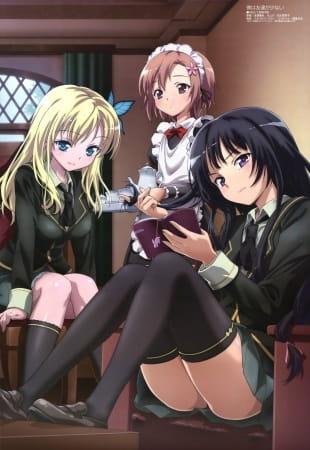
Kodaka Hasegawa transfers to a new school hoping for a fresh start and, ideally, a few friends. Instead, his blond hair and sharp-looking expression earn him an instant reputation as a dangerous delinquent, leaving him isolated even after a month has passed. His routine shifts when he stumbles upon the equally solitary Yozora Mikazuki in an empty classroom, chatting with an imaginary friend.
Bonded by their shared loneliness, Kodaka and Yozora form the Neighbor’s Club—a place for students with no social circle to practice fitting in and learn how to make friends. The club soon attracts more misfits, including the outspoken, eroge-obsessed Sena Kashiwazaki, turning their after-school meetings into a chaotic mix of awkward attempts at friendship, romantic tension, and offbeat comedy.
Otaku Consensus
Haganai lands as a sharp, easygoing club comedy whose best assets are Hisashi Saitou's relaxed direction, AIC Build's clean adaptation of Buriki's character appeal, and the acidic Yozora-Sena rivalry that gives the banter real bite. Its reputation remains firmly middle-tier rather than classic: viewers praise the fun pacing and defined close-up artwork, while the recurring criticism is that the series often feels familiar within the school harem/slice-of-life lane and can overplay its more abrasive personalities.
Why You Should Watch
Watch Haganai if you want a school-club comedy where the jokes come from failed social performance rather than tournament stakes or melodramatic confession timing. It scratches a similar itch to Oregairu's outsider friction, but with a louder ecchi-harem engine and more video-game/otaku-culture gags; it also has the room-to-room hangout rhythm that makes character chemistry the real attraction. The ideal viewer is someone who enjoys messy, prickly personalities bouncing off each other, especially when the show lets awkwardness sit instead of resolving it neatly. AIC Build's 2011 look favors cute, defined character close-ups over visual experimentation, so the appeal is in faces, timing, and verbal jabs. If you want low-pressure comedy with romance tension and a mean streak, this is calibrated for that mood.
Key Characters
- KKodaka Hasegawa(VA: Ryohei Kimura)
Kodaka stands out among harem leads because his problem is not bland passivity but the gap between his intimidating appearance and his comparatively careful, peacekeeping personality.
- YYozora Mikazuki(VA: Marina Inoue)
Yozora is the show's most polarizing presence: a proud, combative loner whose hostility toward 'normal' social life makes her both the comic engine and the character viewers most often criticize.
- SSena Kashiwazaki(VA: Kanae Itou)
Sena's outspoken, eroge-obsessed confidence turns her into Yozora's perfect rival, giving the series much of its most memorable insult comedy and harem friction.
What Makes It Stand Out
- 1
AIC Build adapts Yomi Hirasaka's light-novel setup into a 12-episode Fall 2011 season, keeping the focus on compact clubroom situations rather than a heavily serialized plot structure.
- 2
The visual identity is strongly tied to Buriki's original character designs, with Yoshihiro Watanabe handling the anime character designs and reviews specifically noting the defined close-ups and polished lines used to sell the girls' expressions.
- 3
The comedy mix is unusually explicit about otaku subcultures for a mainstream school harem: AniList tags the series with Video Games at 56%, Nudity at 57%, Crossdressing at 47%, Chuunibyou at 44%, Nun at 43%, and Gender Bending at 40%.
- 4
The show's pacing is frequently described as slow and relaxing rather than escalation-driven, which makes it play more like a hangout comedy with recurring social experiments than a conventional romance chase.
- 5
Satoshi Motoyama served as sound director and Tomohiro Ooshima composed the music, giving the production a dedicated audio team separate from the cast-led theme-song performances.
Fun Facts & Trivia
- Fun fact 1
- The anime aired from October 7, 2011 to December 23, 2011, placing it squarely in the Fall 2011 TV season and ending before the Christmas broadcast window closed.
- Fun fact 2
- Its popularity footprint is much larger than its critical rank suggests: the listed MAL score is 7.13 from 474,932 votes, while its MAL popularity rank is #258 despite an overall rank of #4123.
- Fun fact 3
- Marina Inoue and Kanae Itou are credited in the theme-song performance data, and they also voice the central rivals Yozora Mikazuki and Sena Kashiwazaki.
- Fun fact 4
- The source-material credit belongs to Yomi Hirasaka, while Buriki is credited for the original character designs, a pairing central to the franchise's recognizable light-novel-era identity.
- Fun fact 5
- AniList's audience metrics mirror the 'popular but divisive' reputation: a 68/100 score alongside 1,924 favorites indicates a sizable fanbase without consensus acclaim.
Studios
- AIC Build