The Melancholy of Haruhi Suzumiya
涼宮ハルヒの憂鬱 (Suzumiya Haruhi no Yuuutsu)
- Award Winning
- Comedy
- Mystery
- Sci-Fi
- School
- Episodes
- 14
- Duration
- 23 min per ep
- Aired
- Apr 3, 2006 to Jul 3, 2006
- Status
- Finished Airing
Synopsis
Kyon is a typical high schooler who doesn’t put much stock in aliens, time travelers, or espers—until he crosses paths with Haruhi Suzumiya on his first day. During introductions, Haruhi bluntly declares she has no interest in “ordinary” people and is determined to find the supernatural, a stance that quickly disrupts Kyon’s quiet expectations for school life.
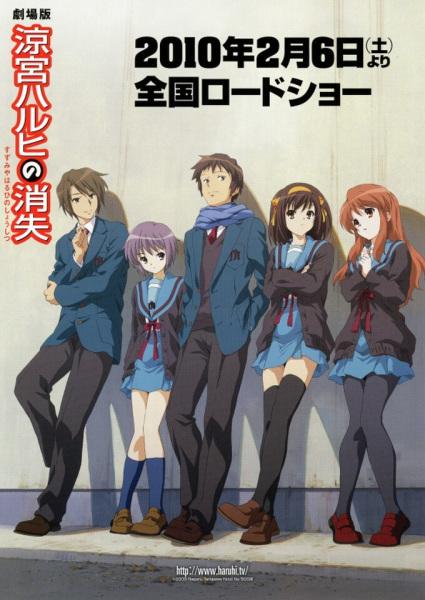
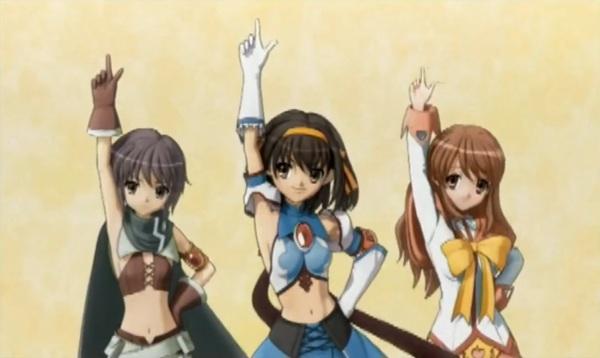
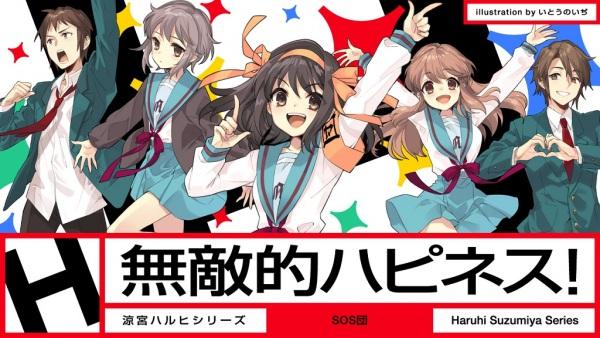
Frustrated by the lack of clubs devoted to the paranormal, Haruhi is pushed—thanks in part to an offhand nudge from Kyon—into forming her own: the SOS Brigade (“Spreading Fun all Over the World with Haruhi Suzumiya Brigade”). Alongside Kyon, she gathers three members: the reserved reader Yuki Nagato, the timid senior Mikuru Asahina, and the ever-cheerful Itsuki Koizumi. Though they seem like regular classmates, each has a hidden connection to Haruhi, and as the brigade lurches from one strange escapade to the next, Kyon finds himself drawn deeper into the mystery of what Haruhi truly is.
Otaku Consensus
The Melancholy of Haruhi Suzumiya remains a defining Kyoto Animation adaptation because Tatsuya Ishihara turns Nagaru Tanigawa’s light-novel material into a formally playful school comedy, using achronological pacing, deadpan narration, and genre parody as part of the text rather than decoration. Critics and fans consistently single out its direction, visual/oral storytelling, musical motifs, and character arcs as the reasons it still feels sharper than most supernatural club shows. Its most persistent drawback is the same thing that made it famous: the non-linear structure and meta experiments can feel alienating or self-indulgent for viewers who want conventional dramatic momentum.
Why You Should Watch
Watch this if you want a school-club anime that treats “ordinary high school life” as a problem of structure, perspective, and cosmic scale rather than as comfort food. It scratches some of the same itch as Monogatari’s talky character friction and Steins;Gate’s otaku-coded reality bending, but with Kyoto Animation’s 2006-era precision: dry reaction shots, deliberately awkward student-film comedy, and visual timing that turns small classroom beats into punchlines. The appeal is not just Haruhi’s energy; it is the way Kyon’s exhausted narration, Yuki’s stillness, Mikuru’s discomfort, and Itsuki’s polish create a constantly shifting comic ecosystem. If you want meta sci-fi without losing the cadence of a school comedy, this is still a key reference point.
Key Characters
- HHaruhi Suzumiya
Haruhi is remembered less as a standard tsundere lead than as a force of editorial disruption, bending the show’s pacing, club culture, and genre identity around her impatience with normalcy.
- KKyon
Kyon’s appeal comes from his weary, hyper-observant narration, which turns him into both the audience’s rational anchor and the show’s sharpest comic instrument.
- YYuki Nagato
Yuki’s near-motionless presence became iconic because Kyoto Animation makes her silence feel active, letting tiny changes in posture and timing carry disproportionate weight.
- MMikuru Asahina
Mikuru functions as the series’ most overt otaku-culture parody figure, with her discomfort and performance inside the club exposing how much of the show is critiquing fan-service roles.
What Makes It Stand Out
- 1
The 2006 broadcast is famous for its achronological order, a structural choice reflected in AniList’s 92% Achronological Order tag and central to how the series withholds context, reframes jokes, and turns episode placement into interpretation.
- 2
Kyoto Animation’s adaptation emphasizes controlled comic timing over spectacle: held reaction shots, awkward pauses, and classroom blocking make ordinary conversations feel choreographed without breaking the school setting.
- 3
The opening student-film-style material is loaded with intentionally “bad” filmmaking grammar, including amateurish staging and technical gags, making the series’ meta and parody tags visible before the larger mystery machinery takes over.
- 4
The staff pairing is unusually important: Tatsuya Ishihara directs from Nagaru Tanigawa’s original story, while Shouko Ikeda adapts Noizi Itou’s character designs into the cleaner, highly readable Kyoto Animation house style.
- 5
Its genre mix is unusually dense for a 14-episode 2006 TV anime, combining School Club, Urban Fantasy, Time Manipulation, Aliens, Philosophy, Parody, and Otaku Culture tags without presenting itself as a straightforward action or adventure series.
Fun Facts & Trivia
- Fun fact 1
- The TV run aired from April 3, 2006 to July 3, 2006 and finished at 14 episodes, yet it still holds major database visibility with MAL Popularity #200 and over 505,000 MAL votes in the provided data.
- Fun fact 2
- AniList records the series at 76/100 with 4,375 favourites, a useful contrast to its MAL score of 7.82 because it shows a title that remains widely watched and specifically cherished rather than merely historically known.
- Fun fact 3
- The production credits separate original character design and animation character design: Noizi Itou created the original look, while Shouko Ikeda handled the anime character designs for Kyoto Animation’s TV adaptation.
- Fun fact 4
- The sound side was led by Youta Tsuruoka as sound director with Eiko Morikawa on sound effects, matching review praise that highlights the show’s oral storytelling and recurring musical/aural motifs.
- Fun fact 5
- Naka Design is credited for the title logo design, a small but notable production credit for a series whose identity is strongly tied to typography, club branding, and otaku-era visual presentation.
Studios
- Kyoto Animation