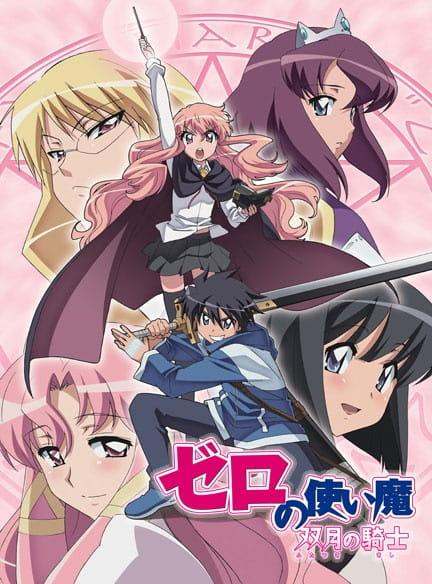
The Familiar of Zero
ゼロの使い魔 (Zero no Tsukaima)
- Action
- Adventure
- Comedy
- Ecchi
- Fantasy
- Isekai
- Romance
- Harem
- School
- Episodes
- 13
- Duration
- 23 min per ep
- Aired
- Jul 3, 2006 to Sep 25, 2006
- Status
- Finished Airing
Synopsis
Louise Françoise Le Blanc de La Vallière attends the prestigious Tristain Academy, where young nobles train to become mages in a world of wands, capes, and courtly tradition. Despite her status, her spellcasting repeatedly goes awry, leaving her branded by classmates as “Louise the Zero.”
During the first-years’ familiar-summoning ritual, Louise’s attempt ends in a massive explosion—yet from the smoke appears Saito Hiraga, a boy pulled into her world and bound to her as her familiar. Treated as little more than a servant and forced into humiliating chores, Saito soon draws attention when a strange mark on his hand is recognized as the sign of Gandalfr, a legendary familiar. As Saito tries to adjust to his new circumstances, Louise begins to show she may be more capable than her reputation suggests.
Otaku Consensus
J.C.Staff’s 2006 adaptation of The Familiar of Zero remains a durable gateway isekai because Yoshiaki Iwasaki’s direction keeps the 13-episode season brisk, prioritizing romcom timing, magic-school class comedy, and Louise/Saito friction over dense worldbuilding. Fans still cite its light fantasy-romance formula as rewatchable and easy to recommend, while the most persistent criticism is that the early master-servant slapstick can feel annoying, cheesy, and more repetitive than its adventure plot deserves.
Why You Should Watch
Watch The Familiar of Zero if you want pre-SAO isekai with capes, duels, nobles, maids, dragons, and messy romantic comedy instead of menus, stat screens, and grim power scaling. It scratches a similar itch to Toradora! for viewers who enjoy combative tsundere chemistry, but filters that energy through a magic-academy fantasy setup closer to classic light-novel escapism. The appeal is not intricate plotting; it is the 2006 J.C.Staff rhythm of quick gags, jealous misunderstandings, swordplay bursts, and a harem structure that keeps poking at class hierarchy. If you can tolerate slapstick humiliation as part of the era’s romcom grammar, this is one of the titles that explains why “summoned to another world” became such a reliable anime comfort food.
Key Characters
- LLouise Françoise Le Blanc de La Vallière
Louise is the series’ defining mid-2000s tsundere: an ojou-sama whose status anxiety, explosive temper, and romantic defensiveness make her both the main hook and the main point of viewer controversy.
- SSaito Hiraga
Saito works as the audience’s isekai surrogate, but fans remember him less for wish-fulfillment competence than for being trapped between slapstick punishment, harem temptation, and bursts of swordplay-driven usefulness.
What Makes It Stand Out
- 1
It is a 2006 isekai before the genre’s later RPG-system boom, so its fantasy identity comes from magic-school etiquette, noble class divisions, familiars, and courtly adventure rather than skill trees or game mechanics.
- 2
The season’s 13-episode structure gives it an unusually fast light-novel adaptation tempo: comedy, romance, school conflict, and action beats are packed tightly instead of being allowed to sprawl.
- 3
J.C.Staff’s production emphasizes character reaction comedy and romcom escalation; with Yoshiaki Iwasaki directing and Takao Yoshioka handling series composition, the show’s most recognizable rhythm is slapstick setup, emotional blowup, and quick reset.
- 4
The AniList tag profile captures why the show is still debated: Tsundere at 82%, Female Harem at 75%, Slapstick at 74%, Slavery at 68%, and Bullying at 62% place its appeal and its discomfort in the same master-servant romantic-comedy engine.
- 5
Masahiro Fujii’s anime character designs adapt Eiji Usatsuka’s original designs into a very identifiable mid-2000s fantasy look, reinforced by Haruko Iizuka’s prop work on the academy’s wands, uniforms, and familiar-world accessories.
Fun Facts & Trivia
- Fun fact 1
- The first season aired from July 3 to September 25, 2006, finishing as a compact 13-episode TV run from J.C.Staff.
- Fun fact 2
- The production’s key creative chain links original creator Noboru Yamaguchi, original character designer Eiji Usatsuka, director Yoshiaki Iwasaki, and series composer Takao Yoshioka.
- Fun fact 3
- Its visibility has outlasted its critical ranking: on MyAnimeList it sits at a 7.2 score and rank #3754, yet its popularity rank is #249 with 487,904 votes.
- Fun fact 4
- AniList’s numbers show a similar split between affection and moderation: a 68/100 score, but 2,823 favourites and very high identity tags for Isekai, Magic, and Tsundere.
- Fun fact 5
- The broader production credits include Yoshinori Hirose as art director, Kyousuke Ishikawa on color design, Rikiya Marumo as director of photography, and Masahiro Gotou on editing, a staff spread typical of a TV anime built around fast scene turnover and clear comedic readability.
Studios
- J.C.Staff