Say "I Love You."
好きっていいなよ。 (Suki tte Ii na yo.)
- Drama
- Romance
- School
- Episodes
- 13
- Duration
- 23 min per ep
- Aired
- Oct 7, 2012 to Dec 30, 2012
- Status
- Finished Airing
Synopsis
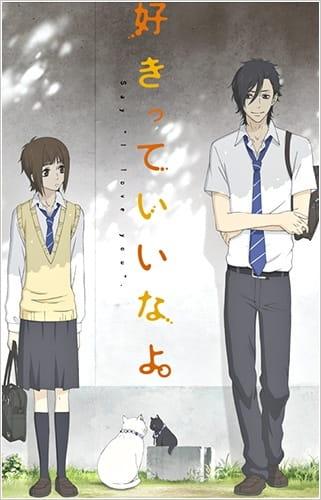
Mei Tachibana has kept her distance from others ever since grade school, when she was unfairly blamed for the death of a class pet by the very friends she trusted. Convinced that getting close to people only leads to pain, she enters high school determined to stay alone—until a misunderstanding brings her into contact with Yamato Kurosawa, a well-liked boy who takes an unexpected interest in her.
Despite Mei’s resistance, Yamato persists in trying to befriend her. After a troubling incident with a stalker leads Yamato to kiss Mei to ward off unwanted attention, her guarded world begins to shift, and feelings she never meant to have start to surface. As their relationship turns into dating and Mei finds herself surrounded by new connections, she struggles to adjust—especially when it comes to expressing what she truly feels. Through miscommunications, jealousy, and the pressures of attention from others, Mei and Yamato gradually learn what it means to honestly say, “I love you.”
Otaku Consensus
Say "I Love You." earns its reputation as a grounded shoujo romance because Takuya Satou’s direction and series composition keep the drama intimate, paced around emotional adjustment rather than contrived spectacle. Critics and fans consistently single out its relatable character development and realistic school-social tension, while the main reservation is that its gentle, low-flash approach can feel too understated for viewers who expect heightened romantic set pieces or faster catharsis.
Why You Should Watch
Watch Say "I Love You." if you want a shoujo romance about trust, insecurity, and social recovery without the constant gag rhythm or melodramatic escalation that can dominate high-school love stories. It scratches a similar itch to Kimi ni Todoke in the way it studies an isolated heroine learning how relationships work, but it is more direct about jealousy, attention, and the uneven power dynamics of popularity. The appeal is not wish fulfillment alone: Zexcs and Takuya Satou frame romance as a process of learning emotional language, not just reaching a confession scene. Viewers who like school drama where small misunderstandings carry real weight, and where character growth is the main engine, will get the most out of its 13-episode run.
Key Characters
- MMei Tachibana
Mei stands out as a shoujo heroine whose guardedness is treated less as a cute quirk and more as a learned survival habit she has to consciously unlearn.
- YYamato Kurosawa
Yamato is memorable because the series uses his popularity as a source of tension and responsibility, not simply as a fantasy upgrade for the romance.
What Makes It Stand Out
- 1
Zexcs produced the anime as a compact 13-episode TV series that aired from October 7 to December 30, 2012, giving the romance a one-cour structure rather than a long episodic sprawl.
- 2
Takuya Satou served as both director and series composition writer, a production setup that helps explain the show’s consistent focus on interpersonal cause-and-effect over episodic detours.
- 3
AniList users tag the series heavily for Bullying at 92%, School at 91%, Shoujo at 85%, Female Protagonist at 80%, and Rehabilitation at 70%, which captures how strongly the audience reads it as a recovery-centered romance rather than a pure dating fantasy.
- 4
The visual design pipeline is unusually specific in the credits provided: Junko Watanabe and Yoshiko Okuda handled character design, while Kyouko Kametani handled costume design and Kanako Hiroo handled prop design, reinforcing the show’s emphasis on everyday school presentation.
- 5
Its reception footprint is larger than its modest MAL rank suggests: it holds a 7.38/10 MAL score from 374,394 votes, sits at #347 in MAL popularity, and has 2,671 AniList favourites.
Fun Facts & Trivia
- Fun fact 1
- The anime adapts Kanae Hazuki’s original work and was released during the Fall 2012 season, finishing its broadcast on December 30, 2012.
- Fun fact 2
- The production credits separate chief direction and direction: Toshimasa Kuroyanagi is listed as chief director, while Takuya Satou is credited as director and series composition writer.
- Fun fact 3
- Art direction was led by Yuka Hirama, with Hiroki Matsumoto credited as assistant art director, giving the background department named oversight alongside the character, costume, and prop design teams.
- Fun fact 4
- Across database reception, the series shows a notable split between mainstream visibility and critical placement: MAL lists it at popularity rank #347 while its score rank is #2711.
- Fun fact 5
- Fan and review commentary repeatedly highlights the anime as “realistic,” “relatable,” and “gentle,” with praise centering on character development rather than on spectacle or comedy.
Studios
- Zexcs