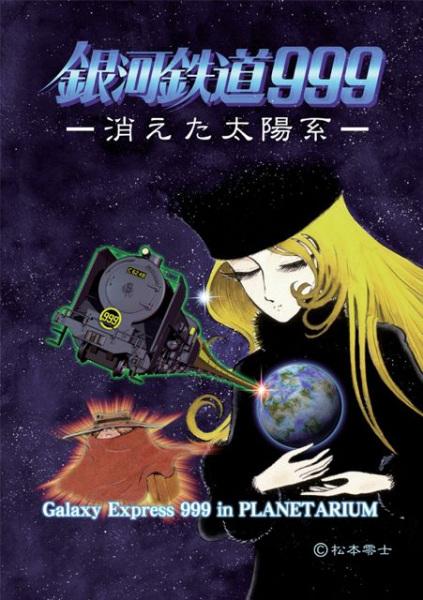
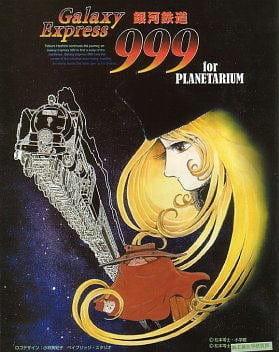
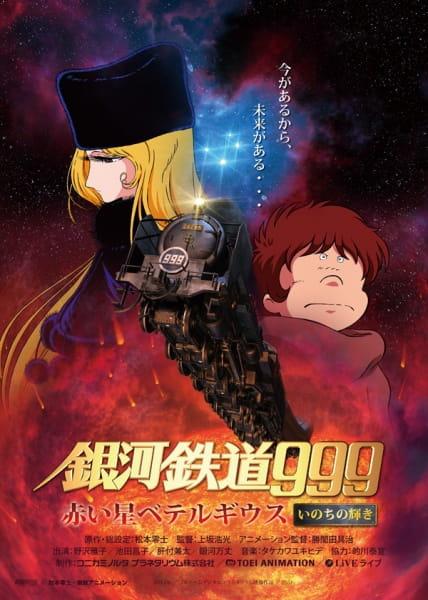
Galaxy Express 999
銀河鉄道999 (Ginga Tetsudou 999)
- Adventure
- Drama
- Sci-Fi
- Space
- Episodes
- 113
- Duration
- 24 min per ep
- Aired
- Sep 14, 1978 to Mar 26, 1981
- Status
- Finished Airing
Synopsis
In a far-off future, immortality is within reach—if you can afford a mechanical body. For the poor, that promise is little more than a rumor, and young Tetsurou Hoshino clings to one legend in particular: the Galaxy Express 999, a train said to cross the cosmos and grant a free mechanical body at its final stop. His hopes are shattered when his mother is killed by Count Mecha, a ruthless machine-man hybrid, leaving him with nothing but grief and a desperate resolve.
On the brink of death himself, Tetsurou is rescued by Maetel, a mysterious blonde woman who bears an uncanny resemblance to his mother. She offers him a coveted pass to the Galaxy Express—on the condition that they journey together. With Maetel at his side, Tetsurou rides from planet to planet, encountering strange worlds and perilous adventures as he pursues the future he has always wanted.
Otaku Consensus
Galaxy Express 999 earns its classic status less through tight plotting than through Nobutaka Nishizawa and Toei Animation’s patient, melancholy travelogue format, where Leiji Matsumoto’s space-opera ideas turn individual stops into moral tests about class, machinery, and mortality. The enduring praise centers on its atmosphere, Maetel’s mystique, and Tetsurou’s long-form coming-of-age, while the most consistent criticism is that 113 episodes make the journey feel repetitive; even sympathetic viewers often point newcomers to the condensed film version for a cleaner narrative experience.
Why You Should Watch
Watch Galaxy Express 999 if you want philosophical sci-fi built from destinations, dilemmas, and emotional aftertaste rather than modern seasonal momentum. It scratches a similar itch to Kino’s Journey in its episodic moral-fable structure, but filtered through late-70s Toei space opera: steam-age romance, cyborg anxiety, gunmetal planets, and music that can swing from Nozomi Aoki’s orchestration to Beethoven’s Moonlight Sonata. The ideal viewer is patient with vintage television rhythms and wants a series where repetition becomes part of the ritual, with each stop testing a different fantasy of progress or immortality. If Space Battleship Yamato gives you the military side of Leiji Matsumoto’s cosmic imagination, Galaxy Express 999 offers the lonelier, more elegiac rail line through it.
Key Characters
- TTetsurou Hoshino
Tetsurou is compelling because his growth is measured through accumulated ethical shocks rather than sudden power-ups, making him one of Matsumoto’s most plainly human protagonists.
- MMaetel
Maetel’s appeal comes from the tension between maternal warmth, aristocratic distance, and carefully withheld motives, a combination that made her one of the defining mysterious women of 1970s anime.
- CCount Mecha
Count Mecha functions less as a routine villain than as the series’ bluntest symbol of machine-bodied privilege and the cruelty hidden inside technological salvation.
What Makes It Stand Out
- 1
The TV series is a full 113-episode Toei Animation production that aired from September 1978 to March 1981, giving it far more room for recurring motifs and philosophical detours than the better-known film condensation.
- 2
Its structure is openly episodic: AniList’s high tags for Episodic, Philosophy, Tragedy, Travel, and Dystopian reflect a show built around discrete planetary encounters rather than a single continuous chase or war campaign.
- 3
Leiji Matsumoto’s central image of a railway crossing outer space fuses two incompatible genres, with AniList tags for Trains at 93% and Space Opera at 85% capturing how literal the mashup is.
- 4
The production’s identity is tied to major named staff: Shingo Araki handled character design, Nobutaka Nishizawa served as chief director, Keisuke Fujikawa wrote scripts, and Osamu Kasai directed episodes.
- 5
Nozomi Aoki’s music gives the series a stately, old-world melancholy, while the soundtrack record is unusual enough to include Ludwig van Beethoven crediting for Moonlight Sonata.
Fun Facts & Trivia
- Fun fact 1
- The franchise has a widely cited alternate entry point: the Galaxy Express 999 movie condenses material from the long TV run, and the sequel Adieu Galaxy Express 999 continues that film path.
- Fun fact 2
- Isao Sasaki performed theme songs for the Japanese production, adding the series to a résumé strongly associated with classic space anime music culture.
- Fun fact 3
- The Italian version has its own notable music footnote: Oliver Onions, the De Angelis brothers’ pop duo, is credited for theme song performance.
- Fun fact 4
- Its database profile reflects cult-classic status rather than mainstream saturation: on MyAnimeList it has a 7.76 score from 8,196 votes, a rank of #1212, and a much lower popularity placement of #3761.
- Fun fact 5
- AniList’s 402 favourites and 75/100 score line up with the modern reception pattern: respected by a devoted audience, but less broadly watched than its historical importance would suggest.
Studios
- Toei Animation