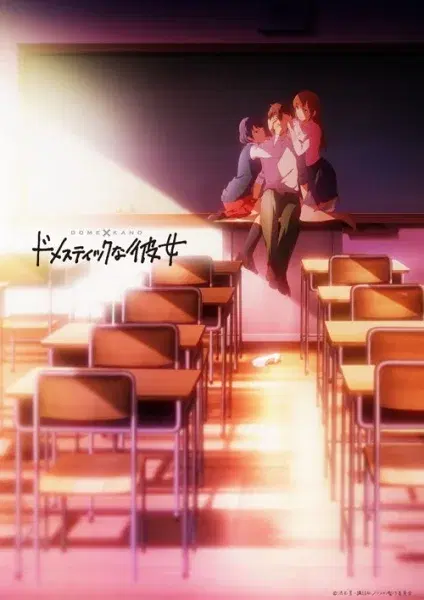
Scum's Wish
クズの本懐 (Kuzu no Honkai)
- Drama
- Romance
- Love Polygon
- School
- Episodes
- 12
- Duration
- 22 min per ep
- Aired
- Jan 13, 2017 to Mar 31, 2017
- Status
- Finished Airing
Synopsis
Hanabi Yasuraoka and Mugi Awaya look like an ideal couple to everyone around them, yet their relationship is built on a shared, private ache: each is in love with someone they can’t have. When Hanabi learns that her longtime neighbor and childhood friend, Narumi Kanai, has become her homeroom teacher, her feelings surge—only to be shaken as the school’s music teacher, Akane Minagawa, begins to grow close to him.
Akane is also the person Mugi has carried a quiet love for since middle school, when she once tutored him. After a chance encounter brings Hanabi and Mugi together, they recognize the same loneliness in each other and form a pact—using one another as stand-ins for their true desires. As they cling to physical closeness to dull the pain, their arrangement pulls them deeper into a complicated web of longing and heartbreak.
Otaku Consensus
Scum’s Wish remains a deliberately divisive romance: its MAL 7.07, AniList 68, and IMDb 6.7 scores track a series admired more for nerve than comfort, while its high popularity shows the discomfort stuck with viewers. Masaomi Andou’s lean direction, Makoto Uezu’s unsentimental series composition, and Lerche’s polished, intimacy-aware visuals make the psychosexual material feel controlled rather than merely lurid. The recurring criticism is also the fault line: its emotionally punishing characters and sexually frank melodrama can alienate viewers looking for romantic catharsis.
Why You Should Watch
Watch Scum’s Wish if you want a school romance that treats desire as a moral problem, not a reward system. It scratches the same uneasy itch as Nana’s romantic self-sabotage and School Days’ discomfort, but without turning into either show’s exact mode: this is quieter, more interior, and more interested in the lies people tell themselves before they hurt anyone else. Lerche gives the series a cool, polished surface, while Masaru Yokoyama’s music and the 96Neko/Sayuri theme-song pairing frame it like a bruised late-night drama rather than a wish-fulfillment romance. If you want clean redemption arcs, skip it; if you want a 12-episode seinen romance built around jealousy, substitution, age gaps, bisexual longing, and emotional accountability, it has teeth.
Key Characters
- MMugi Awaya(VA: Nobunaga Shimazaki)
Mugi is compelling because his outward gentleness keeps clashing with the selfishness and passivity that fans debate long after the credits roll.
- HHanabi Yasuraoka(VA: Chika Anzai)
Hanabi anchors the series with a perspective that is raw, proud, and self-aware enough to make her worst choices feel painfully human rather than ornamental.
What Makes It Stand Out
- 1
Lerche’s visual approach emphasizes detailed backgrounds and noticeably heightened animation during intimacy scenes, a choice critics singled out because the physical moments are treated as dramatic pressure points rather than fanservice breaks.
- 2
Director Masaomi Andou personally episode-directed both episode 1 and episode 12, giving the series a deliberate bookended feel from its opening statement to its closing resolution.
- 3
The AniList tag profile is unusually blunt for a school romance: Psychosexual at 79%, Age Gap at 76%, Bisexual at 73%, and Philosophy at 70%, signaling a series built around interior conflict more than couple formation.
- 4
Masaru Yokoyama’s score sits alongside an opening performed by 96Neko and an ending performed by Sayuri, giving the show a sharper musical identity than the subdued classroom setting might suggest.
- 5
At 12 episodes, the adaptation avoids long-form romantic comedy detours; Makoto Uezu’s series composition keeps the emotional escalation compressed across a single Winter 2017 cour.
Fun Facts & Trivia
- Fun fact 1
- Scum’s Wish is based on the work of original creator Mengo Yokoyari, whose authorship is central to the series’ reputation for blunt, adult-leaning romantic discomfort.
- Fun fact 2
- Keiko Kurosawa served in two key visual roles: character designer and chief animation director, helping keep the cast’s expressions and body language central to the drama.
- Fun fact 3
- The anime aired from January 13, 2017 to March 31, 2017, finishing as a 12-episode Winter 2017 television series.
- Fun fact 4
- Its reception numbers show a rare mix of divisiveness and reach: MAL lists it at 7.07 from 356,696 votes with popularity rank #317, while AniList records 68/100 and 3,680 favourites.
- Fun fact 5
- The credited theme-song performers reflect the show’s split emotional register: 96Neko handles the opening, while Sayuri performs the ending.
Studios
- Lerche