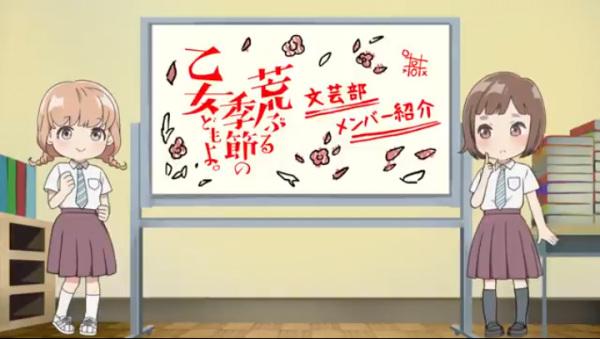
O Maidens in Your Savage Season
荒ぶる季節の乙女どもよ。 (Araburu Kisetsu no Otome-domo yo.)
- Drama
- Romance
- School
- Episodes
- 12
- Duration
- 24 min per ep
- Aired
- Jul 6, 2019 to Sep 21, 2019
- Status
- Finished Airing
Synopsis
Childhood friends Izumi Norimoto and Kazusa Onodera once shared an easy, sibling-like closeness, but puberty complicates everything. As they reach middle school, Kazusa starts to see Izumi in a new light—only to realize other girls do too, leaving her isolated and pushing her to keep her distance by the time high school begins. Seeking a distraction, she joins the literature club, a small group infamous for reading explicit passages aloud, a reputation so awkward that no teacher wants to serve as their adviser.
A casual “bucket list” conversation takes a sharp turn when one member blurts out a single word: sex. The topic lodges in each girl’s mind, coloring their everyday thoughts in ways they don’t know how to handle. When Kazusa accidentally catches Izumi in an intensely private moment, her confusion and jealousy surge to the surface, forcing her to confront what she really feels—just as the club’s precarious standing at school threatens to collapse.
Otaku Consensus
O Maidens in Your Savage Season earns its reputation as a sharp, uncomfortable coming-of-age melodrama because Mari Okada’s series composition treats adolescent embarrassment as dramatic material rather than a punchline, while Lay-duce’s direction gives the club-room conversations unusually careful framing and visual rhythm. Critics and fans most often praise the character writing, ensemble structure, clean animation, and charged cinematography; the recurring complaint is that the final two episodes compress too much emotional fallout, making an already chaotic drama feel rushed at the finish.
Why You Should Watch
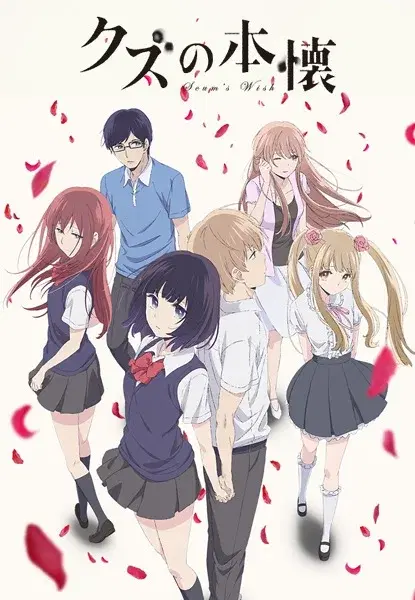
Watch this if you want a school romance that understands why teenage desire can feel ridiculous, frightening, literary, and humiliating all at once. It scratches a similar itch to Scum’s Wish in its refusal to sanitize romantic anxiety, but it is less cynical and more invested in the girls’ attempts to name what they are feeling. The appeal is not wish fulfillment; it is recognition. The series turns cringe into a dramatic tool, using awkward silences, blunt conversations, and club dynamics to make puberty feel like a social disaster with real stakes. Viewers who like Mari Okada’s emotionally exposed writing, ensemble female casts, and romance stories where communication is messy rather than cute will get the most from it.
Key Characters
- KKazusa Onodera
Kazusa anchors the series with the kind of self-conscious romantic panic fans often describe as painfully relatable rather than conventionally charming.
- IIzumi Norimoto
Izumi is interesting less as a standard love interest than as the boy whose ordinary presence destabilizes Kazusa’s sense of childhood familiarity.
What Makes It Stand Out
- 1
Mari Okada is credited as both original creator and series composition writer, giving the anime a tightly unified authorial voice rather than the feel of a committee-shaped school romance.
- 2
The series leans into an ensemble structure: AniList tags it as Primarily Female Cast at 86%, Ensemble Cast at 74%, and School Club at 73%, which matches its focus on multiple girls processing adolescence through the same social space.
- 3
Lay-duce’s production was singled out in viewer criticism for framing, cinematography, effects work, and clean animation, especially in scenes built around conversation rather than action.
- 4
Its tone is deliberately unstable: fan responses repeatedly frame it as disturbing, fun, chaotic, and cringe because the melodrama is built from embarrassment instead of polished romantic fantasy.
- 5
The ending is the main fault line in reception, with multiple reactions praising the journey while calling the last two episodes rushed.
Fun Facts & Trivia
- Fun fact 1
- The anime aired as a complete 12-episode summer 2019 series from July 6 to September 21, 2019, produced by studio Lay-duce.
- Fun fact 2
- Original character designs came from Nao Emoto, while Kaori Ishii handled the anime character designs, a split that helps explain why the cast retains a manga-like softness while fitting television animation needs.
- Fun fact 3
- The production used two credited directors, Takurou Tsukada and Masahiro Andou, alongside two art directors, Takamasa Nakakuki and Youko Nakao.
- Fun fact 4
- Its database profile shows a notable gap between visibility and ranking: on MyAnimeList it sits at 7.29 from 165,649 votes with popularity rank #735, while its rank is #3156.
- Fun fact 5
- AniList’s tag spread highlights the show’s unusual identity for a school romance: Coming of Age at 98%, Writing at 72%, Acting at 55%, and even Asexual at 34% point to a broader thematic range than a simple relationship drama.
Studios
- Lay-duce