Flip Flappers
フリップフラッパーズ
- Adventure
- Comedy
- Sci-Fi
- Mahou Shoujo
- Episodes
- 13
- Duration
- 23 min per ep
- Aired
- Oct 6, 2016 to Dec 29, 2016
- Status
- Finished Airing
Synopsis
Cocona is a quiet, ordinary middle schooler living with her grandmother, still unsure of what she wants to pursue. Her routine shifts when she meets Papika, an impulsive girl who draws her into an organization known as Flip Flap.
Swept along by Papika, Cocona is taken into Pure Illusion, a strange parallel realm where the pair search for crystal shards. Each successful outing sends them onward to new, unpredictable worlds, and when a threatening creature attacks, the two use their crystals to transform into magical girls—Cocona as Pure Blade and Papika as Pure Barrier. Their fight is interrupted by three powered members of a rival group, who finish the creature and seize a fragment it leaves behind, forcing Cocona and Papika to realize they’ll need to synchronize their emotions and work in true tandem to survive Pure Illusion and compete for the shards.
Otaku Consensus
Flip Flappers lands as a cult-favorite rather than a consensus classic: Kiyotaka Oshiyama’s direction, the tanu/Takashi Kojima visual identity, and the brisk 13-episode structure give it a volatile artistic charge that outpaces most 2010s mahou shoujo experiments. Its fan scores remain solid at 7.62 on MAL and 75 on AniList, but the recurring criticism is genuine: the series can feel narratively slippery, and its animation consistency does not always match the ambition of its visual ideas.
Why You Should Watch
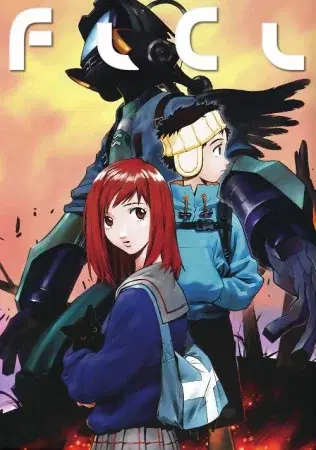
Watch Flip Flappers if you want magical-girl anime as a laboratory for mood, identity, and visual genre-hopping rather than a clean heroic formula. Its closest neighbors are FLCL’s adolescent chaos and Revolutionary Girl Utena’s symbolic coming-of-age theater, but in a 13-episode Studio 3Hz package with brighter sci-fi toy-box energy. Kiyotaka Oshiyama’s direction treats transformation, weapons, robots, and cute-animal imagery as emotional punctuation, while the tanu/Takashi Kojima design pipeline gives each detour a handmade identity. It is best for viewers who enjoy decoding imagery without needing every metaphor underlined. If you want tidy lore, this will frustrate you; if you want a compact mahou shoujo that keeps changing the rules of its own dream space, it delivers the rare kind of weird that invites a rewatch.
Key Characters
- CCocona
Cocona is interesting because the series treats her uncertainty less as a personality quirk and more as the emotional engine behind its coming-of-age imagery.
- PPapika
Papika is the show’s kinetic spark, a character fans often remember for turning impulsiveness into visual momentum rather than simple comic relief.
What Makes It Stand Out
- 1
Studio 3Hz produced Flip Flappers as a compact 13-episode TV anime in Fall 2016, giving it the feel of a concentrated visual experiment rather than a long franchise vehicle.
- 2
The core visual team is unusually legible: Kiyotaka Oshiyama directed, Takashi Kojima handled character design, and tanu provided concept art, a combination that helps explain the show’s emphasis on shape language, color contrast, and shifting visual rules.
- 3
AniList’s tag profile is unusually revealing for a mahou shoujo title: Coming of Age at 93%, Henshin at 85%, Meta at 80%, and Psychosexual at 79%, positioning it closer to symbolic adolescence anime than straightforward magical-girl adventure.
- 4
The production credits separate color, photography, sound direction, and sound effects across Yasuko Suenaga, Kazuto Izumita, Jin Aketagawa, and Yuuji Furuya, which reflects how much of the show’s identity depends on audiovisual texture rather than dialogue exposition.
- 5
Its reception profile is distinctly cult-middle: a MAL score of 7.62 from 75,943 votes and AniList score of 75/100 indicate a passionate but divided audience rather than universal approval.
Fun Facts & Trivia
- Fun fact 1
- Flip Flappers aired from October 6, 2016 to December 29, 2016, completing its run within a single cour during the Fall 2016 season.
- Fun fact 2
- The music credit is shared by Youhei Matsui, Mito, and Masumi Itou, a three-name composition lineup that matches the show’s habit of shifting tone rather than relying on one narrow musical mode.
- Fun fact 3
- AniList lists 1,754 favourites for the series, a useful clue to its afterlife: it has a smaller footprint than mainstream magical-girl titles but a durable pocket of devoted fans.
- Fun fact 4
- The show’s genre stack is broader than the usual mahou shoujo label suggests, with the research data also tagging robots, guns, archery, swordplay, kemonomimi, urban fantasy, and surreal comedy.
- Fun fact 5
- The most common negative throughline in available review summaries is not the premise but execution: critics cite plot coherence and uneven animation quality as the main reasons it is less frequently recommended than its visual imagination might suggest.
Studios
- Studio 3Hz
No community data yet. Be the first to add Flip Flappers to your list!