The Rolling Girls
ローリング☆ガールズ (Rolling☆Girls)
- Action
- Adventure
- Sci-Fi
- CGDCT
- Super Power
- Episodes
- 12
- Duration
- 24 min per ep
- Aired
- Jan 11, 2015 to Mar 29, 2015
- Status
- Finished Airing
Synopsis
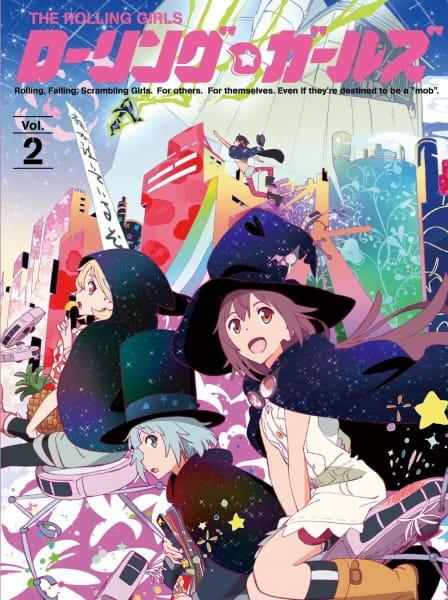
In a fractured, near-future Japan still reeling from the Great Tokyo War, the nation has splintered into ten independent states. Each territory is ruled by a gang headed by a “Best,” a revered figure said to possess devastating superpowers. Nozomi Moritomo is a “Rest,” an ordinary girl and new recruit in her local group, determined to support Masami Utoku—her childhood friend and admired leader—amid escalating border conflicts.
When Masami is badly injured and can no longer take the field, Nozomi sets out to handle the many requests that once came to her from across the country. On the road she’s joined by Yukina Kosaka, a timid girl with a hopeless sense of direction; Ai Hibiki, cheerful and always hungry; and Chiaya Misono, a quiet, enigmatic traveler who wears a gas mask. Riding motorcycles from region to region, the four become entangled in territorial disputes, clashes between factions, and unsettling hints of larger conspiracies.
Otaku Consensus
The Rolling Girls is an original Wit Studio oddity whose reputation rests less on plot mechanics than on Kotomi Deai’s kinetic direction, tanu’s character-design sensibility as translated by Katsuhiko Kitada, and a rainbow-colored production identity that fans still single out. The verdict is enthusiasm with reservations: its road-arc structure, coming-of-age warmth, extravagant fights, and classic J-rock energy work better than the larger conspiracy and political threads, which are the most common source of criticism.
Why You Should Watch
Watch The Rolling Girls if you want cute-girl travel anime with the volume turned up: mopeds, factional weirdness, surreal jokes, superhero brawls, and an art team that treats every region like a poster wall. It scratches the same itch as Little Witch Academia or the brighter end of Trigger-adjacent animator showcases, but without becoming a school comedy or a standard battle shounen. The appeal is not airtight plotting; it is the sensation of four young leads moving through a Japan where local identity, pop performance, gang pageantry, and superpower mythology all collide. Viewers who prize color design, expressive layouts, and episodic adventure over lore explanations will get the most from it.
Key Characters
- NNozomi Moritomo(VA: Ari Ozawa)
Nozomi stands out because she is framed as a Rest rather than a legendary powerhouse, making her the emotional entry point into a world obsessed with stronger, flashier figures.
- YYukina Kosaka(VA: Rina Hidaka)
Yukina’s timid personality and famously terrible sense of direction give the group its most grounded source of comedy amid the show’s loud territorial absurdity.
- AAi Hibiki(VA: Risa Taneda)
Ai brings the series’ cheerful, appetite-driven momentum, the kind of character fans latch onto when they want the road-trip energy to stay buoyant.
- CChiaya Misono(VA: Yumiri Hanamori)
Chiaya is the quiet enigma of the cast, visually defined by her gas mask and tonally useful as the character who keeps the show’s cuteness from feeling too simple.
What Makes It Stand Out
- 1
Wit Studio produced The Rolling Girls as a 12-episode original TV anime that aired in winter 2015, a notable outlier in the studio’s catalog because it leans into pop-art road adventure rather than dark fantasy spectacle.
- 2
The visual identity comes from original character designer tanu, with Katsuhiko Kitada credited for character design; the result is a cast that reads as soft and approachable even when the surrounding action becomes chaotic.
- 3
Seiki Tamura and Yuuho Taniuchi handled art design while Yuuko Kobari handled color design, which helps explain why reviewers consistently point to the show’s dense backgrounds, rainbow palette, and visually busy compositions as core attractions.
- 4
Its structure favors regional mini-arcs over a single linear conflict, letting the series shift tones between superhero parody, local politics, idol-adjacent performance energy, and coming-of-age travelogue.
- 5
The action is often remembered for its exaggerated, flashy fight staging rather than tactical clarity, placing the show closer to an animator-driven spectacle than a conventional superpower drama.
Fun Facts & Trivia
- Fun fact 1
- The show’s AniList tag profile is unusually specific: Primarily Female Cast at 90%, Super Power at 88%, Surreal Comedy at 79%, Coming of Age at 73%, and Motorcycles at 68%, which captures its hybrid identity better than a basic genre label.
- Fun fact 2
- Its audience metrics show a consistent cult-but-divisive profile: 6.6/10 on MyAnimeList from 29,024 votes, 64/100 on AniList, and only 233 AniList favourites despite its strong visual identity.
- Fun fact 3
- The production credits include Kazuto Izumita as director of photography, Mai Hasegawa as editor, Yuuji Koshida as CG director, and Shouji Hata as sound director, pointing to a technically layered presentation rather than a simple CGDCT package.
- Fun fact 4
- Critical writeups frequently praise the show’s character and world design while calling the plotting messy, which is why it is often recommended as an underrated visual experience rather than as a tightly engineered narrative.
- Fun fact 5
- Fans and reviewers repeatedly connect its appeal to classic J-rock energy, making its sound and musical attitude part of the show’s identity alongside its color work and fight animation.
Studios
- Wit Studio