Wonder Egg Priority
ワンダーエッグ・プライオリティ
- Drama
- Supernatural
- Suspense
- Psychological
- Episodes
- 12
- Duration
- 23 min per ep
- Aired
- Jan 13, 2021 to Mar 31, 2021
- Status
- Finished Airing
Synopsis
After the suicide of her only close friend, Koito Nagase, Ai Ooto is left adrift, struggling to make sense of a life that suddenly feels empty. Drawn in by a cryptic presence, she follows its instructions and buys an egg known as a Wonder Egg.
When Ai cracks it open, she’s pulled into a surreal world that forms while she sleeps, where she’s told to protect those facing overwhelming hardships. Each rescue feels like a step toward the hope of reaching Koito again, but the path is perilous—and forces Ai to confront how other people’s torment connects to her own. As trauma, regret, and fear take shape in this strange realm, Ai begins to face the hidden battles that haunt her and those around her.
Otaku Consensus
Wonder Egg Priority earned its reputation as a visually audacious CloverWorks original: Shin Wakabayashi’s direction, Saki Takahashi’s character designs, and Yuusuke Kawakami’s action work turn a psychological drama into one of 2021’s most discussed TV anime. Critics and fans consistently praise its vulnerability and willingness to handle taboo adolescent crises, while the dominant complaint is that its late-stage narrative and ending do not pay off the ambition of its strongest episodes. The verdict: essential viewing for its craft and thematic nerve, but not a cleanly resolved masterpiece.
Why You Should Watch
Watch Wonder Egg Priority if you want a psychological coming-of-age anime that treats teen pain as visual language rather than lecture, and if you can tolerate an ending that remains the show’s most contested choice. It scratches the same itch as Puella Magi Madoka Magica’s genre-bending unease, but trades magical-girl iconography for urban fantasy, school-age alienation, and a primarily female ensemble whose conversations can sting as much as the action. CloverWorks gives the series a glossy, tactile look: expressive faces, carefully individualized outfits, and sudden bursts of weapon choreography keep the emotional material from becoming static. Viewers drawn to anime that address suicide, bullying, eating disorders, hikikomori isolation, and LGBTQ+ identity without sanding off discomfort will find its best episodes unusually direct for a 12-episode TV original.
Key Characters
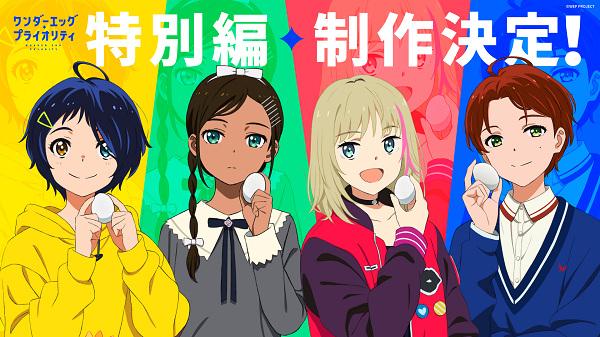
- AAi Ooto(VA: Kanata Aikawa)
Ai anchors the ensemble with guarded awkwardness, making her one of the show’s clearest portraits of social withdrawal, guilt, and the desire to reconnect.
- NNeiru Aonuma(VA: Tomori Kusunoki)
Neiru’s cool precision and emotional reserve give the group its sharpest contrast, especially when the series tests the limits of rational self-control.
- RRika Kawai(VA: Shuka Saitou)
Rika is the abrasive extrovert whose jokes and bravado keep colliding with the show’s interest in self-image, shame, and performative confidence.
- MMomoe Sawaki(VA: Hinaki Yano)
Momoe stands out for how the series uses her androgynous presentation to engage with gendered attention, identity, and LGBTQ+ readings.
What Makes It Stand Out
- 1
It is an original anime rather than a manga or light-novel adaptation, with Shinji Nojima credited as original creator. That source-free format gives the series room to structure itself around mood, symbolism, and thematic escalation instead of chapter-by-chapter adaptation beats.
- 2
CloverWorks’ production is a major part of its reputation: the series pairs polished character acting with abrupt, high-impact action scenes supervised by action director Yuusuke Kawakami. The contrast between intimate teen drama and surreal combat is central to why the show remains widely discussed despite its divisive conclusion.
- 3
The visual pipeline is unusually design-forward, with Saki Takahashi on character design, Haruhi Inoue on prop design, Peter on weapon design, and both Ootori and Peter credited for design works. That division of labor shows in how much personality is carried through outfits, objects, and individualized combat imagery.
- 4
Its subject range is broader and harsher than the average school-set psychological anime: the audience data highlights suicide, bullying, hikikomori isolation, transgender themes, and LGBTQ+ themes, while reviews specifically note eating disorders among the sensitive topics it confronts.
- 5
Its reception profile is strikingly split between visibility and satisfaction: on MyAnimeList it holds a 7.54 score from 377,240 votes, ranks #2035, yet sits at #267 in popularity. That gap reflects a series many viewers tried, debated, and remembered even when they disagreed about the ending.
Fun Facts & Trivia
- Fun fact 1
- Shinji Nojima is credited as the original creator, making Wonder Egg Priority a TV-original project rather than an adaptation with a pre-existing fanbase.
- Fun fact 2
- Shin Wakabayashi directed the series, with Yuuta Yamazaki as assistant director and Yuusuke Kawakami as action director, a staff structure that separates overall tone, production support, and kinetic scene design.
- Fun fact 3
- Peter is credited twice in the design staff list, both for weapon design and design works, while Ootori also appears under design works. The credits point to how carefully the show’s non-character visual identity was planned.
- Fun fact 4
- AniList’s tag distribution is unusually concentrated: Primarily Female Cast, Urban Fantasy, Suicide, and Female Protagonist all sit at 93%, while Bullying follows at 88%. Those numbers match the way viewers categorize the series less by genre formula than by subject matter.
- Fun fact 5
- The series has 7,966 AniList favourites and an AniList score of 74/100, placing it in the category of shows with a devoted core following despite broad critical disagreement over its finish.
Studios
- CloverWorks