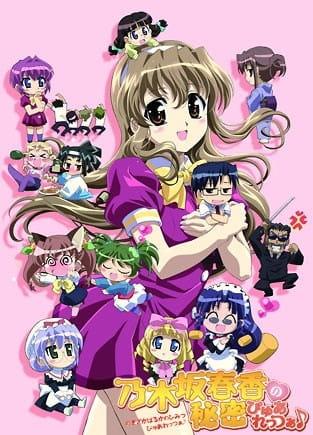
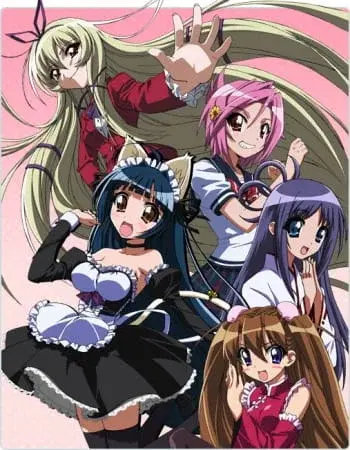
Haruka Nogizaka's Secret
乃木坂春香の秘密 (Nogizaka Haruka no Himitsu)
- Comedy
- Romance
- Otaku Culture
- School
- Episodes
- 12
- Duration
- 25 min per ep
- Aired
- Jul 11, 2008 to Sep 26, 2008
- Status
- Finished Airing
Synopsis
Haruka Nogizaka stands at the top of Hakujo Academy’s social world—admired for her beauty, ability, and refined image. Behind that flawless reputation, she hides a hobby she considers mortifying: she’s an otaku, and being found out could shatter the elegant persona everyone expects from her.
That secret slips when Yuuto Ayase, a quiet classmate, happens upon her in the school library. Rather than expose her, Yuuto agrees to keep it under wraps, and the two begin an unlikely friendship. With Haruka’s celebrity status and their growing closeness, though, even a simple conversation is enough to stir rumors wherever they go.
Otaku Consensus
Haruka Nogizaka's Secret lands as a modest but durable 2008 otaku-romance: Munenori Nawa’s direction works best when it treats fandom anxiety as character texture, and the 12-episode pacing keeps the school comedy from ballooning into dead air. Viewers and fan discussions single out Haruka as the reason the series lingers, while the most consistent weakness is its reliance on familiar late-2000s harem accessories, especially maid gags, love-triangle pressure, and ojou-sama fantasy shorthand.
Why You Should Watch
Watch this if you want an otaku-culture romance that is gentler than Oreimo and less sociological than Genshiken, with the focus kept on emotional embarrassment, reputation, and the small rituals of sharing a hobby. Diomedéa’s 2008 production has the specific charm of the era: clean school-comedy staging, soft character designs adapted from Shaa’s originals, and a seiyuu-pop finish through theme performances by Mai Gotou and Kana Ueda. It is best suited to viewers who like romantic comedy where the tension comes from social performance rather than cruelty. The AniList tag mix tells the truth: high otaku-culture, school, and parody presence, with maids and love-triangle elements as seasoning rather than the whole meal.
Key Characters
- HHaruka Nogizaka
Haruka is the series’ critical anchor, repeatedly cited by fans as more compelling than the premise because her elegance, insecurity, and fandom are written as one consistent identity rather than separate gimmicks.
- YYuuto Ayase
Yuuto functions as the rare romcom lead whose appeal comes from discretion and emotional steadiness, giving the comedy a calmer rhythm than louder harem contemporaries.
What Makes It Stand Out
- 1
The anime is a compact 12-episode Summer 2008 TV run, airing from July 11 to September 26, which gives the romance a tighter seasonal shape than multi-cour school comedies built around repeated resets.
- 2
Diomedéa produced the series with Munenori Nawa directing and Satoshi Ishino adapting Shaa’s original character designs, a staff combination that emphasizes polished ojou-sama presentation over exaggerated slapstick deformation.
- 3
The AniList tag profile is unusually revealing: Otaku Culture at 84%, School at 79%, and Parody at 79% place it closer to fandom-aware romantic comedy than pure wish-fulfillment melodrama.
- 4
Its supporting flavor is quantifiable rather than incidental: Maids at 53%, Love Triangle at 40%, Kuudere at 20%, and Ojou-sama at 20% map the exact late-2000s moe-romcom toolkit the show is playing with.
- 5
Reception is steady rather than cult-dominant: a 7.19 MAL score from 69,777 votes, MAL popularity rank #1887, AniList score of 68/100, and 208 AniList favourites suggest a niche series that remained visible without becoming a consensus classic.
Fun Facts & Trivia
- Fun fact 1
- The anime credits Yuusaku Igarashi as original creator and Shaa for the original character design, separating the source identity from Satoshi Ishino’s anime character-design work.
- Fun fact 2
- The production’s audiovisual spine includes Reiko Kasuga as art director, Toshihiko Kojima as editor, Yoshikazu Iwanami as sound director, and Takeshi Watanabe on music.
- Fun fact 3
- Mai Gotou and Kana Ueda are both credited for theme song performance, tying the series to the character-song and seiyuu-driven marketing culture that surrounded many late-2000s romantic comedies.
- Fun fact 4
- The name Haruka is a unisex Japanese given name that can be written in hiragana as はるか or katakana as ハルカ, which makes the title character’s refined image rely more on the Nogizaka family-name branding than on a uniquely feminine given name.
Studios
- Diomedéa