Cells at Work!
はたらく細胞 (Hataraku Saibou)
- Comedy
- Anthropomorphic
- Educational
- Medical
- Episodes
- 13
- Duration
- 23 min per ep
- Aired
- Jul 8, 2018 to Sep 30, 2018
- Status
- Finished Airing
Synopsis
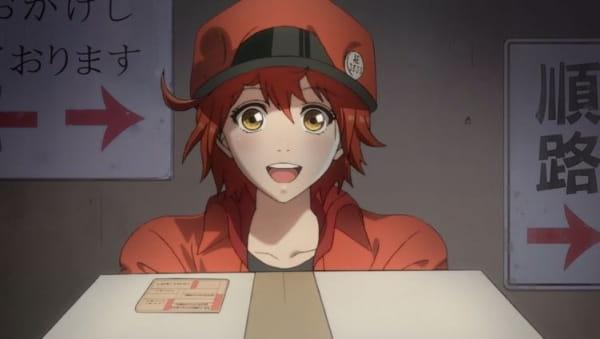
Inside the human body, an estimated 37.2 trillion cells stay on the job around the clock, keeping everything running smoothly. Newly assigned Red Blood Cell AE3803—bright, eager, and a bit scatterbrained—sets out to master her crucial role of delivering oxygen. Meanwhile, White Blood Cell U-1146 tirelessly patrols the body, confronting invading bacteria before they can settle in.
From platelets lining up to tackle a fresh construction job to the chaos of wounds, allergies, wrong turns on the way to the lungs, and squabbles among similar cell types, day-to-day life is anything but calm. Through constant teamwork and close calls, these hardworking cells do their part to protect the body’s health.
Otaku Consensus
Cells at Work! earns its reputation less as a biology lecture than as Kenichi Suzuki and David Production's brisk workplace-action comedy: the direction keeps explainer beats short, the episodic pacing makes each medical scenario self-contained, and the manga's central metaphor survives cleanly in animation. Critics and fans consistently praise its character-design readability and classroom-friendly charm, while the recurring complaint is equally consistent: the science stays introductory, so viewers seeking deep microbiology may find it cute but thin.
Why You Should Watch
Watch Cells at Work! if you want science-flavored anime that teaches through jokes, visual mnemonics, and action beats rather than classroom exposition. It scratches a similar itch to Dr. Stone's “learning can be fun” appeal, but trades invention and survival plotting for a more episodic workplace-comedy rhythm; it also has a bit of Hetalia-style anthropomorphism, only with medical systems instead of nations. The sweet spot is viewers who like clever personification, accessible biology terms, mascot-level cuteness, and occasional slapstick violence without needing a heavy serialized story. It is especially good as a low-commitment 13-episode watch: one concept per episode, quick comedic payoff, and enough shounen-adjacent danger to keep it from feeling like a health-class handout.
Key Characters
- HHakkekkyuu U-1146(VA: Tomoaki Maeno)
Fans tend to remember U-1146 as the deadpan action-comedy anchor: calm, dutiful, and visually defined by the series' sharp contrast between medical instruction and blood-splattered gag violence.
- SSekkekkyuu AE3803(VA: Kana Hanazawa)
AE3803 gives the show its most approachable learning angle, with Kana Hanazawa leaning into a bright, flustered delivery that makes the educational detours feel character-driven rather than textbook-dry.
What Makes It Stand Out
- 1
David Production frames the adaptation as a workplace comedy with action outbursts rather than a straight educational program, which is why the medical explanations land alongside chase scenes, slapstick, and monster-of-the-week bacteria designs.
- 2
The 13-episode structure is strongly episodic, matching AniList's 83% Episodic tag: each installment can focus on a distinct body-process idea without forcing a long serialized plot.
- 3
Takahiko Yoshida's character designs and Keiko Tamaki's sub-character designs make cell functions readable at a glance, turning uniforms, silhouettes, and role-specific props into part of the show's teaching method.
- 4
Yuuko Kakihara's series composition keeps the science at an accessible level, a choice praised by viewers who found it kid-friendly and criticized by viewers who wanted more rigorous microbiology.
- 5
The tonal mix is more graphic than the cute key art suggests: AniList users tag it with Gore at 54%, reflecting how the comedy frequently pairs adorable designs with exaggerated immune-system violence.
Fun Facts & Trivia
- Fun fact 1
- The anime is adapted from Akane Shimizu's original work, with Kenichi Suzuki directing at David Production and Yuuko Kakihara handling series composition.
- Fun fact 2
- Its title branding had dedicated credits for Katsuo Yanagawa and Kokoro Kawazoe as title logo designers, a small production detail that fits a series built around instantly readable visual labeling.
- Fun fact 3
- Reception is broad rather than niche: the series holds a 7.54 MAL score from 343,410 votes, sits at MAL popularity rank #346, and also has an AniList score of 74/100 with 3,024 favourites.
- Fun fact 4
- Viewer reactions in the provided reviews split along educational expectations: one 10/10 review praises it as easy for kids to understand, while lower-scoring reviews argue that the biology is too basic to count as real learning.
- Fun fact 5
- The franchise's appeal extended beyond the 2018 anime for at least some fans: one reviewer reports continuing from the anime into the manga, its spin-offs, and the live-action film.
Studios
- David Production



![Cells at Work [Black]](/_next/image?url=https%3A%2F%2Fcdn.myanimelist.net%2Fimages%2Fanime%2F1914%2F106749l.jpg&w=1920&q=75)