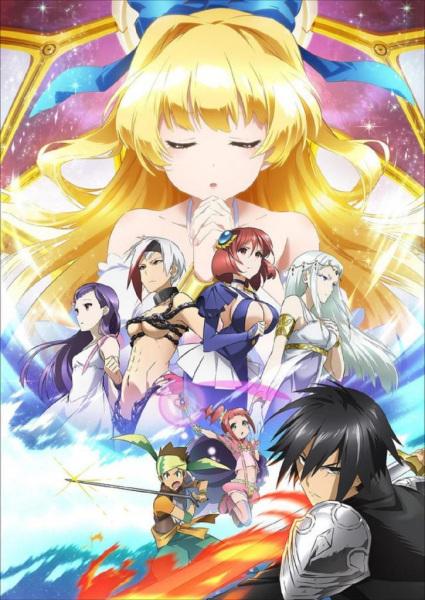
Cautious Hero: The Hero Is Overpowered but Overly Cautious
慎重勇者 ~この勇者が俺TUEEEくせに慎重すぎる~ (Shinchou Yuusha: Kono Yuusha ga Ore Tueee Kuse ni Shinchou Sugiru)
- Action
- Adventure
- Comedy
- Fantasy
- Isekai
- Parody
- Episodes
- 12
- Duration
- 23 min per ep
- Aired
- Oct 2, 2019 to Dec 27, 2019
- Status
- Finished Airing
Synopsis
“Better safe than sorry” becomes a way of life for Seiya Ryuuguuin. Summoned by the goddess Ristarte to rescue the endangered world of Gaeabrande, he arrives with abilities that are already overwhelmingly strong—yet refuses to set out until he’s trained far beyond what anyone considers necessary.
Seiya approaches every encounter like a worst-case scenario: he stockpiles supplies and potions, and even against minor foes he unleashes his most powerful techniques to eliminate all risk. Ristarte can barely keep up with his exhausting level of caution, but in a land where evil forces constantly defy expectations, his paranoia may be exactly what Gaeabrande needs to survive.
Otaku Consensus
Cautious Hero lands because White Fox and director Masayuki Sakoi treat its overpowered-hero joke as a timing machine rather than a license to coast, with Kenta Ihara’s series composition gradually letting Gaeabrande’s grimness intrude on the parody. Critics and viewers consistently praise the Seiya-Ristarte comic rhythm, the bright fantasy presentation, and the midseries shift that makes the caution gag feel less disposable. Its main weakness is that the early episodes can resemble a familiar Konosuba-adjacent isekai spoof with a repeated punchline before the darker stakes sharpen the show’s identity.
Why You Should Watch
Watch this if you want an isekai comedy that weaponizes min-max logic without turning into a spreadsheet power fantasy. It scratches the same god-and-hero dysfunction itch as Konosuba, but it is tighter and more plot-driven, using a 12-episode run to pivot from facial-expression chaos and deadpan overkill to surprisingly grim fantasy pressure. The appeal is not just that Seiya is strong; it is that every heroic convention gets processed through the mind of someone who treats goblins, demon lords, shopping, and training like catastrophe planning. Ristarte’s reactions make the show feel closer to a two-hander comedy than a standard summoned-hero adventure. If you want parody with actual escalation, and comedy that does not completely defang its world, this is the lane.
Key Characters
- SSeiya Ryuuguuin(VA: Yuichiro Umehara)
Fans remember Seiya less as a simple power fantasy lead than as a deadpan anti-hero whose risk management turns battle shounen escalation into a running critique of reckless heroism.
- RRistarte(VA: Aki Toyosaki)
Ristarte is the show’s emotional and comedic pressure valve, with her goddess authority constantly undermined by panic, exasperation, and some of the series’ most elastic reaction comedy.
What Makes It Stand Out
- 1
White Fox gives the series a bright, colorful fantasy look that reviewers singled out as more vibrant than the show’s grim worldbuilding would suggest. The contrast helps the comedy land without hiding the harsher tone that emerges later.
- 2
The adaptation is built around a tonal swerve: it begins as a high-percentage isekai parody and increasingly lets the dangerous setting validate the joke. Viewer discussion often points to the middle stretch, especially around episode 6, as the point where Seiya stops reading as only a gag machine.
- 3
The AniList tag profile is unusually specific for an isekai comedy: Isekai at 97%, Parody at 91%, Magic at 89%, Cultivation at 83%, and Gods at 82%. That combination reflects how much of the humor comes from training logic, divine bureaucracy, and meta-awareness rather than only fantasy slapstick.
- 4
Ristarte’s prominence is reflected in the Female Protagonist tag at 80%, unusually high for a summoned-hero setup centered on a male warrior. The show’s comic POV often belongs to the goddess observing and reacting to Seiya’s decisions.
- 5
At 12 episodes, the series avoids the sprawl common to light-novel fantasy adaptations and keeps its central comic mechanism under pressure. That shorter format is a major reason the serious material is able to recontextualize the comedy instead of arriving as a separate genre switch.
Fun Facts & Trivia
- Fun fact 1
- The anime adapts Light Tsuchihi’s original story, with Saori Toyota credited for the original character designs. The TV version’s character designs were handled by Mai Toda, who also appears in the prop design credits.
- Fun fact 2
- Prop design was split among Noritaka Suzuki, Gouichi Iwahata, and Mai Toda, an unusually visible credit grouping for a comedy isekai where inventories, gear, and fantasy utility items are part of the joke structure.
- Fun fact 3
- The series had two credited art directors, Kazunori Miyazato and Yoshito Takamine, matching reviews that noted the show’s detailed world design despite its reputation as a gag-forward parody.
- Fun fact 4
- It aired from October 2, 2019 to December 27, 2019, completing its run as a single 12-episode TV season during the Fall 2019 anime slate.
- Fun fact 5
- Its reception profile is strong for a niche parody: MAL lists it at 7.46 from over 401,000 votes with popularity rank #343, while AniList records a 73/100 score and 4,158 favourites.
Studios
- White Fox