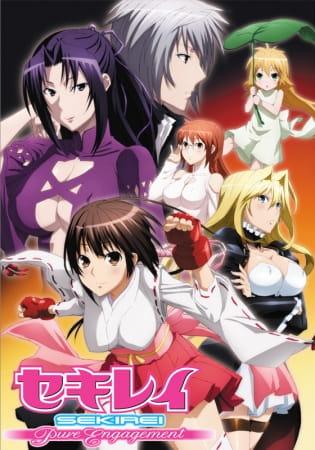
Sekirei
セキレイ
- Action
- Comedy
- Ecchi
- Romance
- Harem
- Super Power
- Episodes
- 12
- Duration
- 23 min per ep
- Aired
- Jul 2, 2008 to Sep 17, 2008
- Status
- Finished Airing
Synopsis
Nineteen-year-old Minato Sahashi may be gifted, but after failing his college entrance exams twice, he’s written off as a hopeless case by nearly everyone around him. His stalled life takes a sudden turn when Musubi—a striking supernatural woman—literally drops into his world. She is a Sekirei: a humanoid extraterrestrial endowed with extraordinary powers, whose abilities can be fully awakened by bonding with a human who carries the Ashikabi gene through a kiss.
Sensing something in Minato, Musubi forms that bond with him, pulling the bewildered student into the dangerous arena where Sekirei and their Ashikabi partners are forced to compete in the “Sekirei Plan,” a battle for survival against other pairs. As Minato and Musubi are drawn deeper into the conflict, it becomes clear that the stakes extend beyond what the competition first appears to be.
Otaku Consensus
Sekirei lands as a divisive but durable late-2000s harem-action title: its MAL 7.01 and AniList 65/100 reflect a show with clear genre appeal rather than broad critical prestige. Keizou Kusakawa’s direction works best when it embraces the material’s absurdity, using brisk slapstick, clothes-shredding brawls, and the Kusano botanical-garden material to break up the tournament mechanics. The recurring criticism is just as clear: the nudity and large-breast gag economy often overpower the battle-royale tension and make the series a hard sell outside ecchi-friendly viewers.
Why You Should Watch
Watch Sekirei if you want a harem show that treats fanservice as part of the combat grammar, not a side dish. It scratches the same itch as High School DxD or Ikki Tousen: super-powered women, romantic escalation, escalating rival pairings, and jokes that know exactly how shameless they are. The appeal is not subtle characterization or a clean tournament rulebook; it is the momentum of a 12-episode package that keeps shifting between apartment comedy, beat-em-up encounters, and earnest protector instincts. Viewers who enjoy ecchi but dislike shows that spend forever explaining their power systems will get the most out of it. Viewers looking for restraint, tragic seriousness, or fanservice-free action should look elsewhere.
Key Characters
- MMinato Sahashi
Minato is memorable less as a power fantasy than as a nervous, failure-marked harem lead whose decency lets the louder personalities around him dominate the comedy and conflict.
- MMusubi
Musubi is the series’ kinetic center, mixing battle-shounen sincerity with the kind of physical comedy and fanservice framing that defines Sekirei’s reputation.
- KKusano
Kusano brings a softer found-family texture to a show otherwise driven by rivalry, libido, and spectacle, especially in the botanical-garden material highlighted in episode coverage.
- KKaoru Seo
Kaoru Seo stands out as a foil to Minato: another Ashikabi whose confidence and streetwise presence make the setting feel larger than one inexperienced protagonist’s perspective.
What Makes It Stand Out
- 1
Seven Arcs produced the 12-episode 2008 season, giving the series a compact late-night-TV structure: quick romantic escalation, short action bursts, and little downtime between new rivals or living-arrangement chaos.
- 2
The show’s identity is unusually transparent in its AniList tag profile: Female Harem at 85%, Large Breasts at 83%, Nudity at 80%, and Battle Royale at 68%, which accurately signals the balance between ecchi spectacle and tournament pressure.
- 3
Keizou Kusakawa’s direction is most effective when the tone goes knowingly ridiculous, a point echoed by reviewers who praised the slapstick, wordplay, and deranged energy more than the dramatic stakes.
- 4
The Kusano botanical-garden material gives the season a different flavor from the standard showdown formula, adding infiltration and rescue beats to a series otherwise built around direct confrontations.
- 5
Hiroaki Sano’s music and Jin Aketagawa’s sound direction sit underneath a cast-forward production package, with theme song performances credited to Aya Endou, Saori Hayami, and Marina Inoue.
Fun Facts & Trivia
- Fun fact 1
- Sakurako Gokurakuin is credited both as the original creator and the original character designer, so the anime’s character silhouettes and fanservice emphasis trace directly back to the source creator’s visual identity.
- Fun fact 2
- Sekirei aired from July 2 to September 17, 2008, placing it squarely in the late-2000s wave of ecchi action shows where battle systems and harem escalation were often packaged together.
- Fun fact 3
- The English-language production included ADR script work by Leah Clark on episodes 2, 4, 5, 8, and 9, a useful detail for dub viewers tracking localization credits.
- Fun fact 4
- Despite mixed reviews, the series remained highly visible: it holds MAL Popularity rank #620 with more than 213,000 votes in the provided data, plus 837 AniList favourites.
- Fun fact 5
- The reception split is unusually stark: one cited review dismissed it with a 2/5, while other viewer-oriented writeups highlighted its charm as a beat-em-up, clothes-disintegrating tournament comedy.
Studios
- Seven Arcs