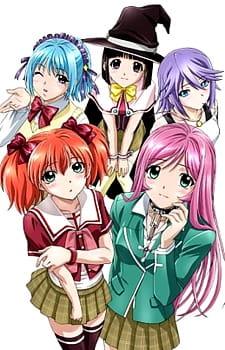
Rosario + Vampire
ロザリオとバンパイア (Rosario to Vampire)
- Comedy
- Ecchi
- Fantasy
- Romance
- Harem
- School
- Vampire
- Episodes
- 13
- Duration
- 24 min per ep
- Aired
- Jan 3, 2008 to Mar 27, 2008
- Status
- Finished Airing
Synopsis
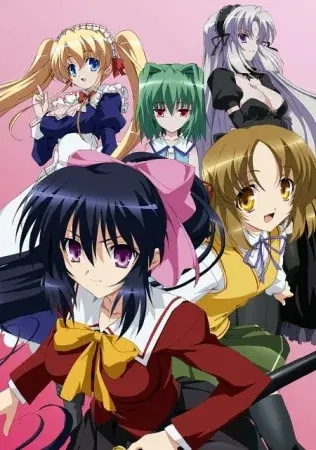
Youkai Academy looks like an ordinary boarding school at first glance, complete with everyday classes and students who blend in as humans. The catch is that the student body is made up of monsters learning to live alongside people—and the campus enforces a strict rule: any human discovered on the grounds is to be executed on the spot.
Tsukune Aono, an unremarkable teen with grades too poor to get into a regular high school, ends up enrolled there by his parents as a last resort. Wandering into a world he doesn’t understand, he meets the striking Moka Akashiya and chooses to remain at the academy to pursue her, unaware that her charm hides a far more dangerous nature: she’s a vampire. As Tsukune tries to survive school life, his days become a string of romantic complications and supernatural mishaps among a growing circle of alluring, lethal classmates.
Otaku Consensus
Rosario + Vampire works best as a brisk Gonzo-produced ecchi school comedy, powered by monster-girl variety, Nana Mizuki-led theme songs, and a blunt commitment to harem chaos over dramatic weight. Its reputation is limited by adaptation choices: fans and critics repeatedly prefer Akihisa Ikeda’s manga, citing weak action scenes, repetitive jokes, and fanservice that often overwhelms the material’s darker fantasy potential.
Why You Should Watch
Watch Rosario + Vampire if you want late-2000s monster-girl harem energy without the heavier mythology or sustained action focus of vampire anime like Hellsing. It scratches a similar itch to To Love-Ru and Monster Musume: a revolving door of supernatural archetypes, school-club comedy, romantic rivalry, and fanservice that is treated as a core feature rather than an occasional accent. The appeal is not in intricate plotting; it is in the specific Gonzo-era rhythm of quick gags, transformation beats, suggestive framing, and character songs. Viewers who enjoy ecchi comedies as time capsules of their era will get more from it than viewers coming in for the manga’s stronger action-fantasy reputation.
Key Characters
- TTsukune Aono
Tsukune functions less as a power-fantasy hero and more as the audience’s survival proxy, which is why reactions to him often track whether a viewer wants harem comedy or a more assertive shounen lead.
- MMoka Akashiya
Moka is the series’ defining icon because her appeal combines vampire glamour, transformation spectacle, and the split-personality hook flagged in the show’s own tag profile.
What Makes It Stand Out
- 1
Gonzo’s adaptation compresses the first TV season into 13 episodes, giving the show a fast sitcom-like rhythm rather than the slower escalation fans associate with the manga.
- 2
The anime’s reception is unusually tied to adaptation disappointment: multiple fan and critic summaries point to the manga as the stronger version, especially for action and long-form fantasy material.
- 3
Nana Mizuki performs both the opening and ending themes, making the music identity of the season closely associated with one of anime’s most recognizable singer-voice talents.
- 4
The staff list includes three credited music figures: Kouhei Tanaka, Shirou Hamaguchi, and music production by Hajime Touma, a larger-than-minimal credit profile for a harem comedy of this length.
- 5
AniList’s tag spread shows how specifically the series is positioned: Monster Girl at 90%, Female Harem at 84%, Vampire at 84%, Succubus at 71%, and Nudity at 64%.
Fun Facts & Trivia
- Fun fact 1
- Despite a modest MAL score of 6.73 and rank of #6408, Rosario + Vampire sits at MAL popularity #323, showing how widely sampled it remains compared with its critical standing.
- Fun fact 2
- The season aired as a Winter 2008 TV anime from January 3 to March 27, finishing as a compact 13-episode run.
- Fun fact 3
- Misato Fukuen is credited with insert song performances in episodes 5 and 13, so the season’s music presence is not limited to the opening and ending themes.
- Fun fact 4
- The production brought together director Takayuki Inagaki, character designer Mariko Fujita, art director Shigemi Ikeda, and sound director Takeshi Takadera under Gonzo.
- Fun fact 5
- AniList records the series at 63/100 with 1,752 favourites, closely mirroring the broader reception pattern: highly visible, genre-recognizable, and divisive among source readers.
Studios
- Gonzo