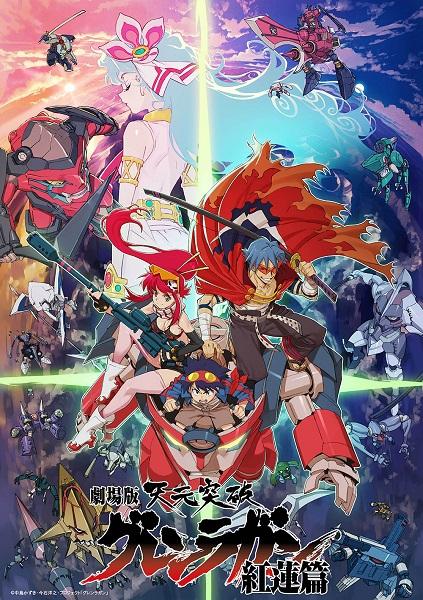
Gurren Lagann The Movie: The Lights in the Sky are Stars
劇場版 天元突破グレンラガン 螺巌篇 (Tengen Toppa Gurren Lagann Movie 2: Lagann-hen)
- Sci-Fi
- Mecha
- Space
- Super Power
- Episodes
- 1
- Duration
- 2 hr 5 min
- Aired
- Apr 22, 2009
- Status
- Finished Airing
Synopsis
Seven years after the Spiral King’s defeat, humanity has returned to Earth and built a comfortable, thriving civilization. That hard-won prosperity comes with a blind spot, though: as the population continues to grow, an unknown force emerges to challenge everything they’ve rebuilt. The threat is the Anti-Spiral, a hostile enemy whose power dwarfs anything they’ve faced before.
With the Spiral King’s warning about the destruction of “the Spiral’s World” beginning to ring true, Team Dai-Gurren prepares for a final confrontation. Carrying forward his late brother’s dream of a brighter future, Simon stands with Nia Teppelin and their comrades to defy the Anti-Spiral and restore hope to humanity.
Otaku Consensus
The Lights in the Sky are Stars is widely treated as the superior half of Gurren Lagann’s two-film retelling, earning its 8.61 MAL score by turning the back stretch of the TV series into a tighter, louder, more climactic theatrical experience. Hiroyuki Imaishi and Masahiko Ootsuka’s direction, Gainax’s maximalist super-robot animation, and the expanded final-act spectacle are the clear selling points; the recurring criticism is that the compression cuts away some of the political and emotional breathing room that made the series land so hard.
Why You Should Watch
Watch this if you want super-robot anime pushed past the usual battlefield scale into full cosmic opera, with the energy of Kill la Kill and Promare but the old-school Gainax lineage of Gunbuster and Diebuster. This is best for viewers who already know Gurren Lagann and want the second half sharpened into a theatrical barrage: fewer pauses, bigger visual payoffs, and a finale built to overwhelm a cinema screen. Taku Iwasaki’s score and Shouko Nakagawa’s theme performance help sell the film’s mix of hot-blooded bravado, grief, romance, and absurd escalation. If you want grounded military mecha, this is the wrong door; if you want impossible machines, philosophy shouted through clenched teeth, and animation that treats scale like a dare, this is the concentrated version.
Key Characters
- SSimon
Simon remains the emotional core because his heroism is framed less as swagger than as earned conviction, making his growth the film’s real engine beneath the cosmic spectacle.
- NNia Teppelin
Nia gives the film its romantic and philosophical pressure point, turning the Anti-Spiral conflict into something more intimate than a simple battle of armies.
- AAnti-Spiral
The Anti-Spiral stands out as a rare mecha antagonist defined by ideology as much as power, giving the film’s battles the feel of a metaphysical argument.
- SSpiral King
The Spiral King’s shadow gives the sequel film a satisfying sense of consequence, reframing earlier warnings as part of a much larger cosmic structure.
What Makes It Stand Out
- 1
Gainax’s super-robot approach is deliberately excessive: the film leans into impossible scale, exaggerated motion, and transformation spectacle rather than the mechanical realism associated with military mecha.
- 2
Hiroyuki Imaishi and Masahiko Ootsuka direct a theatrical condensation of the TV series’ later material, prioritizing momentum and climactic impact over the slower civic and political texture of the episodic version.
- 3
The movie is especially known among fans for its reworked and amplified final confrontation, which gives the theatrical version a distinct identity rather than functioning as a simple recap.
- 4
Taku Iwasaki’s music is central to the film’s emotional rhythm, blending orchestral bombast, choral intensity, and genre-mixing cues that match the story’s jump from personal grief to space-scale defiance.
- 5
AniList’s high-weight tags for Space, Super Robot, Super Power, Politics, and Philosophy accurately reflect the film’s unusual mix: it is both a hot-blooded mecha climax and a debate about civilization, evolution, and the cost of unchecked expansion.
Fun Facts & Trivia
- Fun fact 1
- The film opened on April 22, 2009 as a single theatrical installment and serves as the second Gurren Lagann movie, following the TV series rather than launching a separate continuity from scratch.
- Fun fact 2
- Masahiko Ootsuka has an unusually stacked credit profile on the film in the provided staff data: director, assistant director, and episode director, alongside co-director Hiroyuki Imaishi.
- Fun fact 3
- Atsushi Nishigori handled character design while You Yoshinari handled mechanical design, pairing expressive human designs with the deliberately wild, shape-shifting mecha language associated with Gainax.
- Fun fact 4
- The film’s reception has stayed remarkably strong across major anime databases: MAL lists it at 8.61 from 113,901 votes with a rank of #111, while AniList scores it at 85/100 with 1,293 favourites.
- Fun fact 5
- Shouko Nakagawa performed the theme song, continuing her close association with Gurren Lagann’s musical identity after becoming strongly linked to the franchise through its vocal themes.
Studios
- Gainax