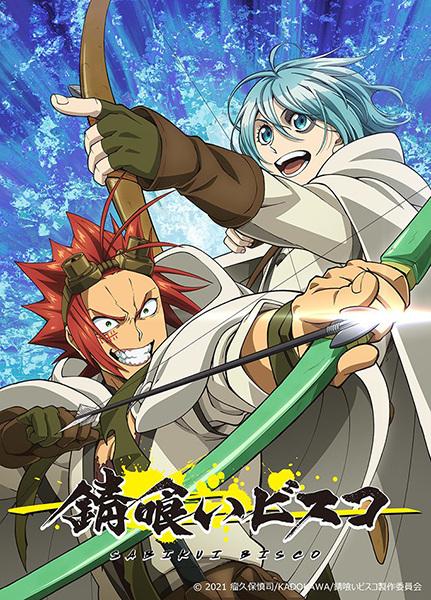
Sabikui Bisco
錆喰いビスコ
- Action
- Adventure
- Fantasy
- Sci-Fi
- Medical
- Episodes
- 12
- Duration
- 23 min per ep
- Aired
- Jan 11, 2022 to Mar 29, 2022
- Status
- Finished Airing
Synopsis
After a calamity reduces Japan to vast stretches of sand, survivors are plagued by a mysterious rusting illness that eats away at bodies and society alike. The government blames the spread of mushroom spores on Bisco Akaboshi, branding him the feared “Man-Eating Mushroom” and casting him as the cause of the world’s decay.
Bisco insists the truth is the opposite: as a “Mushroom Protector,” he searches for the legendary Sabikui mushroom, rumored to be the key to curing the rust disease. Traveling with his giant crab Akutagawa, he teams up with Milo Nekoyanagi, a compassionate doctor desperate to find a treatment for his sister’s rust poisoning. Hounded by suspicion and rumor, Bisco presses forward, determined to cleanse a world that’s steadily corroding away.
Otaku Consensus
Sabikui Bisco earns its cult curiosity status through a feral opening stretch, Atsushi Ikariya’s energetic direction, and one of Winter 2022’s strangest genre cocktails: medical dystopia, desert adventure, archery action, kaiju-scale weirdness, and outlaw buddy chemistry. The verdict from fans and reviewers lands in mixed-positive territory: the world is memorable and the leads carry real momentum, but the most repeated criticism is that the rules of the rust pandemic and the late-series escalation feel under-explained, leaving the climax less controlled than the hook.
Why You Should Watch
Watch Sabikui Bisco if you want a post-apocalyptic road anime that chooses grotesque imagination over clean lore diagrams. It scratches a similar itch to Trigun’s outlaw-desert energy and Dorohedoro’s appetite for body-horror absurdity, but with a medical quest, archery set pieces, and a sporepunk visual identity that keeps throwing new biological oddities at the screen. This is best for viewers who like anime that feels overstuffed, loud, and slightly unhinged without becoming another isekai power ladder. The appeal is not airtight world logic; it is the forward motion of a 12-episode chase story, the contrast between a brash fugitive and a gentle doctor, and a production willing to make mushrooms, rust, drugs, and giant creatures feel like part of the same diseased ecosystem.
Key Characters
- BBisco Akaboshi(VA: Ryouta Suzuki)
Bisco is the series’ divisive engine: fans who love him respond to his reckless outlaw charisma and archery-driven action style, while detractors often cite the same loud intensity as exhausting.
- MMilo Nekoyanagi(VA: Natsuki Hanae)
Milo gives the show its medical conscience, functioning as the gentler counterweight whose bond with Bisco became a major part of the anime’s fan discussion.
What Makes It Stand Out
- 1
Studio OZ handled the 12-episode TV adaptation, with Atsushi Ikariya serving as both director and character designer alongside Ai Asari. That dual role helps explain why the show’s appeal is tied so closely to exaggerated silhouettes, kinetic poses, and character-forward action beats.
- 2
The AniList tag spread is unusually specific: Post-Apocalyptic at 96%, Pandemic at 88%, Medicine at 85%, Archery at 80%, Desert at 76%, Drugs at 72%, Kaiju at 64%, and Cyberpunk at 58%. Few action-adventure anime combine clinical disease anxiety with wilderness travel and creature-feature spectacle this directly.
- 3
Its first impression became part of its reputation: viewer reviews repeatedly point to the trailer, opening, and early premise as unusually dazzling, while one critical write-up framed it as a lesson in how to start an anime. The backlash tends to focus not on the hook, but on whether the later execution pays off that initial confidence.
- 4
The anime’s reception profile is notably polarized rather than quietly average: MAL lists it at 7.14 from 113,875 votes, while AniList sits at 70/100 with 1,293 favourites. User reviews cluster around mixed 5–7 scores, with a smaller but vocal group rejecting the show’s randomness and tonal excess.
- 5
Yoshihiro Sono is credited with creature design, a meaningful production detail for a series whose identity depends on nonstandard fauna, kaiju elements, and biologically strange set pieces rather than conventional fantasy monsters.
Fun Facts & Trivia
- Fun fact 1
- Atsushi Ikariya wore two major hats on the anime: director and character designer. That is notable because the series’ identity depends heavily on how aggressively its characters move, pose, and clash with the wasteland around them.
- Fun fact 2
- The anime separates Shinji Cobkubo’s original story credit from Akagishi K’s original character design credit, while the TV designs are credited to Ai Asari and Atsushi Ikariya. That makes the page’s staff list a compact snapshot of the adaptation pipeline from original concept to animation-ready designs.
- Fun fact 3
- AniList assigns the show both Boys’ Love at 62% and LGBTQ+ Themes at 60%, even though its official genre listing centers on action, adventure, fantasy, sci-fi, and medical themes. That gap reflects how strongly the Bisco-Milo dynamic shaped audience interpretation beyond the formal genre labels.
- Fun fact 4
- Sabikui Bisco aired as a single cour from January 11 to March 29, 2022, placing its entire televised run inside the Winter 2022 season. Its compact length is part of why viewers often praise the momentum while also criticizing the amount of world explanation left compressed.
- Fun fact 5
- Its popularity outpaces its ranking on MyAnimeList: #1011 in popularity versus #4128 in rank. In practical terms, far more people sampled and discussed it than its final score alone would suggest.
Studios
- OZ