Castle in the Sky
天空の城ラピュタ (Tenkuu no Shiro Laputa)
- Adventure
- Award Winning
- Fantasy
- Military
- Episodes
- 1
- Duration
- 2 hr 4 min
- Aired
- Aug 2, 1986
- Status
- Finished Airing
Synopsis
In a world of planes and airships, a young girl named Sheeta is seized by government agents determined to obtain her enigmatic crystal amulet. With little hope of escape aboard their vessel, an unexpected pirate raid throws everything into chaos—giving Sheeta the opening she needs to break free.
Her flight leads her to Pazu, a boy captivated by the legend of Laputa, a castle said to drift among the clouds. Joining forces, the two set out to find the fabled skybound ruin, only to discover the agents are relentless and pursuing the same destination for selfish ends. *Tenkuu no Shiro Laputa* traces their high-flying journey as danger and shared dreams draw them closer along the way.
Otaku Consensus
Castle in the Sky earns its classic status as Studio Ghibli’s first branded release: Hayao Miyazaki’s clean adventure direction, Yoshinori Kanada’s animation energy, and Joe Hisaishi’s wistful musical identity turn a straightforward fantasy into a benchmark for hand-drawn aviation cinema. The most consistent criticism is front-loaded pacing; a minority of viewers find the early stretch cutesy or slow before the film’s momentum and emotional payoff fully take hold.
Why You Should Watch
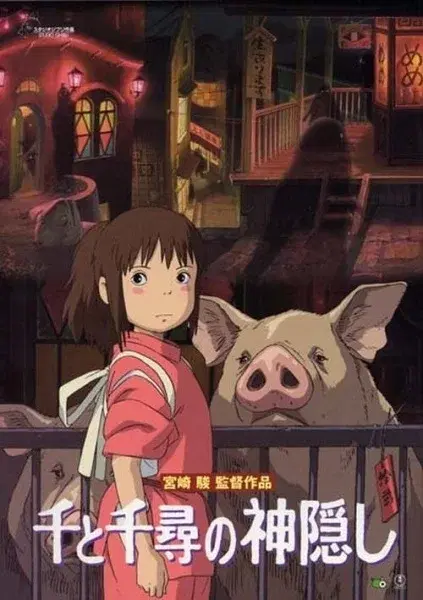
Watch Castle in the Sky if you want a self-contained fantasy adventure with the craft density of peak theatrical anime and none of the franchise homework. It scratches the same sense-of-wonder itch as Spirited Away and Kiki’s Delivery Service, but with more pulp-serial propulsion: airships, pirate mayhem, industrial machinery, military pressure, and lost-civilization awe all packed into one film. Viewers who love steampunk aesthetics, environmental undercurrents, and Miyazaki’s fascination with flight will find this one especially rewarding. It is also ideal if you want an early Studio Ghibli work that shows the studio’s identity forming in real time: handcrafted motion, moral clarity without factional simplicity, and a climax critics often cite as the point where the film’s childlike adventure becomes genuinely moving.
Key Characters
- SSheeta
Sheeta stands out as an early Miyazaki heroine defined less by spectacle than by quiet moral resolve, making her central to the film’s value-over-sides reading among fans.
- PPazu
Pazu grounds the film’s aerial fantasy in working-class earnestness, giving the adventure a tactile sense of labor, craft, and stubborn hope rather than chosen-one mythology.
What Makes It Stand Out
- 1
It was the first film released under the Studio Ghibli name, making it a key text for seeing the studio’s theatrical identity before later global touchstones such as Kiki’s Delivery Service and Spirited Away.
- 2
Hayao Miyazaki is credited as both original creator and director, so the film is not an adaptation filtered through studio assignment but a direct expression of his aviation, anti-militarist, and environmental interests.
- 3
Yoshinori Kanada served as main animator, a notable credit because his energetic approach to motion and effects animation helped define the film’s sense of mechanical speed and airborne danger.
- 4
The production’s visual atmosphere was shaped by art directors Nizou Yamamoto and Toshirou Nozaki, color designer Michiyo Yasuda, and director of photography Hirokata Takahashi, a staff configuration that supports the film’s contrast between industrial grit and cloudborne fantasy.
- 5
Its reputation is unusually tied to escalation: multiple viewers and critics describe the first half as lighter or more conventional, while the latter movement and climax are where the film’s emotional force lands.
Fun Facts & Trivia
- Fun fact 1
- Castle in the Sky aired in Japan on August 2, 1986 as a single theatrical feature, and database listings still classify it under Adventure, Award Winning, and Fantasy rather than a narrower children’s-film label.
- Fun fact 2
- AniList’s highest-confidence tags frame the film very specifically: Lost Civilization at 92%, Steampunk at 84%, Pirates at 82%, Environmental at 82%, and Aviation at 81%.
- Fun fact 3
- The film’s sound identity was built by sound director Shigeharu Shiba and sound effects artist Kazutoshi Satou, while critics frequently single out Joe Hisaishi’s music as part of the movie’s lingering, almost haunted atmosphere.
- Fun fact 4
- Its modern database footprint remains large for a 1986 film: MyAnimeList lists a score of 8.26 from 336,707 votes, rank #382, and popularity #471, while AniList records an 80/100 score and 4,195 favourites.
- Fun fact 5
- Editor Takeshi Seyama is part of the credited key staff, and the film’s reception often hinges on editing rhythm: some viewers report a slower initial half, followed by a much stronger accumulation of tension and feeling.
Studios
- Studio Ghibli