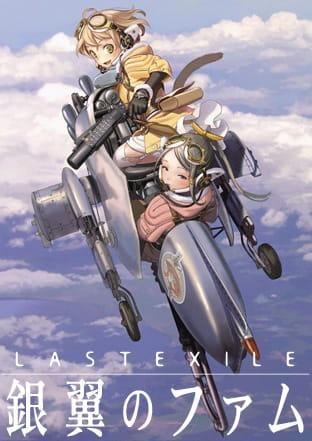
Last Exile
LAST EXILE(ラストエグザイル)
- Action
- Adventure
- Sci-Fi
- Military
- Episodes
- 26
- Duration
- 24 min per ep
- Aired
- Apr 8, 2003 to Sep 30, 2003
- Status
- Finished Airing
Synopsis
On the planet Prester, the skies are the main thoroughfare, powered by Claudia Fluid—a liquid derived from the world’s crystals. Over it all stands the Guild, holding an iron grip on flight technology through its exclusive control of the engines that use this resource. As ecological upheaval worsens the long-running war between Anatoray and Disith, the Guild even serves as the official mediator, while independent Sky Couriers in nimble, two-seat vanships slip between factions to keep goods and messages moving.
Claus Valca and his navigator, Lavie Head, are teenage couriers driven by a shared ambition to outdo the legacy of their parents. Their work often means braving the Grand Stream, a violent air current dividing the rival nations and dangerous even for full-sized airships. Everything changes when they accept a top-priority job: delivering an orphaned girl, Alvis Hamilton, to the battleship Silvana—an assignment that pulls them into the heart of the conflict and into direct opposition with the Guild’s overwhelming power.
Otaku Consensus
Last Exile remains a respected but contested Gonzo original: Kouichi Chigira’s early direction, Range Murata’s character sensibility, and the first stretch of courier-and-vanship aviation episodes give it a texture few TV anime have matched. Its 7.78 MAL score and 74 AniList score reflect the split verdict: fans remember the relationships, opening energy, and steampunk/dieselpunk identity, while critics most often fault the series for losing focus between coming-of-age adventure, political war drama, and Guild mythology. The aged 2003 CG is part of the bargain, but the deeper complaint is narrative diffusion rather than ambition.
Why You Should Watch
Watch Last Exile if you want aviation fantasy with military ceremony, skybound hardware, and old-school Gonzo risk-taking without the clean formulas of modern seasonal sci-fi. It scratches a similar itch to Escaflowne’s romantic worldbuilding and the airship awe of Castle in the Sky, but with a more diesel-stained, command-deck-heavy mood. The appeal is not a perfectly engineered plot; it is the sensation of a whole aerial civilization expressed through uniforms, engines, class rituals, cockpit teamwork, and impossible weather. Viewers who prize production identity over tidy exposition will get the most from it, especially anyone hungry for steampunk anime that treats flight as labor, sport, warfare, and social hierarchy all at once.
Key Characters
- CClaus Valca(VA: Mayumi Asano)
Claus is often remembered less as a flashy protagonist than as a steady emotional anchor whose sincerity lets the stranger personalities around him take over the screen.
- LLavie Head(VA: Chiwa Saitou)
Lavie gives the central vanship partnership its bite, grounding the series’ aviation romance in mechanical familiarity, frustration, loyalty, and lived-in banter.
- AAlvis E. Hamilton(VA: Anna Shiraki)
Alvis functions as the show’s quiet pressure point, a child character whose presence changes the emotional temperature of nearly every adult-dominated conflict around her.
- DDio Eraclea(VA: Junko Noda)
Dio is the cult-favorite wildcard, bringing an unsettling mix of playfulness, privilege, and alien social logic that makes the Guild feel stranger than a standard villain faction.
What Makes It Stand Out
- 1
Gonzo’s 2003 production leans heavily on CGI for vanships, airships, and large-scale aerial movement, placing it in the early TV-anime wave where CG assets became practical but compositing was still visibly rough.
- 2
The visual identity is built from Range Murata’s original character designs, then translated for animation by Yuuichi Tanaka, Osamu Horiuchi, and Minoru Murao; that layered design pipeline is a major reason the cast looks distinct from standard early-2000s sci-fi anime.
- 3
The series’ most praised stretch is its opening run, where small-scale flight culture, courier professionalism, and vanship handling define the experience before the narrative expands into broader war politics.
- 4
Its world design fuses steampunk and dieselpunk cues rather than choosing one lane: aristocratic military ritual, industrial aircraft, and Guild-controlled technology all coexist as visible social systems.
- 5
The show’s reputation is inseparable from its structural pivot from intimate coming-of-age aviation adventure into ensemble military science fiction, a choice admired for ambition and criticized for scattering the drama’s focus.
Fun Facts & Trivia
- Fun fact 1
- Kouichi Chigira served as both director and series composition lead, giving Last Exile a unusually centralized creative authorship for a 26-episode original TV anime.
- Fun fact 2
- The mechanical design credits pair Makoto Kobayashi and Mahiro Maeda, while Hitoshi Ueda handled layout design and Hiromasa Ogura served as art director, explaining why the hardware and environments feel as curated as the characters.
- Fun fact 3
- Last Exile aired from April 8 to September 30, 2003, making it a full two-cour Gonzo original from the same period when digital compositing and TV CG were rapidly reshaping anime production.
- Fun fact 4
- The opening is singled out even in mixed fan reviews as a major hook, with viewers who criticize the story still frequently praising the show’s immediate musical and atmospheric pull.
- Fun fact 5
- The later manga Travelers from the Hourglass is often discussed as more of an epilogue than a conventional sequel, and retrospective commentary notes that it clears up confusion left by the anime’s ending.
Studios
- Gonzo