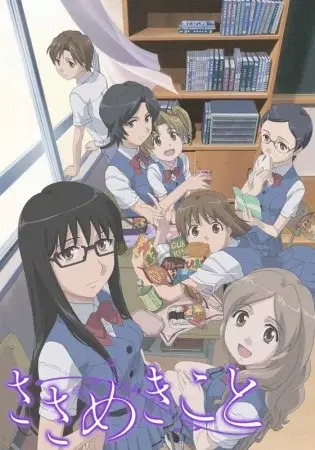
Sweet Blue Flowers
青い花 (Aoi Hana)
- Drama
- Girls Love
- School
- Episodes
- 11
- Duration
- 22 min per ep
- Aired
- Jul 2, 2009 to Sep 10, 2009
- Status
- Finished Airing
Synopsis
Shy, gentle Fumi Manjoume and straightforward, kind Akira Okudaira were inseparable in elementary school—until Fumi’s family moved away and their friendship quietly slipped into the past. Years later, Fumi returns to her hometown after enrolling at Matsuoka Girls’ High School, and the two finally meet again, with Akira attending nearby Fujigatani Girls’ Academy. The reunion is real, but the closeness they once shared doesn’t come back as easily as either of them expects.
As Fumi settles into school life, she catches the attention of the popular upperclassman Yasuko Sugimoto, who singles her out with an unusual amount of praise. Pulled between old comfort and new feelings, Fumi begins confronting who she wants to be on her own terms, while Akira struggles with the gap that time has created. Growing up brings new relationships and difficult choices, testing whether their bond can adapt—or drift apart.
Otaku Consensus
Sweet Blue Flowers earns its reputation as a serious early-TV yuri drama: Kenichi Kasai’s restrained direction, Fumihiko Takayama’s patient structure, Shichirou Kobayashi’s watercolor-like art direction, and Takefumi Haketa’s unobtrusive score make its queer coming-of-age material feel observed rather than engineered. Its 7.09 MAL and 68/100 AniList reception fits a work respected more than broadly popular; the recurring criticism is that its tranquility can read as underpowered, and the 11-episode anime ends long before Takako Shimura’s manga had finished unfolding.
Why You Should Watch
Watch Sweet Blue Flowers if you want LGBTQ+ school drama without harem framing, punchline sexuality, or melodramatic villainy. It scratches the same contemplative itch as Bloom Into You, but with an older josei sensibility: conversations stall, feelings remain asymmetrical, and emotional damage comes from social roles rather than contrived misunderstandings. J.C.Staff’s production is quiet on purpose, pairing soft character designs with detailed, stylized backgrounds that make classrooms, train rides, and rehearsal spaces feel lived-in instead of decorative. The show is especially rewarding for viewers interested in yuri as queer coming-of-age history; in 2009, its matter-of-fact treatment of adolescent female desire stood out in a landscape where representation was still far scarcer.
Key Characters
- FFumi Manjoume(VA: Ai Takabe)
Fumi is compelling because her shyness is treated as a real social constraint rather than a cute quirk, letting her self-assertion emerge through small, uneasy decisions.
- AAkira Okudaira(VA: Yuko Gibu)
Akira’s direct kindness gives the series its emotional oxygen, but the writing keeps her interesting by showing that warmth does not automatically translate into understanding.
- YYasuko Sugimoto(VA: Chiemi Ishimatsu)
Yasuko is the show’s most divisive catalyst, an admired tomboy upperclassman whose confidence exposes how easily admiration, performance, and desire blur in an all-girls school setting.
What Makes It Stand Out
- 1
J.C.Staff and director Kenichi Kasai stage the drama with unusually low theatricality for a school romance: pauses, glances, and restrained blocking carry more weight than confrontation scenes.
- 2
Art director Shichirou Kobayashi and director of photography Yoshio Ookouchi give the series its soft, watercolor-like surface, with detailed but stylized backgrounds that critics repeatedly singled out as a major part of its appeal.
- 3
Takefumi Haketa’s music, supervised under sound director Jin Aketagawa, supports the show’s hushed tone without turning it saccharine; reviewers often note that the audio-visual softness never feels like simple cuteness.
- 4
The series treats yuri as a serious adolescent and social experience rather than as titillation, which was still comparatively rare in TV anime when it aired in summer 2009.
- 5
The school setting is not just a backdrop: the show’s acting and performance elements connect directly to its interest in female roles, public image, and the pressure to behave correctly in front of peers.
Fun Facts & Trivia
- Fun fact 1
- Takako Shimura’s Sweet Blue Flowers manga ran from 2004 to 2013, while the anime aired in 2009, meaning the TV version adapts the work while the source material was still in progress.
- Fun fact 2
- The Nozomi Blu-ray release has been specifically praised for adding noticeable vibrancy compared with standard-definition viewing, making it a preferred way to watch a series whose impact depends heavily on color and atmosphere.
- Fun fact 3
- AniList’s tag profile is unusually explicit for the genre: Yuri at 94%, LGBTQ+ Themes at 84%, Josei at 68%, Bisexual at 64%, and Tomboy at 60%, reflecting how centrally identity and gender presentation factor into its reception.
- Fun fact 4
- Ceui performs the theme song, while Takefumi Haketa handles the score; the production’s musical identity is built around gentleness rather than pop-idol brightness.
- Fun fact 5
- Despite its niche status, the anime has a measurable long-tail audience: MAL lists 38,784 score votes, popularity at #2298, and a score of 7.09, while AniList records 259 favourites.
Studios
- J.C.Staff