We Without Wings – Under the Innocent Sky
俺たちに翼はない -under the innocent sky. (Oretachi ni Tsubasa wa Nai: Under the Innocent Sky.)
- Comedy
- Drama
- Ecchi
- Romance
- Harem
- Episodes
- 12
- Duration
- 24 min per ep
- Aired
- Apr 4, 2011 to Jun 20, 2011
- Status
- Finished Airing
Synopsis
Haneda Takashi carries a secret he can’t bring himself to share. Dreaming of escaping a monotonous school routine for another world, he finds himself held back by the people closest to him—Kobato, his clumsy younger sister, and Watarai Asuka, his inattentive girlfriend.
Chitose Shuusuke scrapes by as a cash-strapped drifter, bouncing between part-time jobs until a disastrous first meeting with Tamaizumi Hiyoko turns into an unexpected workplace connection when they end up employed at the same job. Meanwhile, Narita Hayato prides himself on being “hard-boiled,” enduring grueling work and keeping others at arm’s length—yet his nights draw him into the city’s rougher crowds, where he encounters the bright, unguarded Otori Naru.
As these bonds deepen, the three young men find their lives increasingly shaped by the girls around them—and by a lingering question: what ties the three of them to each other?
Otaku Consensus
We Without Wings earns its cult pocket by turning a Navel harem setup into a jagged psychological puzzle, with Shinji Ushiro’s direction and Nomad’s 12-episode compression making the eventual interlocking structure more interesting than the surface ecchi comedy suggests. Its reputation is split for legitimate reasons: fans praise the surreal comedy, multi-route adaptation gambit, and darker character construction, while detractors consistently cite the overloaded first episode, whiplash pacing, and heavy fanservice as barriers rather than flavor.
Why You Should Watch
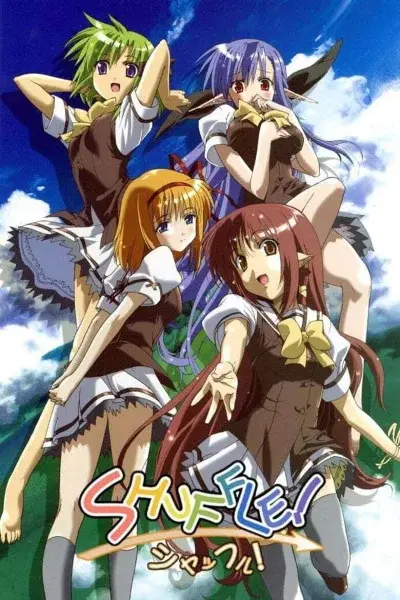
Watch We Without Wings if you want a visual-novel harem that refuses to behave like a clean romance route chart. It scratches a bit of the same itch as Shuffle! through its Navel lineage, but its real hook is closer to a disorderly, low-budget cousin of Monogatari: city nightlife, abrasive banter, ecchi provocation, and a structure that makes you work before it pays off. The ideal viewer is someone who enjoys decoding perspective shifts and can tolerate an intentionally messy opening stretch. If you want gentle wish fulfillment without tonal sabotage, skip it; if you want a 2011 oddity where the fanservice, comedy, and psychological drama keep colliding instead of staying in their lanes, it has a distinctive aftertaste.
Key Characters
- SShuusuke Chitose(VA: Hiroaki Miura)
Shuusuke gives the series its scrappiest adult-life texture, grounding the chaos in part-time work, money trouble, and a more bruised kind of romantic comedy.
- TTakashi Haneda(VA: Hiro Shimono)
Takashi is the character viewers tend to reassess most, because his timid school-life role reads very differently once the series’ structure begins to clarify.
- HHayato Narita(VA: Junichi Suwabe)
Hayato’s self-styled hard-boiled persona gives Junichi Suwabe room for a cooler, rougher register than the average harem lead archetype.
- KKobato Haneda(VA: Ai Matayoshi)
Kobato stands out less as a standard little-sister accessory and more as one of the emotional pressure points around Takashi’s evasive inner life.
What Makes It Stand Out
- 1
The anime is a 2011 Nomad production adapting a Navel visual novel into only 12 televised episodes, which explains why so many reviewers describe it as unusually dense for its length.
- 2
Its first episode has a notorious reputation among viewers: even positive reviews call it awful or bewildering because it front-loads a large cast and several tonal modes before giving the audience a stable framework.
- 3
The series uses a fractured, multi-protagonist structure rather than the cleaner one-route-at-a-time rhythm many visual novel adaptations rely on, making the harem elements feel more like pieces of a formal puzzle.
- 4
Its ecchi content is not incidental; web criticism specifically calls out the unusually high frequency of panty shots, nudity, and a much-discussed episode 8 scene as part of why the show alienates as many viewers as it attracts.
- 5
The reception profile is unusually polarized for a mid-ranked title: MAL sits at 6.64 from 34,849 votes, IMDb lists 5.5 from 145 ratings, yet user reviews include passionate 8/10, 10/10, and 'guilty pleasure' defenses.
Fun Facts & Trivia
- Fun fact 1
- The title is commonly abbreviated by fans as Oretsuba, a shortened form of its Japanese title Oretachi ni Tsubasa wa Nai.
- Fun fact 2
- The source material comes from Navel, the visual novel studio also associated with Shuffle!, which helps explain why viewers often approach it expecting a more conventional harem romance than it delivers.
- Fun fact 3
- The TV broadcast ran from April 4, 2011 to June 20, 2011, placing it in the early-2010s wave of visual novel adaptations that mixed romance routes with increasingly experimental structure.
- Fun fact 4
- Reviewer discussion often singles out director Shinji Ushiro’s handling of the adaptation, with detractors blaming the cramped presentation and defenders crediting the same disorientation as the show’s identity.
- Fun fact 5
- Several web summaries and reviews describe the complete viewing experience as more crowded than the official 12-episode TV listing suggests, reflecting how packed the adaptation feels rather than a simple episode-count consensus.
Studios
- Nomad