The Take
Here is the blunt version: today’s August 5, 2026 Star Wars anime premiere does not prove that every Star Wars story should be animated, but it does prove that the franchise’s most exciting future may be in anime. The reason is not just that lightsabers look cool with sharper linework, or that space battles benefit from expressive compositing. It is that anime gives Star Wars permission to be myth again.
For years, live-action Star Wars has often been caught between two competing obligations: expand the galaxy, but never stray so far that the brand silhouette becomes unrecognizable. That tension can make expensive productions feel oddly conservative. By contrast, this new Production I.G series arrives with the looseness of a campfire legend: a Force-sensitive heroine, a kidnapped sabersmith father, Jedi-in-training, kyber crystals that visually reflect the wielder’s inner state, and a masked villain whose blue blade scrambles our usual moral shorthand. That is not simply aesthetic novelty. It is Star Wars remembering that its strongest ideas were always fairy tale, samurai drama, pulp serial, and spiritual coming-of-age story all at once.
Otaku Insider’s take: Star Wars does not work better as anime because anime is magically superior to live action. It works better here because anime is structurally better at embracing symbolic exaggeration, stylized morality, and visual reinvention without apologizing for them.
The Evidence
The strongest evidence is the production model itself. Lucasfilm has positioned this release as an eight-episode limited anime series under a banner designed for longer-form stories. That matters. The earlier anthology approach proved the concept: let Japanese studios treat Star Wars as a creative language rather than a canon spreadsheet. But a short can only suggest a world. Eight episodes can stress-test whether that world has narrative weight beyond a gorgeous premise.
Production I.G is exactly the kind of studio you want for that test. Even if a viewer only knows the studio through the kinetic sports clarity of Haikyu!! or the hard-edged institutional dread of Psycho-Pass, the common thread is control: bodies move with intent, spaces communicate power, and action is readable even when the emotional stakes are heightened. That skill set is ideal for Star Wars, a franchise where a duel is rarely just a fight. A lightsaber clash should tell us who someone thinks they are, who they are afraid of becoming, and what ideology is winning in the moment.
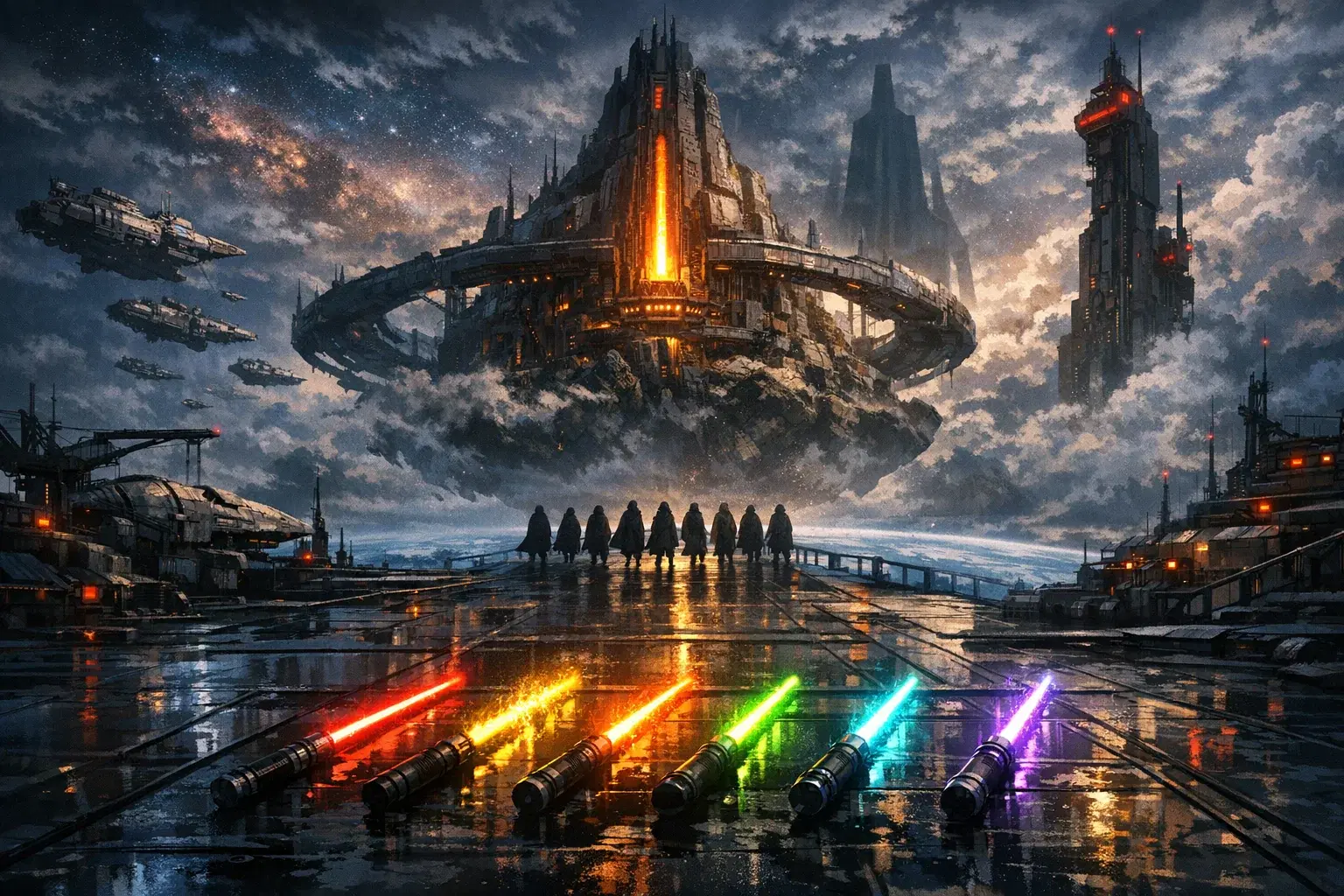
The new story’s central lightsaber idea is also more than a cool toy-box variation. In this series, sabers can change color depending on the wielder’s relationship to the Force. Supervising director Kenji Kamiyama has described the concept as growing from an early misunderstanding of how Star Wars sabers worked, later transformed into a deliberate storytelling device. That origin is revealing. The best anime adaptations and reinterpretations often come from productive misreadings: a creator sees the emotional logic of a thing before the rulebook. Instead of treating established lore as a locked museum display, this project treats lore as metaphor.
That is where anime has a particular advantage. In live action, a color-changing lightsaber risks becoming either a continuity headache or a visual-effects gimmick. In anime, it can be grammar. Color shifts, silhouettes, sudden negative space, exaggerated stillness, and impossible camera movement are normal expressive tools. Think about how Neon Genesis Evangelion turns machinery into psychology, how Gurren Lagann makes scale a measure of willpower, or how Revue Starlight: The Movie uses theatrical unreality to make internal conflict legible. Anime audiences are trained to read style as substance.
That matters because Star Wars has been struggling with visual predictability. The franchise’s live-action television era has delivered some memorable highs, especially when the writing is as politically focused as Andor. But other recent projects have leaned on familiar desert towns, familiar bounty-hunter iconography, familiar imperial corridors, and familiar legacy gravity. Even when the craft is strong, the images can feel pre-approved. You can sense the franchise managing risk.
Anime reduces that pressure by shifting the baseline. A masked general inspired by the shadow of Darth Vader but carrying a blue lightsaber does not need to be explained with a family tree before he becomes interesting. He can function first as image, mood, and contradiction. A sabersmith father is not just a plot device; he is a fantasy craft archetype, closer to the legendary weapon-makers and inherited burdens that run through adventure anime. A young heroine discovering what her blade says about her soul is not a lore footnote. It is coming-of-age storytelling rendered as visual design.
That is why comparisons to classic space anime are useful, not because Star Wars should copy them, but because they show what the medium naturally amplifies. Cowboy Bebop understood that a lived-in galaxy needs boredom, music, debt, hunger, and sudden violence. Star Blazers: Space Battleship Yamato 2199 understood that space opera works when military spectacle is fused to longing and sacrifice. Mobile Suit Gundam 0083: Stardust Memory understood that factions are more interesting when everyone is trapped inside history. Star Wars has all of those ingredients, but live-action franchise management often sands them down into brand-recognizable beats. Anime can push them outward again.
There is also a practical industry point here. Hollywood franchise storytelling increasingly treats coherence as the highest virtue: interconnected timelines, cross-platform character arcs, and Easter eggs designed to reward encyclopedic viewing. Anime fandom certainly knows continuity obsession too; just look at how long-running shonen and science-fiction communities map power systems and timelines. But anime production also has a healthier mainstream appetite for alternate tellings, spinout interpretations, and director-forward experiments. Fans of Code Geass: Lelouch of the Rebellion or Fullmetal Alchemist: Brotherhood understand that a story’s power often comes from strong thematic architecture, not from whether it slots neatly beside every adjacent installment.
The release strategy reinforces the point. Dropping all eight episodes at once on Disney+ and Hulu in the U.S. turns the series into a concentrated argument: not a weekly lore scavenger hunt, but a complete anime object viewers can judge on pacing, theme, and emotional payoff. That is refreshing. It asks fans to engage with Star Wars less as homework and more as story.
The Counterargument
The obvious counterargument is that Star Wars does not need anime to be bold. And that is fair. Andor, especially in its acclaimed later run, demonstrated that live-action Star Wars can be politically sharp, visually disciplined, and dramatically adult without relying on Jedi mythology at all. The upcoming theatrical pipeline also suggests Lucasfilm still sees live action as the franchise’s flagship language. Big-screen Star Wars carries cultural weight that an anime release on streaming may not match.
There is also a risk in over-romanticizing anime freedom. Anime is not automatically daring. It has its own formulas, production crunch, committee logic, market-tested character types, and sequel incentives. A Star Wars anime can be just as hollow as a live-action one if it mistakes style for vision. A bright saber trail and a dramatic scream do not guarantee meaningful storytelling.
Another concern: the more Star Wars embraces non-canon or lightly connected anime experimentation, the more some fans may feel the stories are disposable. Franchise audiences have been trained to ask whether something “counts.” If a story does not alter the central timeline, does it matter? For canon-first viewers, the answer may be no.
But that objection reveals the problem this project is challenging. If Star Wars only matters when it rearranges the official timeline, then the franchise has shrunk. Myth does not endure because every version is legally synchronized. It endures because artists keep retelling it in ways that reveal new emotional angles. Anime is not replacing live action here. It is reminding live action what it has forgotten: mystery is more valuable than explanation, and iconography is strongest when creators are allowed to bend it.
The Conclusion
So, can today’s new Star Wars anime prove the franchise works better as anime? My answer: it proves Star Wars works better when it thinks like anime. That means prioritizing visual metaphor over continuity maintenance, emotional clarity over lore compliance, and creator perspective over brand uniformity. Production I.G’s eight-episode project is timely because Star Wars is at a crossroads. One path keeps refining the familiar until the galaxy feels smaller. The other lets artists treat the Force, sabers, Jedi, and villains as living symbols again.
Anime fans should care because this is not just another Western IP borrowing Japanese aesthetics. It is a test of whether a massive franchise can learn from anime’s willingness to stylize, reinterpret, and mythologize. If this series lands, Lucasfilm should not merely commission more side experiments. It should let anime influence the franchise’s center of gravity.
And if you are coming to this as an anime fan rather than a Star Wars loyalist, the appeal is simple: watch it the way you would watch Cowboy Bebop, Psycho-Pass, or Gurren Lagann. Do not ask first where it fits. Ask what it feels like, what it risks, and whether its images stay with you after the credits. That, more than any timeline placement, is where Star Wars may find its next real spark.
Sources
- [1] Star Wars: Visions Presents — The Ninth Jedi | Series | StarWars.com (starwars.com)
- [2] Star Wars: Visions Presents - The Ninth Jedi - Official Trailer | StarWars.com (starwars.com)
- [3] Production I.G [WORK LIST] (productionig.com)
- [4] Star Wars: Visions is Here! | StarWars.com (starwars.com)
- [5] 5 Things We Learned from the Star Wars: Visions Filmmaker Focus Featurettes | StarWars.com (starwars.com)
- [6] Star Wars: Visions Presents - The Ninth Jedi - Interview | StarWars.com (starwars.com)
- [7] STAR WARS: VISIONS PRESENTS – THE NINTH JEDI to Make Disney+ Debut (broadwayworld.com)
- [8] Star Wars: The Mandalorian and Grogu | Film | StarWars.com (starwars.com)
- [9] Andor: Season 2 First Reviews: Some of the Best Star Wars Storytelling Ever | Rotten Tomatoes (editorial.rottentomatoes.com)
- [10] Disney+ Debuts Trailer & Announces Cast For “Star Wars: Visions” | Disney Plus Press (press.disneyplus.com)
- [11] Star Wars: Visions | Lucasfilm.com (lucasfilm.com)
- [12] “It’s a Love Letter”: The Producers of Star Wars: Visions Celebrate the Unique Anime Collection | StarWars.com (starwars.com)
- [13] Volume 3 Release Date and New Star Wars: Visions Spin-off Series | StarWars.com (starwars.com)
- [14] Behind Star Wars: Visions Volume 3 — James Waugh on Storytelling and Style at Anime NYC | Explore Disney+ (disneyplus.com)
- [15] Star Wars: Visions producer says the show isn't concerned about the franchise's established canon: "I don't think we'd ever get things like The Duel if we tried to fit it into that" (gamesradar.com)
- [16] First Impression: Star Wars: Visions Presents – The Ninth Jedi – Beneath the Tangles (beneaththetangles.com)
- [17] Production I.G|『Star Wars Visions Presents -The Ninth Jedi』『The Ninth Jedi: Child of Hope』制作決定! (production-ig.co.jp)
- [18] STAND ALONE COMPLEX | Ghost in the Shell Official Global Site (theghostintheshell.jp)
- [19] Bones President & Producer Explains Why MARRIAGETOXIN Was Chosen for an Anime Adaptation (ANIME_CORNER)
- [20] Square Enix Ends Yang Can't Live Alone After Editorial Issues, Says Trust With Creator Could Not Be Rebuilt (ANIME_CORNER)
- [21] Suikoden: The Anime Unveils New Key Visual (CRUNCHYROLL)
- [22] Suikoden STAR LEAP Mobile Game Launch Date Set for Japan (CRUNCHYROLL)
- [23] Daemons of the Shadow Realm OP and ED Artists Masanori Otoda and Kei Sugawara Top 5 Anime (CRUNCHYROLL)
- [24] My Stepmother and Stepsisters Aren't Wicked Anime Casts Yo Taichi as Riru Kazan (CRUNCHYROLL)
- [25] Digimon Franchise Reveals Poll Winners for Best Episodes of 1st 4 Digimon Anime Series (ANN)
- [26] Mii-chan and Miss Yamada Staff Issue Statement After Backlash to Anime News (ANN)
- [27] International J-Pop Star yama to Perform at Anime NYC 2026 (ANN)
- [28] Garena to Launch Palworld Online Mobile MMORPG This Year (ANN)
- [29] My Stepmother and Stepsisters Aren't Wicked Anime Casts Yō Taichi (ANN)
- [30] Crunchyroll's Anime Nights to Screen Webtoon-Based Korean-Animated Film Your Letter on August 17 (ANN)
- [31] KAKERU Launches New Succubus Hunter Exex Manga in August (ANN)
- [32] Pan Dorobō Anime's New Video Unveils More Cast & Staff, Opening Song (ANN)
- [33] Super Psychic Policeman Chojo Anime Reveals October 6 TV Debut (ANN)
Written by Ranen with AI support — Ranen picks every story, shapes the angle, and reviews each article before it's published. Learn more in our editorial policy.