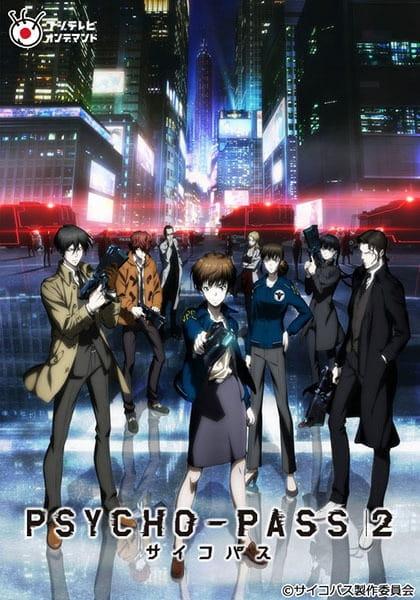
Psycho-Pass
サイコパス
- Action
- Mystery
- Sci-Fi
- Suspense
- Adult Cast
- Detective
- Psychological
- Episodes
- 22
- Duration
- 23 min per ep
- Aired
- Oct 12, 2012 to Mar 22, 2013
- Status
- Finished Airing
Synopsis
In 22nd-century Japan, law enforcement is governed by the Sibyl System, which evaluates each person’s mental state for signs of criminal intent—an assessment known as a Psycho-Pass. Those deemed a threat can be subdued on the spot, even lethally, by Inspectors. Working under them are Enforcers: individuals labeled latent criminals who are allowed limited freedom in return for carrying out the most dangerous work.
Akane Tsunemori enters the force with a sincere belief in justice, only to have her convictions tested as she partners with seasoned Enforcer Shinya Kougami. As cases unfold, she begins to see flaws in the supposedly impartial system, forcing her to confront what justice means when it’s enforced by an authority that may not be as infallible—or as clean—as it claims.
Otaku Consensus
Psycho-Pass is widely celebrated as a sharp, cyberpunk police thriller whose best-in-class Season 1 marries tense casework with big philosophical questions about morality, surveillance, and “objective” justice. Fans and critics consistently praise its adult cast, escalating suspense, and the ideological duel at its core, backed by Production I.G’s slick urban futurism. Detractors most often call it self-serious or “pretentious,” arguing that its world-building and writing don’t always support the weight of its themes—even as many still concede it’s an intelligent, highly watchable genre standout.
Why You Should Watch
Watch Psycho-Pass if you want a sci-fi crime series that treats its premise like a loaded weapon: thrilling to handle, terrifying to aim. It’s not just “cops with cool tech”—it’s a detective story where every arrest is also an ethical argument, and where the system’s promise of safety is inseparable from its capacity for abuse. The show’s appeal is the constant pressure between human judgment and algorithmic authority, embodied by an adult ensemble that feels like professionals rather than archetypes. If you like cyberpunk urban dread, philosophical antagonists, and suspense that turns procedural cases into a larger moral indictment, Psycho-Pass delivers—often brutally.
Key Characters
- TTsunemori, Akane(VA: Hanazawa, Kana)
A principled new Inspector whose belief in justice is tested by a society that quantifies the mind and punishes intent as readily as action.
- KKougami, Shinya(VA: Seki, Tomokazu)
A hardened Enforcer with the instincts of a true detective, compelling precisely because he knows the system’s rules—and what they cost.
- MMakishima, Shougo(VA: Sakurai, Takahiro)
A charismatic ideological threat who turns the series into a philosophical chess match, forcing everyone to justify what “justice” even means.
What Makes It Stand Out
- 1
A high-concept dystopia built around the Sibyl System and the idea of a measurable “Psycho-Pass,” turning every investigation into a debate about free will, public safety, and moral responsibility.
- 2
A gripping detective-and-police framework (Detective/Police tags rank among the highest) that keeps the pacing tight while steadily widening into larger societal questions.
- 3
An unusually adult-forward cast and tone—professional, psychologically burdened, and often forced into no-win choices—matching the series’ suspense and philosophical edge.
- 4
Production I.G’s clean, modern cyberpunk aesthetic: dense urban spaces, augmented-reality texture, and a clinical visual language that reinforces the show’s obsession with measurement and control.
- 5
A central character triangle (Akane, Kougami, Makishima) that functions as competing moral models, giving the thriller stakes emotional and intellectual bite rather than relying on twists alone.
Fun Facts & Trivia
- Fun fact 1
- Psycho-Pass aired from Oct 12, 2012 to Mar 22, 2013 and ran for 22 episodes, with Production I.G handling animation.
- Fun fact 2
- The series is based on an original story by Gen Urobuchi, a creator frequently associated by viewers with darker, psychologically intense storytelling—something reflected in both the praise and the backlash found in user reviews.
- Fun fact 3
- It remains a major community staple: MAL Popularity sits at #71 with an 8.33/10 score from 826,619 votes, and it has 12,341 favourites on AniList.
- Fun fact 4
- Key creative leadership includes Chief Director Katsuyuki Motohiro and Director Naoyoshi Shiotani, with character design rooted in Akira Amano’s original designs and adapted for animation by Kyouji Asano.
Studios
- Production I.G