Space Pirate Captain Harlock
宇宙海賊・キャプテンハーロック (Uchuu Kaizoku Captain Herlock)
- Action
- Adventure
- Drama
- Sci-Fi
- Space
- Episodes
- 42
- Duration
- 25 min per ep
- Aired
- Mar 14, 1978 to Feb 13, 1979
- Status
- Finished Airing
Synopsis
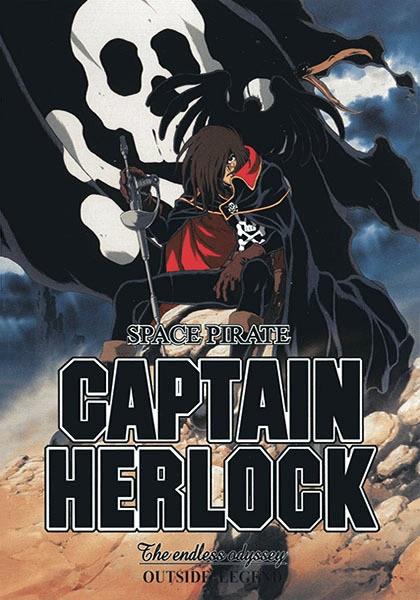
In 2977 AD, humanity has slipped into complacency: robots handle the labor, subliminal conditioning keeps the public docile, and leaders waste their days on leisure pursuits. Captain Harlock refuses to accept that hollow peace, choosing instead a life of defiance and exploration with a band of kindred spirits aboard the starship Arcadia.
Earth’s fragile calm is shattered by the arrival of the Mazone, an enigmatic invading force that appears as cloaked women and eliminates anyone who gets too close to the truth. Tadashi Daiba becomes a target after his scientist father is dismissed by indifferent authorities and then killed by the Mazone, pushing Tadashi to seek out Harlock and join his pirate crew. Together, they take on the growing alien threat while a stagnant world struggles to wake up.
Otaku Consensus
Space Pirate Captain Harlock endures because Rintarou turns Leiji Matsumoto's outlaw space opera into something solemn, political, and mythic, with Toei Animation's late-1970s TV craft reinforced by Seiji Yokoyama and Nozomi Aoki's music. Its 7.68 MAL score and 73/100 AniList score reflect a respected classic rather than a mass-popularity title, and the main caveat is real: the 42-episode, heavily episodic structure can feel repetitive to viewers trained on tighter modern cours.
Why You Should Watch
Watch Space Pirate Captain Harlock if you want old-school space opera with ideological bite rather than gadget-of-the-week spectacle. Its closest modern positioning is the solemn, political end of Legend of the Galactic Heroes filtered through Leiji Matsumoto's romantic outlaw mythology; it also scratches the classic-voyage itch associated with Space Battleship Yamato, but with a loner-pirate code replacing military duty. The appeal is in Rintarou's grave, operatic staging, Toei's 1978 television craft, and a 42-episode rhythm that lets adult crewmates feel like people carrying private convictions. If contemporary sci-fi anime feels too busy or too ironic, Harlock offers starfields, uniforms, speeches, and silence with total sincerity. The trade-off: you must enjoy episodic structure and period animation instead of expecting modern velocity.
Key Characters
- CCaptain Harlock
Harlock is less a conventional action lead than a Leiji Matsumoto emblem: a romantic dissident whose charisma comes from restraint, personal codes, and the refusal to let society define freedom for him.
- TTadashi Daiba
Tadashi gives the series its younger emotional entry point, contrasting Harlock's weathered conviction with the raw anger of someone learning what rebellion costs.
What Makes It Stand Out
- 1
The series is a full 42-episode Toei Animation television production that aired from March 14, 1978 to February 13, 1979, giving it the expansive pacing of a pre-cour-era space opera rather than a compressed modern adaptation.
- 2
Rintarou directs from Leiji Matsumoto's original creation, a pairing that anchors the show in Matsumoto's signature blend of melancholy, masculine romanticism, and anti-authoritarian space mythology.
- 3
AniList's tag profile is unusually clear about the show's identity: Space Opera at 90%, Pirates at 82%, Aliens at 77%, and Episodic at 70%, placing it closer to serialized pulp voyages than to hard sci-fi mechanics.
- 4
The credited music team combines Seiji Yokoyama and Nozomi Aoki, giving the production a dedicated dramatic score presence rather than treating the soundtrack as incidental television filler.
- 5
The cast profile skews older than many adventure anime, with AniList marking it as Primarily Adult Cast at 60% and Seinen at 68%, which helps explain the show's reputation for stern ideals and moral weariness.
Fun Facts & Trivia
- Fun fact 1
- The Japanese title is often romanized as Uchuu Kaizoku Captain Herlock, while the English-facing franchise identity is overwhelmingly known as Space Pirate Captain Harlock.
- Fun fact 2
- Despite being a late-1970s TV anime, it remains actively catalogued by modern fan databases: MAL lists 12,031 votes with a 7.68 score, while AniList records a 73/100 score and 250 favourites.
- Fun fact 3
- Takamura Mukuo is credited with art design, a role especially important for a series whose identity depends on ship interiors, starfields, and the visual language of decayed futurism.
- Fun fact 4
- Moriyasu Taniguchi is specifically credited as animation director for episode 6, a reminder that individual episode craft on long-running TV anime often depended on rotating specialist staff.
- Fun fact 5
- The Italian version has its own documented localization staff, with Marco Visconti credited as ADR director and Renato Cominetti credited for ADR script, reflecting the show's international afterlife beyond Japan.
Studios
- Toei Animation