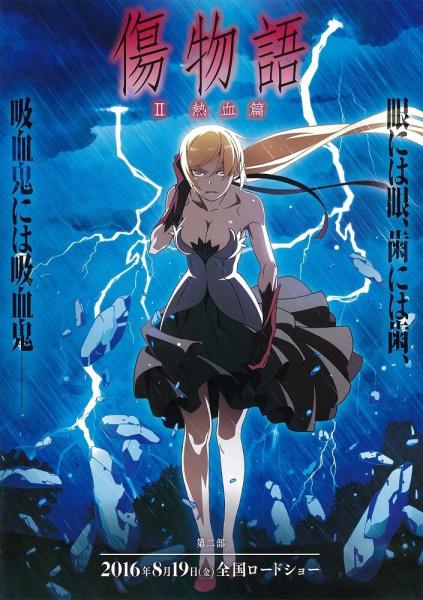
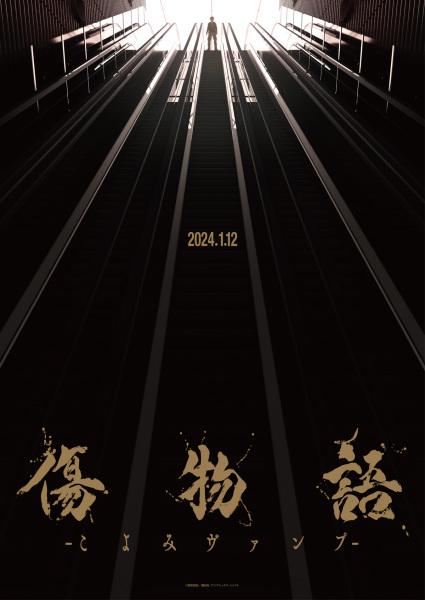
Kizumonogatari Part 3: Cold-Blooded
傷物語〈Ⅲ冷血篇〉 (Kizumonogatari III: Reiketsu-hen)
- Action
- Mystery
- Supernatural
- Vampire
- Episodes
- 1
- Duration
- 1 hr 22 min
- Aired
- Jan 6, 2017
- Status
- Finished Airing
Synopsis
After bringing the legendary vampire Kiss-shot Acerola-orion Heart-under-blade back from the brink, Koyomi Araragi finds himself transformed into a vampire and bound to her as a servant. Kiss-shot insists she can restore his humanity—but only after reclaiming the power she lost.
With the limbs taken from her by the three vampire hunters now recovered, Araragi stands on the verge of fulfilling his goal. Yet the closer Kiss-shot comes to becoming whole again, the harder it is to ignore what her return to full strength could mean—and how little anyone might be able to do if she chooses to act. As doubts surface, Araragi is forced to confront unsettling questions about the hunters’ victory over Kiss-shot, whether her promise can be trusted, and what it would even take to make him human again.
Otaku Consensus
Kizumonogatari III: Reiketsu-hen lands as a ferocious, theatrical finish: Shaft’s direction under Tatsuya Oishi and Akiyuki Shinbou turns NISIOISIN’s vampire material into noir body horror, with the finale widely singled out for its savage emotional clarity. Its most common criticism is pace: compared with the leaner, more propulsive Part 2, Part 3 can feel more deliberate and confrontational, but that friction is also what gives its closing stretch its reputation for majesty and discomfort.
Why You Should Watch
If your favorite Monogatari material is the uncomfortable space between comedy, erotic panic, and philosophical self-interrogation, Cold-Blooded is the trilogy at its most punishing. It scratches the same itch as Bakemonogatari’s verbal mind-games and Devilman Crybaby’s eroticized body horror, but with Shaft’s gallery-space framing and noir emptiness replacing TV rhythm with theatrical pressure. Watch it if you want vampire action without power-fantasy comfort: the film leans into rotoscoped physicality, gore, nudity, survival horror, and psychosexual embarrassment until genre coolness curdles into tragedy. It is also the cleanest test of whether you respond to Tatsuya Oishi’s Monogatari style: long silences, impossible architecture, graphic impact, and characters treated like specimens under studio lighting.
Key Characters
- KKoyomi Araragi(VA: Hiroshi Kamiya)
Araragi is compelling here because the film strips away the witty problem-solver image and fixates on his shame, bodily panic, and adolescent need to turn self-sacrifice into identity.
- TTsubasa Hanekawa(VA: Yui Horie)
Hanekawa functions as more than the franchise’s model student archetype, becoming the sharpest human counterweight to the film’s supernatural logic and emotional evasions.
- SShinobu Oshino(VA: Maaya Sakamoto)
Shinobu’s presence in Cold-Blooded is fascinating for how it reframes a fan-iconic Monogatari figure through menace, theatrical poise, and the loneliness of myth.
What Makes It Stand Out
- 1
Shaft’s film uses the studio’s signature abstraction in a harsher register than the TV entries: empty urban spaces, posed bodies, abrupt graphic compositions, and exaggerated negative space push the material toward noir rather than sitcom-like banter.
- 2
The production is strongly associated with Tatsuya Oishi’s direction, with Akiyuki Shinbou credited as chief director; that pairing gives the film a distinct identity from later Monogatari installments that lean more heavily on rapid-fire conversational rhythm.
- 3
AniList’s high-weight tags for the film include Rotoscoping, Body Horror, Noir, Philosophy, Gore, and Psychosexual, which accurately reflects how the movie’s action is staged as humiliation and bodily crisis rather than clean supernatural spectacle.
- 4
Critical discussion often positions Part 3 against Part 2: Nekketsu-hen is viewed as the tighter and more propulsive middle chapter, while Reiketsu-hen is remembered for its confrontational closure and emotionally abrasive ending.
- 5
The film’s adaptation style does not treat vampirism as a simple monster-action hook; reviews highlight its rage against genre conventions and its focus on indignity, making its supernatural set pieces feel morally and physically ugly.
Fun Facts & Trivia
- Fun fact 1
- Kizumonogatari III: Reiketsu-hen aired as a single-episode entry on January 6, 2017, completing Shaft’s three-part adaptation of NISIOISIN’s Kizumonogatari material.
- Fun fact 2
- The credited visual lineage runs from VOFAN’s original character designs to anime character designers Hideyuki Morioka and Akio Watanabe, a combination that helps explain the film’s mix of sleek character iconography and harsher cinematic anatomy.
- Fun fact 3
- The film carries major database prestige: its MyAnimeList score is 8.78 from 300,887 votes, with a MAL rank of #42 and popularity rank of #507, while AniList lists it at 87/100 with 7,517 favourites.
- Fun fact 4
- Hisaharu Iijima served as art director, Nobuyuki Takeuchi handled art design, Hitoshi Hibino handled color design, and Michiya Katou served as director of photography, making the film’s stark lighting and constructed spaces a multi-department signature rather than a single stylistic flourish.
- Fun fact 5
- Review excerpts repeatedly describe the trilogy as an experience rather than an easy recommendation, with Reiketsu-hen specifically praised for providing closure even by viewers who preferred the pacing of the second film.
Studios
- Shaft