Glitter Force
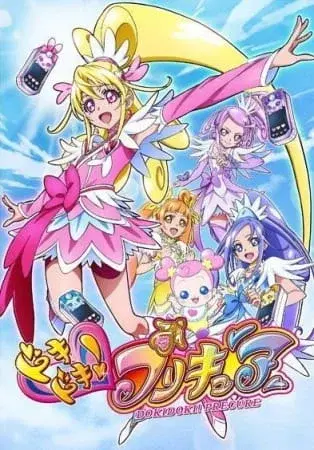
スマイルプリキュア (Smile Precure!)
- Action
- Mahou Shoujo
- Episodes
- 48
- Duration
- 24 min per ep
- Aired
- Feb 5, 2012 to Jan 27, 2013
- Status
- Finished Airing
Synopsis
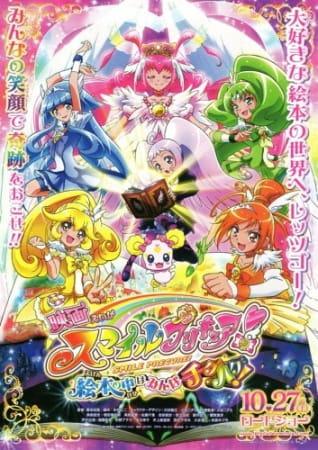
Miyuki Hoshizora adores fairy tales and the promise of bright, happy endings, carrying that optimism into everyday life. On her first day as a transfer student, she crosses paths with Candy, a strange little fairy from the storybook realm of Märchenland—only for Candy to vanish just as suddenly, leaving Miyuki unsure whether it was real at all.
Before long, a hidden school library pulls Miyuki into Candy’s world, where Candy reveals she’s searching for the legendary Precure warriors. When happiness itself is threatened, Miyuki discovers she can transform into Cure Happy, stepping into a new role as a protector. With danger looming over both worlds, she sets out to find the other Precure and fight to keep everyone’s happiness from being taken away.
Otaku Consensus
Glitter Force / Smile Precure! lands as a sturdy, action-forward Precure entry: Toei Animation’s episodic direction, brisk henshin-and-fight rhythm, and Yasuharu Takanashi’s bright scoring make its 48-episode run easy to sample, while the fairy-tale framing gives its optimism a distinct franchise flavor. The reception numbers, MAL 6.94 and AniList 70, match the conversation: warmly remembered by young-viewer and empowerment-focused audiences, but docked by older fans for limited dramatic depth and, in the Glitter Force localization, cut or culturally flattened material compared with the Japanese Smile Precure!.
Why You Should Watch
Watch Glitter Force / Smile Precure! if you want team magical-girl action with the clean, ritualized punch of tokusatsu and the low-friction comfort of episodic children’s television. It scratches the Sailor Moon itch of color-coded heroines, mascot magic, and repeated transformation spectacle, but it is lighter on romance, denser mythology, and angst. Toei’s house style keeps the focus on readable action poses, big emotional buttons, and instantly legible villains, so it works especially well for viewers who like superhero formulas without grimdark escalation. The Japanese Smile Precure! version is the better pick if localization fidelity matters to you; the Netflix-era Glitter Force dub is easier for younger English-speaking viewers but is often criticized for cutting and smoothing over cultural texture.
Key Characters
- MMiyuki Hoshizora
Miyuki is the kind of lead Precure fans remember for making optimism feel like an active combat style rather than a passive personality trait.
- CCandy
Candy fills the classic magical-girl mascot role with a fairy-tale bent, acting as both mission catalyst and the series’ most visible link to Märchenland.
What Makes It Stand Out
- 1
Toei Animation builds the show around the Precure franchise’s action-first magical-girl grammar: transformation stock footage, named powers, superhero team posing, and direct physical combat rather than purely wand-based spellcasting.
- 2
The series ran as a complete 48-episode television year from February 5, 2012 to January 27, 2013, and its AniList tag profile marks it as strongly episodic at 85%, which reflects its monster-of-the-week accessibility more than a binge-drama structure.
- 3
Yasuharu Takanashi’s music credit matters for action fans: his scoring gives the comedy, henshin sequences, and battle climaxes a sharper shounen-adjacent momentum than the pastel surface might suggest.
- 4
Its identity is unusually explicit about fairy-tale texture, with AniList tagging Fairy Tale at 76% and Fairy at 75%, making it more storybook-coded than many magical-girl shows that rely primarily on idols, astrology, or school-club motifs.
- 5
The Glitter Force version is not just an English dub in fan discourse; it is frequently discussed as a localized adaptation with cut content, which is why many fans recommend comparing it with the original Japanese Smile Precure! for tone and cultural detail.
Fun Facts & Trivia
- Fun fact 1
- The original creator credit is Izumi Toudou, the long-running Pretty Cure franchise credit associated with Toei’s in-house creation model rather than a single manga source author.
- Fun fact 2
- Yoshimi Narita scripted a substantial slice of the run, including episodes 11, 13, 16, 24, 27, 29, 35, 36, 39, 42, 46, and 47, placing her fingerprints on both midseason development and the late-series stretch.
- Fun fact 3
- Yuuji Yamaguchi both storyboarded and directed episodes 12 and 33, while Masatoshi Chioka directed episode 10 and Youko Ikeda directed episodes 7 and 18.
- Fun fact 4
- Aya Ikeda performed the opening theme, and Hitomi Yoshida performed the ending theme, tying the series to the Precure tradition of highly branded, performance-forward theme songs.
- Fun fact 5
- Its database footprint is modest but steady: MAL lists 26,443 votes with a 6.94 score, rank #5155, and popularity #3517, while AniList records a 70/100 score and 495 favorites.
Studios
- Toei Animation