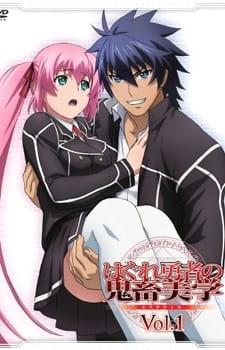
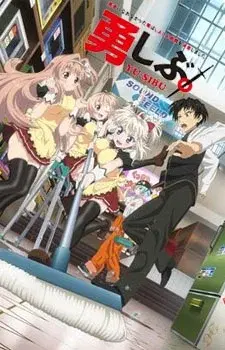
Aesthetica of a Rogue Hero
はぐれ勇者の鬼畜美学〈エステティカ〉 (Hagure Yuusha no Aesthetica)
- Action
- Ecchi
- Fantasy
- School
- Urban Fantasy
- Episodes
- 12
- Duration
- 24 min per ep
- Aired
- Jul 6, 2012 to Sep 21, 2012
- Status
- Finished Airing
Synopsis
Thirty years after the emergence of Samon Syndrome, countless youths have been drawn into fantasy realms; only a small number make it back, and the rare returnees often retain the extraordinary powers they gained beyond their world.
Akatsuki Ousawa—dubbed the “Rogue Hero”—leaves behind a quiet life in the land of Alayzard to return to Earth in search of new trials. He arrives with Miu, the daughter of the Demon King he defeated, and keeps her identity secret by presenting her as his younger sister. Before long, the pair enroll at Babel, a specialized academy for interdimensional travelers who’ve come home with magic and combat abilities.
Officially, Babel exists to educate these returnees and steer them toward a responsible future, yet its real agenda is difficult to read. As Akatsuki and Miu navigate their new lives, they find themselves at odds with a formidable, antagonistic student council—and with the lingering question of who is truly pulling the strings.
Otaku Consensus
Aesthetica of a Rogue Hero lands as a divisive but memorable 2012 ecchi-action fantasy: its strongest hook is Akatsuki’s aggressively capable lead energy, a direct antidote to the timid male protagonists that dominated many harem-school shows of the era. Rion Kujou’s brisk 12-episode TV pacing and Arms’ unapologetic fanservice-forward presentation keep it watchable for the target audience, while the most consistent criticism is that the ecchi machinery often crowds out the action-fantasy worldbuilding. Its reception numbers tell the story clearly: popular enough to remain visible at MAL popularity #580, but critically mid-tier with a 6.68 MAL score, 61/100 on AniList, and 6.8/10 on IMDb.
Why You Should Watch
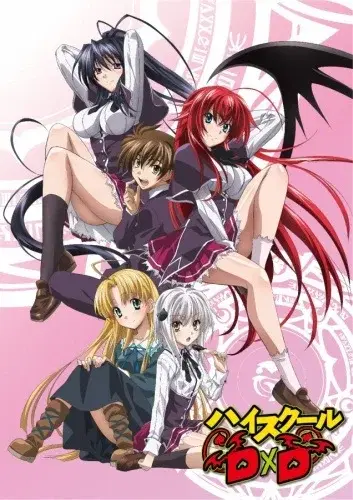
Watch Aesthetica of a Rogue Hero if you want a post-isekai power fantasy where the lead already acts like the final boss, not a nervous rookie waiting for permission to be cool. It scratches the same itch as High School DxD’s supernatural-school bravado, but with a sharper reverse-isekai angle: the interesting part is what happens after the fantasy adventure is supposedly over. The show is best for viewers who want magic-school politics, public displays of overwhelming power, and a male protagonist who treats intimidation as a social skill. It is not the pick for anyone looking for restraint; Arms builds the series around ecchi spectacle, nudity-heavy comedy, and confrontational harem energy. For fans of pre-boom isekai variants, its 2012 timing gives it a different flavor from later template-driven portal fantasies.
Key Characters
- AAkatsuki Ousawa
Akatsuki is the show’s main selling point for many fans: a deliberately cocky, physically dominant ecchi-action lead built to overwhelm situations instead of blushing through them.
- MMiu
Miu gives the series its emotional pressure point, balancing school-life cover comedy with the dangerous fantasy baggage that follows Akatsuki back into ordinary society.
What Makes It Stand Out
- 1
The series uses a post-returnee structure rather than a standard “getting summoned” isekai opening, making Earth’s response to fantasy-world survivors part of the genre hook. That angle predates the later isekai saturation wave and helps it feel closer to an urban-fantasy academy show than a pure portal adventure.
- 2
Its protagonist design is a specific genre correction: web reviews highlight the appeal for viewers tired of wimpy or excessively nice male leads. Akatsuki’s assertive personality is not incidental comedy; it is the engine behind the action, harem tension, and school confrontations.
- 3
Studio Arms’ production leans into the TV-MA/ecchi identity instead of hiding it behind the fantasy premise. AniList’s tag spread makes that emphasis explicit, with Nudity at 70%, Female Harem at 70%, Magic at 100%, and School at 93%.
- 4
The show’s genre mix is broader than a simple action-fantasy label suggests: AniList also tags it with Super Power at 76%, Isekai at 73%, Battle Royale at 60%, LGBTQ+ Themes at 53%, and Demons at 45%. That combination points to a school-combat series with multiple subgenre signals competing for space.
- 5
Its audience profile is unusually clear: MAL lists it at popularity #580 despite a rank of #6752, while AniList records 829 favourites alongside a 61/100 score. In other words, it is a remembered cult/ecchi title more than a broadly acclaimed one.
Fun Facts & Trivia
- Fun fact 1
- The anime is based on work by original creator Tetsuto Uesu, with original character designs credited to Tamago no Kimi. The TV adaptation was directed by Rion Kujou, with Ryuunosuke Kingetsu handling series composition.
- Fun fact 2
- Faylan performed the opening theme and is also credited with its lyrics, giving the OP a more direct performer-songwriter connection than many anisong credits. Aki Misato performed the ending theme.
- Fun fact 3
- The music is credited to MOKA☆, whose name is stylized with the star symbol in the staff listing. That distinctive credit is part of the show’s production identity alongside Arms’ studio branding.
- Fun fact 4
- Hidetoshi Takahashi directed episodes 4 and 9 and also storyboarded episode 9. That makes episode 9 a notable staff overlap point in the available production credits.
- Fun fact 5
- The core TV run was 12 episodes, airing from July 6, 2012 to September 21, 2012. IMDb labels the title as a 2012–2013 TV series and shows a larger episode-guide count, illustrating how database listings can fold in release-format differences beyond the main broadcast season.
Studios
- Arms