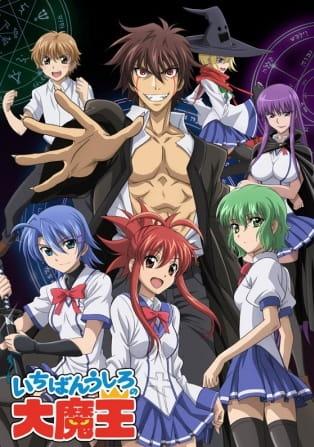
Demon King Daimao
いちばんうしろの大魔王 (Ichiban Ushiro no Daimaou)
- Action
- Comedy
- Ecchi
- Fantasy
- Romance
- Harem
- School
- Episodes
- 12
- Duration
- 23 min per ep
- Aired
- Apr 3, 2010 to Jun 19, 2010
- Status
- Finished Airing
Synopsis
Akuto Sai enrolls at Constant Magic Academy with hopes of using magic to improve the world. On his journey there, he meets Junko Hattori, a principled member of a ninja clan, and the two promise to work toward a better future together. That optimism is shaken the moment Akuto arrives: a prophecy declares he is destined to become the Demon King.
Rumors spread quickly, turning classmates and faculty wary, and even Junko begins to doubt him. Determined to live by his own choices, Akuto finds that every attempt to do the right thing only seems to confirm everyone’s fears. As his powers awaken, he’s pulled into a chaotic mix of school politics and romantic entanglements, surrounded by girls whose motives range from stopping him to falling for him—leaving Akuto to struggle against misfortune and prove that destiny doesn’t have the final say.
Otaku Consensus
Demon King Daimao earns its cult staying power as a brisk, shameless ecchi-action harem whose Artland production values, Takashi Watanabe direction, and unusually assertive male lead keep the early academy chaos livelier than its reputation suggests. Its 12-episode adaptation tries to sprint from school comedy into political, divine, and identity-scale conflict, giving it a bigger swing than a routine fan-service vehicle. The common complaint is consistent across fans and critics: the final stretch is abrupt and confusing, making the show easier to recommend as genre candy than as a satisfying fantasy narrative.
Why You Should Watch
Watch Demon King Daimao if you want a magic-school harem that refuses to keep its power fantasy polite. Its appeal is the collision of a non-wimpy lead, ninja-school discipline, deadpan android comedy, and 2010-era ecchi excess delivered in a tight 12-episode binge. It scratches the same itch as High School DxD for viewers who like shameless fan-service welded to supernatural fights, but it is shorter and more chaotic; it also has the classroom friction of The Familiar of Zero with less romantic patience and more escalation. The best audience is the harem-action fan who enjoys tsundere blowups, magic rankings, sudden swordplay, and tonal whiplash, but does not need a clean landing or careful lore unpacking.
Key Characters
- AAkuto Sai(VA: Takashi Kondou)
Akuto stands out in the harem field because viewers repeatedly note that he is not a passive, stammering lead; his intimidating presence turns romantic misunderstandings and school hostility into actual momentum.
- JJunko Hattori(VA: Youko Hikasa)
Junko is the show’s most divisive tsundere element, a disciplined Iga ninja and class representative whose rigid sense of honor makes her clashes with Akuto sharper than standard slapstick jealousy.
- KKorone(VA: Aoi Yuuki)
Korone supplies the kuudere counterweight to the louder harem comedy, using deadpan delivery and android detachment to make the show’s sexual humor feel more absurd than flirtatious.
- FFujiko Etou(VA: Shizuka Itou)
Fujiko gives the female cast a more calculating edge, functioning less like a simple admirer and more like someone whose agenda keeps the harem from becoming uniformly affectionate.
What Makes It Stand Out
- 1
Artland produced the series as a compact Spring 2010 TV run, and contemporary viewer commentary repeatedly singles out its stronger-than-expected production values for an ecchi harem title.
- 2
Takashi Watanabe is credited as both director and storyboard, and the show reflects that hands-on pacing: comedy beats, magic combat, swordplay, and fan-service interruptions often collide inside the same sequence rather than occupying separate modes.
- 3
Takao Yoshioka’s series composition is one of the show’s defining strengths and weaknesses: it compresses school politics, identity questions, and god-scale escalation into 12 episodes, creating momentum but also the abrupt ending most reviews criticize.
- 4
The AniList tag spread is unusually honest about the viewing experience: Magic and School sit above 80%, Female Harem is listed at 83%, while Nudity and Demons both register at 73%, making the mix of academy fantasy and erotic comedy explicit rather than incidental.
- 5
Tatsuya Katou’s music supports the tonal pile-up by treating the action-fantasy material seriously even when the surrounding scene is harem chaos, helping the series feel larger than a pure gag vehicle.
Fun Facts & Trivia
- Fun fact 1
- The anime credits Shoutarou Mizuki as original creator and Souichi Itou for original character design, while the TV character designs were handled by Toshimitsu Kobayashi and Miyabi Ozeki.
- Fun fact 2
- Toshimitsu Kobayashi also served as chief animation director, giving the adaptation a clear visual-control role beyond simply translating the original designs to television.
- Fun fact 3
- The sound side was led by Satoshi Motoyama as sound director, with music by Tatsuya Katou, a pairing that helped balance ecchi comedy timing with action-fantasy scoring.
- Fun fact 4
- Demon King Daimao aired from April 3 to June 19, 2010, fitting its entire run into a single 12-episode broadcast season rather than a split or extended cour.
- Fun fact 5
- Its database footprint is bigger than its average score suggests: it sits at 6.69 on MyAnimeList with over 318,000 votes and a popularity rank of 448, while AniList lists a 62/100 score and 980 favourites, marking it as a widely sampled but divisive genre title.
Studios
- Artland