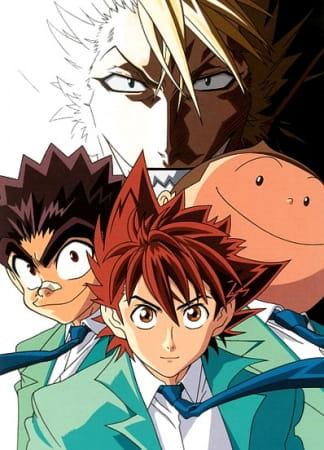
Eyeshield 21
アイシールド21
- Sports
- Team Sports
- Episodes
- 145
- Duration
- 23 min per ep
- Aired
- Apr 6, 2005 to Mar 19, 2008
- Status
- Finished Airing
Synopsis
Quiet and undersized, Deimon High student Sena Kobayakawa has spent years as an easy mark for bullies. Constantly being sent on errands, though, has left him unusually quick on his feet and adept at slipping through crowds. When sharp-witted Deimon Devil Bats captain Youichi Hiruma spots Sena’s lightning-fast sprint, he pressures the timid boy into joining the American football team.
To keep rival clubs from discovering his identity, Sena is made to play behind a mirrored visor as “Eyeshield 21,” the number 21 running back surrounded by rumors of impossible speed and alleged accomplishments in the United States at Notre Dame College. What began as a habit of running away from trouble becomes a strength on the field, as Sena grows into a crucial hidden asset and starts building confidence through his teammates and the connections he forms.
Otaku Consensus
Eyeshield 21 earns its reputation as a long-running sports shounen with sturdy team chemistry, loud comedy, and accessible American-football set pieces, helped by Gallop’s TV-friendly emphasis on momentum over technical realism. The verdict is positive but qualified: fans praise the character development and Hiruma-driven energy, while the most persistent criticism is that 145 episodes stretch the material and the anime is widely considered a weaker adaptation than Riichirou Inagaki and Yuusuke Murata’s manga.
Why You Should Watch
Watch Eyeshield 21 if you want a sports anime about turning misfits into a functioning unit, not a glossy pro-athlete fantasy. It scratches the same long-form club-growth itch as Haikyuu!! and Prince of Tennis, but with American football’s roles, formations, and one-play bursts giving each match a different rhythm from volleyball rallies or tennis duels. The series works best for viewers who enjoy shounen exaggeration, slapstick intimidation, and a cast that can be abrasive before it becomes lovable. It is also a strong pick if you know little about football and prefer learning through character stakes and repeated game situations rather than rulebook exposition. If your priority is a tight, prestige adaptation, read the manga; if you want a sprawling team-sports binge, the anime has real staying power.
Key Characters
- SSena Kobayakawa(VA: Miyu Irino)
Sena stands out as a sports protagonist built around evasion, hesitation, and incremental confidence rather than natural bravado, which makes his growth feel unusually tied to self-image.
- YYouichi Hiruma(VA: Atsushi Tamura)
Hiruma is the show’s most polarizing engine: fans celebrate his tactical cruelty and comic menace, while detractors often find the same relentless personality exhausting.
- MMamori Anezaki(VA: Aya Hirano)
Mamori functions as both emotional safeguard and source of friction, with her overprotectiveness becoming one of the character dynamics viewers debate most.
- RRyokan Kurita(VA: Kouichi Nagano)
Kurita is the cast’s gentle anchor, notable because even negative viewer reactions often single him out as the immediately likable presence.
What Makes It Stand Out
- 1
Studio Gallop produced a 145-episode adaptation that aired continuously from April 2005 to March 2008, giving the series a scale closer to classic weekly shounen than modern seasonal sports anime.
- 2
The anime’s reception is inseparable from its source-material debate: viewers often enjoy the TV version’s comedy and team energy, while manga readers frequently criticize it as a diminished version of Inagaki and Murata’s original.
- 3
Its American football focus remains unusual within mainstream sports anime, and discussion around the series often notes the tension between exciting match drama and weaker rule explanation for newcomers.
- 4
The tonal mix is unusually aggressive for a school sports series, with AniList tags highlighting delinquents, slapstick, bullying, and coming-of-age elements alongside team sports.
- 5
Kou Ootani handled the music, with Hiroki Matsuoka as sound director, giving the adaptation a dedicated sports-shounen soundscape across its lengthy broadcast run.
Fun Facts & Trivia
- Fun fact 1
- The original story was written by Riichirou Inagaki, who later became widely known for Dr. Stone, while the original character designs come from Yuusuke Murata, later famous for illustrating One Punch Man.
- Fun fact 2
- Aya Hirano is listed both as Mamori Anezaki’s voice actor and as a theme song performer for the anime, linking one of the main characters directly to the show’s music identity.
- Fun fact 3
- Shouko Nakagawa, a well-known anime-song performer and media personality, is also credited with theme song performance on the series.
- Fun fact 4
- The manga’s reputation is notably stronger in several critical circles: Pop Culture Shock’s Sam Kusek selected it as the best continuing manga series, and Comic Book Bin praised later volumes as one of the best shounen titles out there.
- Fun fact 5
- Across database reception, the anime sits in solid-positive territory rather than cult-only obscurity, with a MAL score of 7.91 from 93,734 votes and an AniList score of 76/100.
Studios
- Gallop