God Eater
GOD EATER
- Action
- Fantasy
- Sci-Fi
- Military
- Episodes
- 13
- Duration
- 23 min per ep
- Aired
- Jul 12, 2015 to Mar 26, 2016
- Status
- Finished Airing
Synopsis
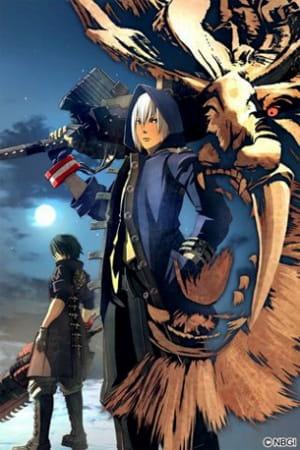
In 2071, humanity teeters on the edge of collapse after the rise of the Aragami—ravenous creatures that shrug off conventional weapons and leave devastation in their wake. As the world is consumed, the organization Fenrir becomes a last line of defense, deploying “God Eaters”: humans infused with Oracle cells who can wield the God Arc, the only weapon known to bring down an Aragami.
Among them is Lenka Utsugi, a New-Type God Eater whose God Arc can shift between blade and gun. Thrown into Fenrir’s fight for survival, Lenka must learn to master his power while Aragami continue to multiply and the remaining pockets of humanity cling to life, with only God Eaters standing between them and extinction.
Otaku Consensus
God Eater is a divisive but visually distinctive game adaptation: ufotable's direction, Kentarou Waki's photography, and Gou Shiina's music give its monster-hunting sorties a premium, apocalyptic weight that many viewers remember more vividly than the narrative. Its strongest editorial choice is giving a voice and dramatic spine to material that originated with a silent player stand-in, but the common criticism is real: the plot is familiar, the early pacing is slow for a 13-episode run, and the action does not land for everyone.
Why You Should Watch
Watch God Eater if you want a compact, grim military survival anime built around massive weapons, hostile terrain, and a thick sense of extinction pressure without committing to a long-running franchise. It scratches a similar itch to Attack on Titan's desperate expedition energy and ufotable's Fate-era digital polish, but with a more overt video-game structure: squads, specialized roles, weapon transformations, and boss-like encounters. The main draw is not narrative novelty; it is the audiovisual assault of ufotable's 2D/3D compositing, Gou Shiina's choral and percussive score, and a cast framed through multiple battlefield perspectives. Viewers who value atmosphere, production texture, and adaptation craft over intricate plotting will get the most out of it.
Key Characters
- RRindou Amamiya(VA: Hiroaki Hirata)
Rindou is the veteran presence fans tend to latch onto: relaxed in tone, sharp in crisis, and useful as the series' measure of what long-term combat does to a professional.
- AAlisa Illinichina Amiella(VA: Maaya Sakamoto)
Alisa brings the show's most immediately striking character energy, combining elite New-Type capability with a brittle emotional edge that makes her more than a standard ace pilot archetype.
- SSouma Schicksal(VA: Kazuya Nakai)
Souma stands out as the brooding specialist of the squad, the kind of character whose silence and hostility invite viewers to read the institutional damage behind his role.
- SSakuya Tachibana(VA: Sayaka Ohara)
Sakuya gives the ensemble a composed tactical counterweight, often functioning as the steadier adult presence amid younger, more volatile fighters.
What Makes It Stand Out
- 1
ufotable gives the series a heavy 2D/3D hybrid look, with CGI prominent enough that AniList tags it at 75% CGI and 51% Full CGI; the result is closer to a stylized game-cinematic aesthetic than conventional TV action animation.
- 2
Gou Shiina's score is a major part of the show's identity, using spine-tingling orchestral and vocal intensity to sell scale even when viewers are split on the writing.
- 3
The adaptation tackles a difficult source-material problem: the original game used a silent player stand-in, while the anime reshapes that role into a defined protagonist with a clearer dramatic function.
- 4
The series has an unusually stretched broadcast footprint for a 13-episode TV anime, airing from July 2015 to March 2016, which helps explain why its pacing and release experience became part of its reputation.
- 5
Its reception is unusually polarized for a popular title: MAL lists it at 7.18 from over 267,000 votes and #439 in popularity, while fan commentary ranges from praise for its adaptation and audiovisual craft to blunt complaints about dull plotting.
Fun Facts & Trivia
- Fun fact 1
- Takayuki Hirao is credited not only as director but also as sound director, giving the series a notable degree of centralized control over both staging and audio presentation.
- Fun fact 2
- Kentarou Waki served as Director of Photography, a key role for a show so dependent on compositing 2D characters, 3D elements, lighting, and post-processing into a unified ufotable finish.
- Fun fact 3
- The opening theme was performed by OLDCODEX, while insert songs were performed by GHOST ORACLE DRIVE, reinforcing the show's heavier, performance-driven sound profile.
- Fun fact 4
- Takuya Nonaka directed episodes 4, 6, 9, and 11, making him one of the recurring episode directors across the back half of the production.
- Fun fact 5
- The ending sequence was storyboarded by Yuka Shibata, while episode-specific animation credits include Masato Nagamori as animation director on episode 4 and Miyako Yatsu on key animation for episode 7.
Studios
- ufotable