Deca-Dence
デカダンス
- Action
- Adventure
- Sci-Fi
- Mecha
- Military
- Psychological
- Survival
- Episodes
- 12
- Duration
- 23 min per ep
- Aired
- Jul 8, 2020 to Sep 23, 2020
- Status
- Finished Airing
Synopsis
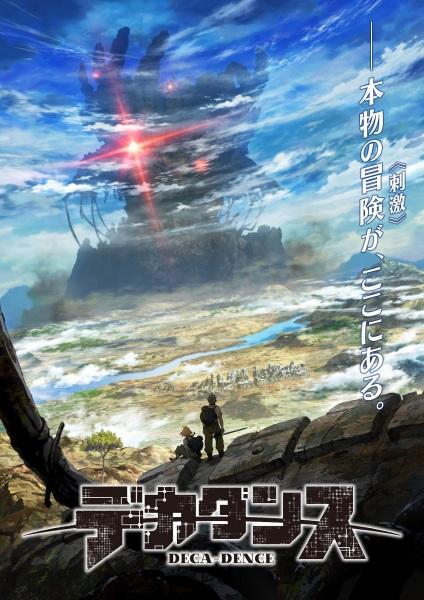
In the distant future, humanity is pushed to the brink by the sudden emergence of monstrous lifeforms called Gadoll. The remaining survivors live within Deca-Dence, a colossal mobile fortress: the lower “Tank” district houses civilians who support the war effort, while the upper levels are home to the Gears, fighters who venture outside as part of the Power. Natsume, a determined Tanker with a prosthetic right arm, refuses to accept a life on the sidelines and dreams of joining the front lines alongside the Gears.
Her application to enlist stalls even as those around her receive their assigned roles, leaving her to take work as a cleaner for an armor repair unit. There she’s placed under Kaburagi, a blunt, seemingly indifferent leader who appears to be hiding more than he shows. As their uneasy partnership develops, Kaburagi begins to see how Natsume’s drive could disrupt the world’s rigid order—and starts preparing her for a role that could change everything.
Otaku Consensus
Deca-Dence landed as a solidly liked original rather than a consensus classic, with its 7.35 MAL score and 71/100 AniList score reflecting admiration for Yuzuru Tachikawa’s brisk direction, Studio Nut’s hybrid action staging, and the series’ willingness to mutate its genre identity early. Its sharpest asset is the Natsume-Kaburagi pairing inside a 12-episode structure that keeps revealing new rules; the most common drawback is that the final act compresses worldbuilding and emotional payoff faster than its most intriguing ideas deserve.
Why You Should Watch
Watch Deca-Dence if you want Attack on Titan-scale desperation without a multi-season commitment, and if you like action anime that interrogates systems rather than simply escalating battles. Yuzuru Tachikawa’s direction gives the series the snap associated with Mob Psycho 100—fast pivots, expressive bodies, and tonal swerves—while Hiroshi Seko’s scripting keeps the 12-episode run moving like a pressure test. It scratches the Gurren Lagann itch for scrappy rebellion and absurd machinery, but the more distinctive hook is its corporate-game satire: heroism is treated as a managed product, not a destiny. Viewers who enjoy original anime that take one risky structural swing early and commit to it will get more out of Deca-Dence than those looking for lore-heavy military realism.
Key Characters
- NNatsume
Natsume stands out because her optimism is not written as innocence; it becomes a form of resistance against a world that has already filed her under the wrong category.
- KKaburagi
Kaburagi is the series’ dry, guarded counterweight, a mentor figure whose exhaustion makes his gradual investment in Natsume feel sharper than a conventional heroic speech would.
What Makes It Stand Out
- 1
Deca-Dence is an anime-original TV series from Studio Nut, so its best-known early structural pivot was not inherited from a manga or light novel cliffhanger. That gives the 12-episode run a self-contained shape built around surprise rather than adaptation coverage.
- 2
The director-series composition pairing is a major part of its identity: Yuzuru Tachikawa brings the elastic, high-velocity sensibility associated with his work on Mob Psycho 100, while Hiroshi Seko’s composition keeps the rules of the setting constantly tightening.
- 3
The visual pipeline is unusually well-defined in the credits: pomodorosa provided the original character designs, Shinichi Kurita adapted them for animation, and Fuminori Tsukida and Hiyori Denforword Akishino are credited on prop design. That matters in a show where bodies, tools, and industrial machinery all signal social function.
- 4
Its action identity is not pure hand-drawn spectacle; AniList’s CGI tag at 60% reflects how the series uses CG and mechanical staging for scale while preserving 2D character acting for its human friction.
- 5
The tonal mix is stranger than the military-mecha label suggests: AniList tags it not only as Dystopian, Post-Apocalyptic, Kaiju, and Cyborg, but also as Satire and Slapstick. That collision is why the show can move from survival tension to bureaucratic absurdity without becoming a different anime.
Fun Facts & Trivia
- Fun fact 1
- Deca-Dence aired from July 8 to September 23, 2020, making it a compact Summer 2020 original rather than part of a longer franchise rollout.
- Fun fact 2
- The production credits split design duties across several specialists: pomodorosa handled original character design, Shinichi Kurita handled character design, Hiromi Taniguchi and Ai Ogata handled sub character design, and Fuminori Tsukida and Hiyori Denforword Akishino handled prop design.
- Fun fact 3
- Hiyori Denforword Akishino appears twice in the key staff list, credited for both prop design and design assistance, which underlines how much of Deca-Dence’s identity is carried by objects, equipment, and machinery rather than costumes alone.
- Fun fact 4
- The show’s database footprint is stronger in visibility than acclaim: it sits at MAL popularity #862 with 145,855 votes, while its rank of #2844 and AniList score of 71/100 point to a well-known but not universally embraced original.
- Fun fact 5
- Its strongest AniList identity markers are not the broad genres of Action or Sci-Fi, but Dystopian at 91%, Post-Apocalyptic at 90%, Kaiju at 84%, and Cyborg at 84%, which accurately captures the show’s layered genre construction.
Studios
- Nut