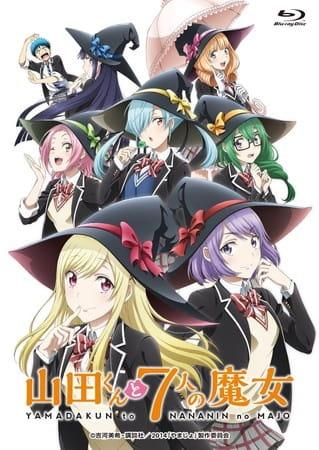
Yamada-kun and the Seven Witches
山田くんと7人の魔女 (Yamada-kun to 7-nin no Majo)
- Comedy
- Mystery
- Romance
- Supernatural
- Harem
- School
- Episodes
- 12
- Duration
- 24 min per ep
- Aired
- Apr 12, 2015 to Jun 28, 2015
- Status
- Finished Airing
Synopsis
Ryuu Yamada enrolls at Suzaku High hoping to leave behind his reputation as a violent delinquent and start fresh. By his second year, that resolve has faded—he’s back to skipping effort, pulling terrible grades, and landing in fights, bored with the routine of school life.
After another trip to the staff office, Ryuu runs into Urara Shiraishi, a top student known for her beauty and perfect record. A slip on the stairs leads to an accidental kiss, and the two discover a strange consequence: kissing causes them to swap bodies, a talent that quickly becomes as inconvenient as it is useful.
Their secret draws the attention of Toranosuke Miyamura, a student council officer and the lone member of the Supernatural Studies Club, who pulls them into his investigation. With the arrival of the occult-obsessed Miyabi Itou, the club begins digging into a campus rumor about the Seven Witches of Suzaku High—seven girls with different kiss-activated powers—and sets out to uncover who they are.
Otaku Consensus
Yamada-kun and the Seven Witches earns its 7.52 MAL score and 73/100 AniList rating by turning what looks like a stock harem setup into a brisk supernatural school mystery with real comic timing. Critics and fan reviewers consistently single out the body-swap performances, Seiki Takuno’s light touch, and the adaptation’s refusal to become shallow fanservice as its biggest wins. Its most common limitation is scale: at 12 episodes, the show stays featherweight and sometimes favors fast romantic-farce momentum over deeper supernatural worldbuilding.
Why You Should Watch
Watch Yamada-kun and the Seven Witches if you want a school rom-com that has harem energy without surrendering to empty wish fulfillment. It scratches the same itch as Kokoro Connect’s identity-swapping character comedy, but with a lighter shounen rhythm and more kiss-powered chaos; it also has the club-room investigation flavor that makes school-supernatural series easy to binge. The appeal is in how practical the jokes are: voice actors and animators get to play characters performing each other, social status gets scrambled, and romance develops through embarrassment, strategy, and accidental intimacy rather than melodramatic speeches. If you like urban-fantasy rules applied to everyday school politics, this is a compact Spring 2015 binge with very little downtime.
Key Characters
- RRyuu Yamada(VA: Ryota Osaka)
Ryuu works because he is not a polished romantic lead but a blunt delinquent type whose best comic moments come from being forced into social intelligence he never wanted to learn.
- UUrara Shiraishi(VA: Saori Hayami)
Urara is the series’ emotional anchor, using the “perfect honor student” image less as a cliché than as a pressure point the comedy keeps poking.
- TToranosuke Miyamura(VA: Toshiki Masuda)
Miyamura gives the show its schemer energy, turning the Supernatural Studies Club into both a detective unit and a social laboratory.
- MMiyabi Itou(VA: Maaya Uchida)
Miyabi’s occult obsession makes her the audience’s genre-savvy stand-in, the character most likely to treat school rumors like an investigation board.
What Makes It Stand Out
- 1
LIDENFILMS leans into performance comedy rather than spectacle: the body-swapping scenes depend on posture, timing, and voice-actor mimicry, a point repeatedly praised in reviews.
- 2
The series is structurally tighter than its harem-looking title suggests, using the Seven Witches rumor as a mystery framework instead of simply adding girls to the cast at random.
- 3
Its genre mix is unusually balanced for a 12-episode rom-com: AniList tags it as Witch at 94%, Body Swapping at 92%, School Club at 81%, and Urban Fantasy at 73%, which matches how central the supernatural rules are to the comedy.
- 4
The romance avoids becoming a detached side dish; the show’s best jokes often double as relationship tests, so the comedy and romantic tension are produced by the same supernatural mechanic.
- 5
Despite the Mixed Gender Harem tag at 57%, the series is frequently received as a harem subversion because the core dynamic is built around cooperation, investigation, and embarrassment rather than a passive protagonist collecting affection.
Fun Facts & Trivia
- Fun fact 1
- The anime adapts Miki Yoshikawa’s manga and aired as a single-cour Spring 2015 TV series from April 12 to June 28, finishing in 12 episodes.
- Fun fact 2
- Seiki Takuno directed the series, with Fumiaki Usui as assistant director; the clean romantic-comedy pacing is one reason reviewers describe it as light, fast, and easy to binge.
- Fun fact 3
- Character design was handled by Eriko Iida, with Eriko Itou credited for sub-character design, an important division for a cast built around many visually distinct school figures.
- Fun fact 4
- The visual staff list is unusually complete for a rom-com page: Toshiyuki Tokuda served as art director, Hiroshi Izumi handled art design, Hitomi Ikeda handled color design, Toyotoku Yamada directed photography, and Kiyoshi Hirose edited the series.
- Fun fact 5
- Its audience footprint is larger than its rank suggests: MAL lists it at #256 in popularity with 480,019 votes, while AniList records 3,210 favourites.
Studios
- LIDENFILMS