The World God Only Knows
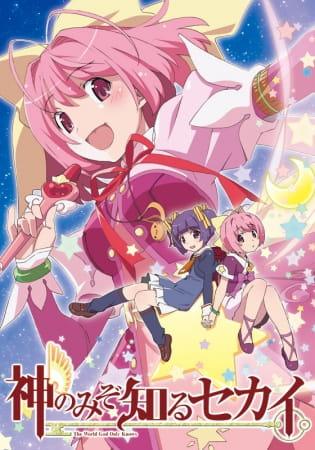
神のみぞ知るセカイ (Kami nomi zo Shiru Sekai)
- Comedy
- Romance
- Supernatural
- Harem
- Otaku Culture
- School
- Episodes
- 12
- Duration
- 23 min per ep
- Aired
- Oct 7, 2010 to Dec 23, 2010
- Status
- Finished Airing
Synopsis
Keima Katsuragi is celebrated online as the “God of Conquest,” a master of winning hearts—so long as they belong to heroines in dating sim games. Offscreen, he’s a devoted galge otaku who prefers the certainty of two-dimensional romance to the messiness of real life.
After smugly accepting an anonymous challenge, Keima is tricked into partnering with Elucia “Elsie” de Lute Ima, an earnest little demon tasked with recapturing escaped evil spirits now hiding among humans. The catch: the only way to draw them out is for Keima to do what he avoids at all costs—successfully “conquer” real girls. Bound to Elsie by a lethal collar, he’s forced to apply his game-honed strategies to unpredictable, three-dimensional hearts, putting his reputation to a far more daunting test.
Otaku Consensus
The World God Only Knows earns its reputation through Masato Takayanagi’s brisk direction and Hideyuki Kurata’s clean adaptation structure, turning Tamiki Wakaki’s dating-sim satire into a sharp episodic comedy rather than a routine harem setup. Fans and critics most consistently praise the first two seasons for their character dynamics and meta humor, while the later Goddess Arc is often singled out for using the expanded cast with stronger emotional momentum. The common criticism is real: the convenient reset structure keeps the show agile, but it also delays lasting progress and makes some viewers feel the formula before the payoff arrives.
Why You Should Watch
Watch this if you want a harem comedy that understands dating-sim grammar instead of merely borrowing its character types. The pleasure is in seeing romance tropes treated like software: flags, routes, bad ends, archetype recognition, and the gap between clean game logic and messy human behavior. It scratches some of the same otaku-culture itch as Saekano, but with more slapstick propulsion, and it has the school-comedy rhythm of something like School Rumble without relying on endless misunderstanding loops. Manglobe keeps the first season lean at 12 episodes, so each segment functions like a compact genre riff rather than another name added to a love polygon. If you want meta jokes, otaku self-mockery, and fast character-driven comedy without heavy melodrama, this is one of the cleaner 2010s entries in the lane.
Key Characters
- KKeima Katsuragi
Keima stands out because fans read him less as wish-fulfillment and more as a deadpan systems analyst who treats romance flags, routes, and genre conventions like hard data.
- EElucia “Elsie” de Lute Ima
Elsie’s appeal comes from how her earnest incompetence turns supernatural exposition into slapstick and prevents the series from becoming a pure strategy monologue.
What Makes It Stand Out
- 1
Manglobe’s 12-episode first season uses a tight episodic format, matching the AniList emphasis on Episodic, Meta, Parody, and Otaku Culture rather than building a conventional serialized romance from the start.
- 2
Series composer Hideyuki Kurata structures the adaptation so each girl’s segment works like a separate dating-sim route, a choice critics credit for keeping the pacing clean even when they criticize the convenience of the reset mechanic.
- 3
The show’s comedy is unusually specific about galge logic: it mines routes, flags, archetypes, and player mentality as the actual joke engine, not just background decoration for an otaku protagonist.
- 4
Hayato Matsuo handles the music, while the theme-song roster in the production data includes ELISA, Hiro Shimono, Ayana Taketatsu, and Aoi Yuuki, giving the anime a stronger musical identity than many comparable school harem comedies.
- 5
Its franchise reception has a clear contour: the first two seasons are widely remembered for humor and character dynamics, while the Goddess Arc is frequently praised for brisk pacing and better use of the larger cast.
Fun Facts & Trivia
- Fun fact 1
- The anime adapts Tamiki Wakaki’s manga and was produced by Manglobe, airing as a 12-episode Fall 2010 TV series from October 7 to December 23.
- Fun fact 2
- AniList’s highest tags for the series are Video Games and Episodic at 74%, followed closely by Meta at 72% and Parody and Otaku Culture at 71%, which accurately reflects why the show is discussed as a genre commentary rather than a plain harem comedy.
- Fun fact 3
- A recurring critical note is that the post-conquest reset is both the show’s biggest shortcut and one of its smartest pacing tools: it avoids juggling too many romantic consequences while letting selected characters reappear later.
- Fun fact 4
- Despite being a niche-sounding galge parody, it has broad database reach, with a MAL popularity rank of #371 and more than 348,000 MAL score votes attached to its 7.63 rating.
- Fun fact 5
- The series’ later discussion often centers on contrast: some viewers felt the second season dipped, while other reviewers highlight the Goddess Arc as a stronger, more compulsively watchable continuation.
Studios
- Manglobe