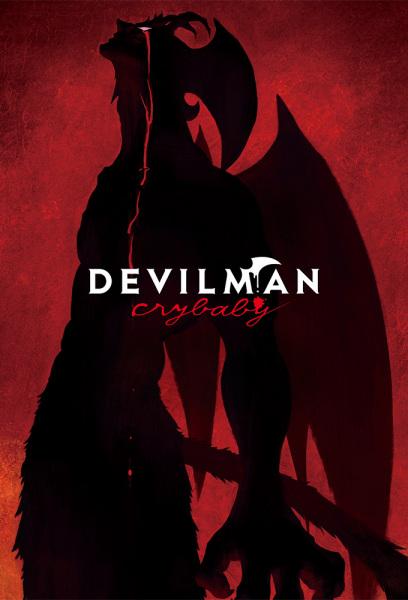
Devilman: Crybaby
DEVILMAN crybaby
- Action
- Avant Garde
- Horror
- Supernatural
- Gore
- Mythology
- Episodes
- 10
- Duration
- 24 min per ep
- Aired
- Jan 5, 2018
- Status
- Finished Airing
Synopsis
Devils can only exist in the human world by taking over a living body. Yet when a person’s will proves stronger than the invading demon, they can seize that power for themselves—becoming a Devilman.
Gentle and unassuming, Akira Fudou has always been unable to ignore someone in pain. When his childhood friend Ryou Asuka asks him to help expose the truth about devils, Akira agrees without question. Their search leads them to Sabbath, a lawless gathering where indulgence turns to carnage as demons possess partygoers, twisting them into grotesque monsters. In the chaos, Akira merges with the devil Amon to save Ryou, emerging as a Devilman with the strength to fight back.
The transformation grants Akira terrifying power, along with a primal hunger he struggles to contain. Still driven by the same soft-hearted compassion, he joins Ryou in battling demons that threaten humanity and the people he cares about.
Otaku Consensus
Masaaki Yuasa and Science SARU deliver the rare legacy adaptation that feels both faithful to Gou Nagai’s manga and unmistakably contemporary, with elastic direction, ruthless pacing, and a finale fans repeatedly single out as emotionally devastating. Its 10-episode compression gives the series a feverish force, but the same speed and its graphic mix of gore, nudity, and sexualized violence remain the most common barrier for viewers who want cleaner horror or more breathing room.
Why You Should Watch
Watch Devilman: Crybaby if you want apocalyptic horror with no shounen safety rails: bodies distort, desire turns predatory, and compassion is treated as something dangerous rather than soft. It scratches a similar itch to The End of Evangelion’s emotional annihilation and Berserk’s flesh-and-faith brutality, but filtered through Masaaki Yuasa’s loose, kinetic animation instead of polished heroic spectacle. The appeal is not just shock value; the series uses its psychosexual body horror, demonic mythology, and urban panic to ask whether humanity’s worst impulses need monsters as an excuse. If you want a complete, 10-episode descent that hits like an album played too loud in one sitting, this is one of Netflix-era anime’s defining gut punches.
Key Characters
- RRyou Asuka(VA: Ayumu Murase)
Ryou fascinates fans as the ice-cold counterweight to Akira, a character whose certainty and charisma make every moral compromise feel dangerously persuasive.
- AAkira Fudou(VA: Kouki Uchiyama)
Akira is memorable because his sensitivity is not erased by horror; the series keeps testing whether empathy can survive when the body itself becomes violent.
- DDevilman(VA: Kouki Uchiyama)
Devilman works as more than a power-up identity, giving Kouki Uchiyama space to play the clash between human grief and monstrous appetite in the same voice.
What Makes It Stand Out
- 1
Science SARU’s animation leans into distortion rather than model-perfect polish, making transformations feel wet, elastic, and unstable in a way that suits the Body Horror and Shapeshifting tags.
- 2
The series condenses Gou Nagai’s original Devilman material into 10 episodes, creating a hard acceleration from urban fantasy violence into cosmic horror and war-scale despair.
- 3
Masaaki Yuasa’s direction makes motion a form of psychology: running, dancing, fighting, and collapsing bodies are used to communicate panic and desire as much as action choreography.
- 4
Its mature content is unusually central to the text rather than decorative; the violence often has a sexual charge, which is why parental guides and reviews consistently flag it as adult-only material.
- 5
The ending has a distinct reputation among viewers as a tear-down-the-room finale, frequently cited in fan reactions as the point where the show’s brutality turns into grief rather than spectacle.
Fun Facts & Trivia
- Fun fact 1
- Devilman: Crybaby is a modern adaptation of Gou Nagai’s Devilman, a source work influential enough that many reviews judge the 2018 version by how well it preserves the manga’s tone rather than by premise alone.
- Fun fact 2
- The production pairs director Masaaki Yuasa with Science SARU, with Ayumi Kurashima on character design, Ryou Kouno as art director, and Mika Nakajima handling art design.
- Fun fact 3
- Akira Fudou and Devilman are both credited to Kouki Uchiyama in the Japanese cast data, reinforcing the series’ interest in identity as something split but not cleanly separated.
- Fun fact 4
- Its audience footprint is unusually large for such abrasive material: the research data lists a MAL popularity rank of 127, over 770,000 MAL votes, and 16,420 AniList favourites.
- Fun fact 5
- The show’s tag profile on AniList is unusually explicit about its tonal recipe, with Demons, Psychosexual, Body Horror, Gore, Cosmic Horror, Philosophy, War, and Mythology all appearing among its strongest descriptors.
Studios
- Science SARU