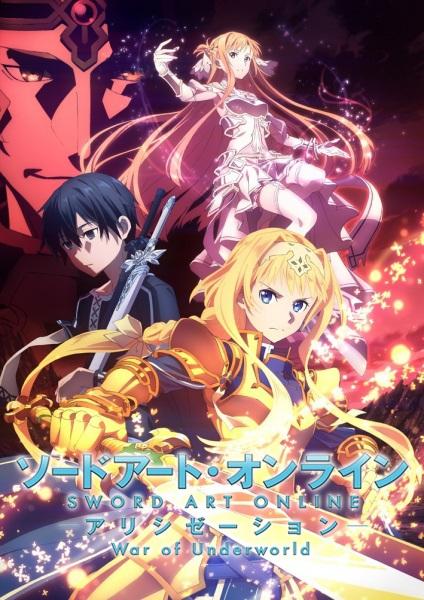
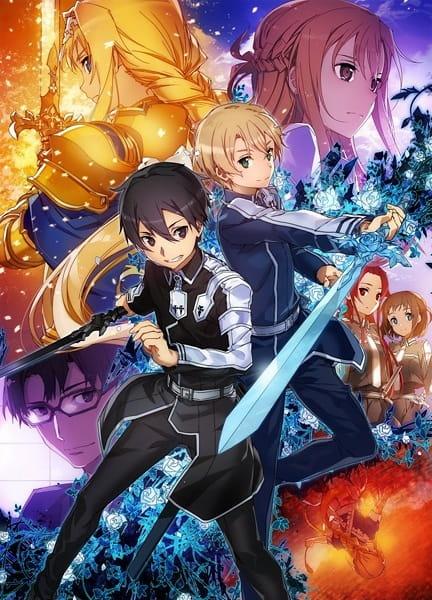
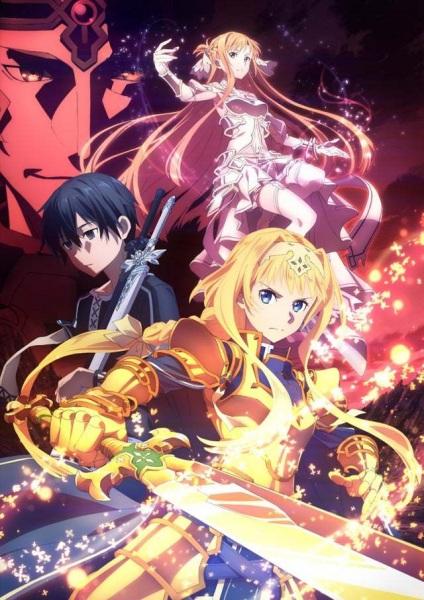
Sword Art Online: Alicization
ソードアート・オンライン アリシゼーション
- Action
- Adventure
- Fantasy
- Video Game
- Episodes
- 24
- Duration
- 24 min per ep
- Aired
- Oct 7, 2018 to Mar 31, 2019
- Status
- Finished Airing
Synopsis
Rath’s experimental full-dive system, the Soul Translator, doesn’t just feed signals to the brain—it interfaces directly with a person’s Fluctlight, a technological stand-in for the human soul. To refine the project, the institute recruits Sword Art Online survivor Kazuto Kirigaya as a part-time tester, sending him into the Underworld, a vast fantasy realm created through the device. Bound by strict confidentiality, any experiences he gains there are meant to be erased upon returning, leaving only a faint, unsettling trace of one name: Alice.
After walking Asuna Yuuki home one night, Kazuto and Asuna run into a familiar enemy, and the confrontation leaves Kazuto gravely injured. He awakens to find himself fully immersed in the Underworld—and unable to log out—forcing him to press forward through its world in search of a way back to reality.
Otaku Consensus
Sword Art Online: Alicization is the franchise’s most credible rebound point, with Manabu Ono’s direction, steadier long-form pacing, and a more thematic adaptation of the Alicization material convincing many lapsed viewers that SAO could be watched “unironically” again. Its strongest reputation rests on the way the arc treats artificial intelligence, identity, and social hierarchy as more than game mechanics, while A-1 Pictures gives the swordplay a cleaner, more prestige-TV finish than the series’ weaker stretches. The recurring criticism is not that it lacks ambition, but that its 24-episode run still hits tepid lows where melodrama and uneven writing blunt an otherwise stronger season.
Why You Should Watch
Watch Alicization if you want SAO with its power-fantasy dialed down and its philosophical machinery turned up: less “clear the game,” more questions about personhood, hierarchy, memory, and whether a virtual society deserves moral weight. It scratches some of the same itch as Log Horizon’s systems-minded worldbuilding and Fate/stay night’s polished duel spectacle, but keeps SAO’s speed, romantic loyalty, and sword-forward identity intact. Viewers who bounced off earlier arcs may find this the rare sequel season that feels like a course correction rather than an apology tour. The 24-episode structure gives the setting room to breathe, and the mix of virtual-world sci-fi, medieval fantasy, AI ethics, and class tension makes it one of the franchise’s densest entries.
Key Characters
- KKazuto Kirigaya
Alicization makes Kazuto more interesting by testing him through memory, dependency, and moral uncertainty rather than relying only on his reputation as SAO’s unbeatable swordsman.
- AAsuna Yuuki
Asuna remains the emotional anchor for viewers invested in the franchise’s real-world consequences, giving the season a thread of intimacy amid its heavier sci-fi framework.
- AAlice
Alice became one of Alicization’s defining figures because the season ties her name to its central questions about artificial life, obedience, and selfhood without treating her as just another quest objective.
What Makes It Stand Out
- 1
A-1 Pictures produced the season as a 24-episode, two-cour TV run from October 7, 2018 to March 31, 2019, giving the Alicization material more continuous breathing room than a single-cour adaptation would allow.
- 2
The production lists three character designers, Shingo Adachi, Gou Suzuki, and Tomoya Nishiguchi, alongside original character designs by BUNBUN; that split reflects how visually broad this arc is compared with the franchise’s more narrowly game-interface-driven material.
- 3
The tag profile is unusually dense for a mainstream action-fantasy sequel: Virtual World at 99%, Artificial Intelligence at 85%, Isekai at 83%, Class Struggle at 79%, and Medieval at 79%, with Time Manipulation, Gore, and Nudity all registering as notable secondary elements.
- 4
Critical discussion often singles out this season as an improvement over earlier SAO entries because the pacing, character writing, and thematic focus feel more deliberate, even among reviewers who still object to the franchise’s familiar lows.
- 5
Its reception numbers show a sharp divide between reach and critical placement: a 7.58 MAL score from 680,165 votes and #150 popularity indicate massive engagement, while its #1863 rank and AniList 75/100 score point to approval without full consensus.
Fun Facts & Trivia
- Fun fact 1
- The series credits Reki Kawahara for the original story and BUNBUN for the original character designs, preserving the light-novel creative pairing at the foundation of the adaptation.
- Fun fact 2
- Manabu Ono directed the season with Takashi Sakuma as assistant director; Ono’s involvement is central to why many reviews frame Alicization as a more disciplined and thematically focused SAO entry.
- Fun fact 3
- The production even separates prop design between Asami Hayakawa and Kiminori Itou, a useful clue to how much this arc depends on tangible fantasy-world objects rather than only digital UI iconography.
- Fun fact 4
- Yukako Ogawa served as art director, an important staff role for a season whose appeal rests heavily on making the Underworld feel like a lived-in medieval society rather than a generic game map.
- Fun fact 5
- AniList records 7,699 favourites for Alicization, showing that the season produced a dedicated fanbase even while broader review summaries remained mixed about its worst dramatic beats.
Studios
- A-1 Pictures