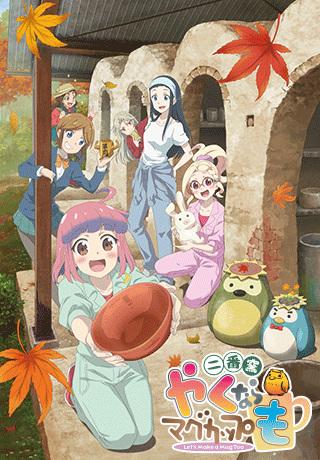
Let's Make a Mug Too
やくならマグカップも (Yaku nara Mug Cup mo)
- Slice of Life
- CGDCT
- Iyashikei
- School
- Visual Arts
- Episodes
- 12
- Duration
- 14 min per ep
- Aired
- Apr 3, 2021 to Jun 21, 2021
- Status
- Finished Airing
Synopsis
Tajimi is famous for its Mino ware pottery—and for being the place where Himeno Toyokawa’s mother once lived. Revered as a remarkable potter, her mother died suddenly when Himeno was four, yet her presence still lingers in the many distinctive mugs now displayed at the Toyokawas’ new restaurant in Tajimi.
After her father’s Tokyo business goes bankrupt, Himeno returns to the city and starts high school, bringing a few of her mother’s mugs in hopes of connecting with classmates. Her quiet gesture catches the attention of Mika Kukuri, an offbeat girl who introduces her to Tooko Aoki, the Pottery Club’s president. Learning about her mother’s ties to the club and the craft, Himeno asks to join—and with her father’s support, steps into the club alongside Mika and Mika’s childhood friend, Naoko Naruse, to carry on that legacy while finding her own relationship with pottery.
Otaku Consensus
Jun Kamiya’s restrained direction and the brisk half-length pacing turn pottery practice into a soothing, tactile viewing experience, with glazed ceramics receiving more visual attention than the otherwise basic character animation. The series earns goodwill through its sincere treatment of creativity and inherited expectations, but its idealized, nearly frictionless cast leaves the comedy and character development too mild for viewers seeking a more dynamic CGDCT ensemble.
Why You Should Watch
If you want a restorative school-club anime without romantic complications, loud conflict, or marathon-length episodes, Let’s Make a Mug Too offers a compact introduction to the patience and self-criticism involved in making ceramics. Its strongest images are not flashy character cuts but the distinctive shapes, reflective glazes, and small imperfections of finished pieces. The atmosphere scratches the same low-pressure itch as Yuru Camp, while its attention to tools and process gives it the practical appeal of a craft demonstration. The half-length format keeps the educational material approachable, and the unusually kind social environment makes it easy to use as a late-night comfort watch. Come for a specific regional art form rather than rapid-fire comedy: the emotional reward lies in watching creative confidence emerge through repetition, experimentation, and the acceptance that handmade work need not be perfect.
Key Characters
- HHimeno Toyokawa(VA: Minami Tanaka)
Himeno gives the series its subdued emotional weight, approaching creativity with enough uncertainty and self-scrutiny to keep the craft from feeling like a simple tourism showcase.
- MMika Kukuri(VA: Yuu Serizawa)
Mika supplies the ensemble’s eccentric comic energy, preventing the otherwise placid club dynamic from settling entirely into instructional calm.
- TTooko Aoki(VA: Rina Honizumi)
As the club president, Tooko functions as the group’s technical center and embodies the disciplined side of pottery that balances Mika’s spontaneity.
- NNaoko Naruse(VA: Yuuki Wakai)
Naoko’s grounded presence gives the core group a useful conversational counterweight to its more craft-obsessed personalities.
What Makes It Stand Out
- 1
The first season consists of 12 half-length episodes, making its lessons on ceramic work and its low-stakes club scenes considerably brisker than a standard full-length iyashikei series.
- 2
Nippon Animation keeps the character art deliberately simple while placing conspicuous visual emphasis on individual ceramic pieces; early critical impressions specifically praised the unique forms and luminous glaze effects.
- 3
Director Jun Kamiya and series composer Naruhisa Arakawa maintain an unusually low-friction tone in which mentorship, experimentation, and creative anxiety replace conventional interpersonal drama.
- 4
Prop designer Reiki Taki is separately credited from character designer Ayano Yoshioka, reflecting a production structure that treats mugs, bowls, and workshop objects as important designed elements rather than interchangeable background props.
- 5
Tomoki Hasegawa’s music supports the show’s iyashikei rhythm rather than pushing for melodrama, matching sound director Takumi Itou’s restrained treatment of its friendly, idealized environment.
Fun Facts & Trivia
- Fun fact 1
- The visual staff divides environmental work among art director Hiroko Tanabe and art designers Eiko Tsunadou and Tadashi Iwasa, while Tomoko Hanamura handles color design.
- Fun fact 2
- The series aired from April 3 to June 21, 2021, completing its 12-episode run within the Spring 2021 season.
- Fun fact 3
- Its aggregate reception is remarkably consistent across major databases: MyAnimeList records 6.56 from 16,549 votes, while AniList reports 64 out of 100.
- Fun fact 4
- Reception often split along the show’s civic-promotion angle: detractors regarded the focus on Tajimi and Mino ware as advertising, while favorable reviews credited the same specificity with making an overlooked craft newly approachable.
- Fun fact 5
- AniList users identify the educational and regional components almost as strongly as the comfort factor, tagging the series Educational at 80 percent, Rural at 81 percent, and Iyashikei at 86 percent.
Studios
- Nippon Animation