D.N.Angel
D・N・ANGEL
- Action
- Comedy
- Fantasy
- Romance
- School
- Episodes
- 26
- Duration
- 23 min per ep
- Aired
- Apr 3, 2003 to Sep 25, 2003
- Status
- Finished Airing
Synopsis
Daisuke Niwa is an awkward, timid middle schooler with a knack for getting flustered—especially around his longtime crush, Risa Harada. On his 14th birthday he finally works up the courage to confess, only to be turned down, leaving him more embarrassed than ever.
Soon after, Daisuke’s life takes a surreal turn: whenever his thoughts fixate on Risa, he transforms into Dark Mousy, a notorious phantom thief. Daisuke has no idea why it’s happening, but his mother does—and she’s been counting on him to carry out art heists and revive the thief’s name. Caught between school life, complicated feelings, and a secret legacy he never asked for, Daisuke struggles to keep his relationships intact, especially as he learns he may not be the only one bound by fate—and his toughest opponent could be someone uncomfortably close.
Otaku Consensus
D.N.Angel remains a durable early-2000s shoujo favorite because Nobuyoshi Habara's TV direction, Xebec's saturated art style, and Naruhisa Arakawa's 26-episode structure give its romance, crime capers, and magic a clean weekly rhythm. The adaptation benefits from Yukiru Sugisaki's direct involvement as supervisor and original character designer, which helps preserve the manga's character appeal even when the anime charts its own compact route. Its most persistent criticism is not the emotional core but the worldbuilding: viewers often find its Japanese school life, Mediterranean architecture, German phrases, and Catholic imagery more atmospheric than coherent.
Why You Should Watch
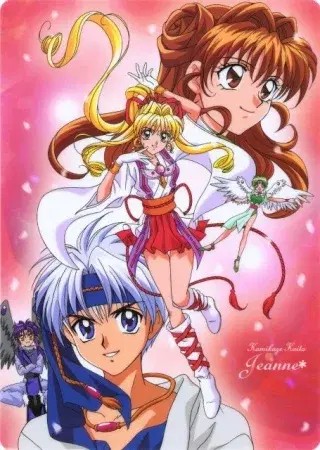
Watch D.N.Angel if you want Y2K shoujo fantasy with phantom-thief glamour, school-romance messiness, and a gothic fairy-tale sheen without committing to a long-running franchise. It scratches a neighboring itch to Kamikaze Kaitou Jeanne's magical-heist romance and Cardcaptor Sakura's adolescence-through-magic mood, but with a stronger emphasis on duality, legacy, and the theatrical pleasure of stolen art. The appeal is in the tonal braid: awkward middle-school emotion, comic embarrassment, rooftop-crime iconography, and a setting that feels like Japan filtered through European cathedrals and storybook plazas. For viewers tired of modern isekai templates, its 2003 production texture, 26-episode completeness, and unapologetically shoujo emotional logic make it a distinctive time capsule.
Key Characters
- DDaisuke Niwa(VA: Miyu Irino)
Daisuke is memorable because Miyu Irino plays him as a genuinely adolescent lead: nervous, earnest, and constantly outmatched by the melodrama his family history drops on him.
- DDark Mousy(VA: Ryoutarou Okiayu)
Dark is the show's fan-service engine in the older sense of the term, a suave phantom-thief persona whose confidence sharply contrasts Daisuke's middle-school panic.
- SSatoshi Hiwatari(VA: Akira Ishida)
Satoshi gives the series its cool-blooded counterweight, with Akira Ishida's restrained delivery turning him into the character fans often cite when discussing the show's darker edge.
- RRisa Harada(VA: Masumi Asano)
Risa stands out as more than a simple crush figure because her reactions help expose how the series treats romantic idealization as something unstable and performative.
What Makes It Stand Out
- 1
Xebec produced the 26-episode TV series during its 2003 run, and contemporary viewer commentary still singles out the vivid color palette, scenery, and character art as part of its staying power.
- 2
Yukiru Sugisaki was not only the original creator but also credited for original character design and supervision, giving the anime a closer visual and tonal relationship to its source than many early-2000s manga adaptations received.
- 3
The credited series composition by Naruhisa Arakawa organizes a genre mix that is unusually dense for a school romance: AniList tags identify Magic at 100%, Crime at 80%, Twins at 76%, and Dissociative Identities at 92%.
- 4
The setting has a deliberately hybrid flavor noted by viewers: Japanese dialogue and school routines sit beside Mediterranean-looking architecture, German speech, and Catholic motifs, matching AniList's high Foreign tag.
- 5
Rather than running indefinitely, the anime aired as a closed two-cour broadcast from April 3 to September 25, 2003, which makes it one of the more digestible classic shoujo-fantasy entries from that era.
Fun Facts & Trivia
- Fun fact 1
- Anime News Network lists thousands of user ratings for D.N.Angel, including substantial votes in both subtitled and dubbed categories, reflecting a fanbase that followed it across multiple release formats.
- Fun fact 2
- The ANN rating breakdown also records non-English viewing formats such as Spanish subtitled, Tagalog dubbed, French subtitled, German subtitled, and Spanish dubbed entries, a snapshot of how widely the series circulated among international fans.
- Fun fact 3
- On MyAnimeList, the anime holds a 7.16 score from 101,497 votes, while AniList records a 66/100 score and 295 favourites; the gap captures its status as a nostalgic fan title rather than a consensus canon pick.
- Fun fact 4
- The production credits include specialized roles beyond the usual headline staff: Yasuhiro Moriki handled prop design, Hitoshi Ichikawa designed the title logo, and Yoshimi Umino served as art director.
- Fun fact 5
- A common long-tail talking point among reviewers is the show's cultural collage, with one viewer specifically calling out the mix of Japanese language, Mediterranean architecture, German dialogue, and Catholic imagery as both intriguing and disorienting.
Studios
- Xebec