Sound of the Sky
ソ・ラ・ノ・ヲ・ト (So Ra No Wo To)
- Sci-Fi
- Slice of Life
- CGDCT
- Iyashikei
- Military
- Music
- Episodes
- 12
- Duration
- 24 min per ep
- Aired
- Jan 5, 2010 to Mar 23, 2010
- Status
- Finished Airing
Synopsis
On Helvetia’s far edge lies Seize, a quiet town of cobblestone streets where everyday routines continue even as relations with the neighboring Roman Empire grow increasingly strained. Life moves at an unhurried pace beneath the shadow of a world that’s beginning to show its cracks.
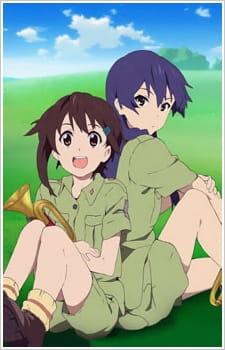
Assigned to Seize’s Clocktower Fortress, the Helvetian army’s 1121st platoon welcomes an eager new recruit: Kanata Sorami. She enlisted with a simple goal—learning to play the bugle—and soon finds guidance from Sergeant Major Rio Kazumiya, a talented trumpeter. Alongside the reserved mechanic Noël Kannagi, hot-blooded gunner Kureha Suminoya, and kindhearted Captain Felicia Heideman, Kanata settles into the rhythms of garrison life, discovering the small, sustaining joys of music, camaraderie, and a community determined to endure.
Otaku Consensus
Sound of the Sky is valued less as a conventional military drama than as a precisely modulated A-1 Pictures original where Mamoru Kanbe’s restrained direction and Hiroyuki Yoshino’s episodic structure let iyashikei routine, CGDCT chemistry, and post-apocalyptic unease occupy the same frame. Its 7.54 MAL score and 74 AniList score reflect a respected cult favorite rather than a consensus blockbuster; the recurring criticism is that its quiet middle stretch withholds hard sci-fi and war momentum long enough to frustrate viewers expecting plot-first escalation.
Why You Should Watch
Watch Sound of the Sky if you want a military anime where procedure, instruments, maintenance work, and off-duty rituals matter more than tactical spectacle. It scratches the observational, restorative itch of Aria while carrying the ruin-scarred melancholy later associated with Girls’ Last Tour, and it is less gag-driven than its surface-level “cute girls in uniform” reputation suggests. The 12-episode length makes its slow pacing deliberate rather than endless: small behavioral details, recurring musical practice, and the contrast between soft character acting and damaged-world background design do the heavy lifting. Viewers who like slice-of-life with buried history, female ensemble casts, and moral unease beneath calming routines will get far more from it than viewers hunting for a hard war thriller.
Key Characters
- KKanata Sorami
Kanata’s fan appeal comes from how her earnestness turns musical practice into character language rather than a simple hobby trait.
- RRio Kazumiya
Rio stands out as the series’ emotional ballast, a skilled trumpeter whose mentorship gives the platoon’s gentler moments a disciplined edge.
- NNoël Kannagi
Noël is the quiet mechanic archetype filtered through post-apocalyptic unease, making her reserve feel tied to the world’s machinery as much as to personality.
- KKureha Suminoya
Kureha’s hot-blooded soldierly pride gives the ensemble its sharpest comic friction while keeping the show’s military identity visible.
What Makes It Stand Out
- 1
A-1 Pictures treats the series as a tonal hybrid rather than a genre switch: AniList’s highest-weighted tags are Post-Apocalyptic at 90% and Military at 89%, even though Cute Girls Doing Cute Things is also prominent at 82%. That ranking captures why the show feels stranger than a standard barracks slice-of-life title.
- 2
The show’s structure is openly episodic, reflected in AniList’s 75% Episodic tag, but the episodes are not disposable skits; they gradually layer lost-civilization clues, military anxiety, and local customs into otherwise quiet routines.
- 3
Mel Kishida’s original character designs are adapted for animation by Toshifumi Akai, creating a soft, rounded cast that deliberately contrasts with Junya Ishigaki’s mechanical design work and Katsuhiko Kitada’s prop design.
- 4
Music functions as a recurring dramatic system rather than background flavor: the bugle and trumpet material tie training, communication, memory, and rank together across the ensemble.
- 5
The production’s genre identity is unusually split for a 2010 TV anime: Sci-Fi and Slice of Life are the listed genres, while the themes span CGDCT, Iyashikei, Military, and Music, explaining why it attracts both comfort-watch fans and lore-focused viewers.
Fun Facts & Trivia
- Fun fact 1
- Sound of the Sky is credited to Paradores as original creator, marking it as an anime-original project rather than an adaptation of a manga, light novel, or game.
- Fun fact 2
- It aired as a compact 12-episode winter 2010 series from January 5 to March 23, 2010, which is part of why its slow-burn structure feels concentrated rather than long-running.
- Fun fact 3
- The key staff list has an unusually clear division between softness and hardware: Mel Kishida supplied the original character designs, Toshifumi Akai handled character design for animation, Junya Ishigaki handled mechanical design, and Katsuhiko Kitada handled prop design.
- Fun fact 4
- Several individual episodes have notable key animation credits in the production data: Mariko Aoki is credited on episode 8, Akiko Kumada on episodes 3 and 9, and Masaaki Yamano on episodes 5, 7, and 11.
- Fun fact 5
- On AniList, the series has 953 favorites and a 74/100 score, suggesting a smaller but durable fanbase compared with its broader MAL footprint of 58,486 score votes and popularity rank of #1598.
Studios
- A-1 Pictures