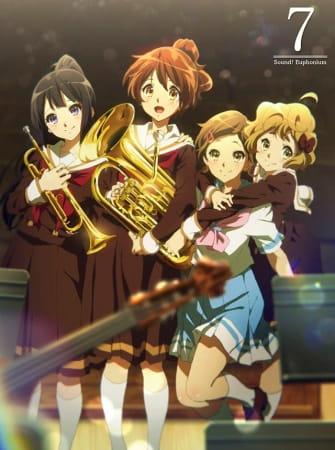
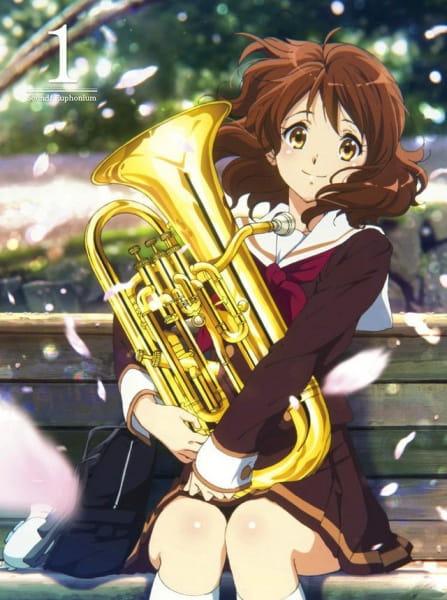
Sound! Euphonium
響け!ユーフォニアム (Hibike! Euphonium)
- Drama
- Music
- Performing Arts
- School
- Episodes
- 13
- Duration
- 23 min per ep
- Aired
- Apr 8, 2015 to Jul 1, 2015
- Status
- Finished Airing
Synopsis
After starting at Kitauji High School, Kumiko Oumae wants to leave her middle school baggage behind. That plan quickly unravels when new friends Sapphire Kawashima and Hazuki Katou pull her into the concert band, putting a euphonium back in her hands and returning her to a world she hoped to step away from.
Kitauji’s band is in rough shape, struggling to even make it to the local Sunfest, much less aim for nationals. Their new advisor, Noboru Taki, forces a decision between a casual club atmosphere and serious, demanding practice toward competition. As Kumiko hesitates—afraid of repeating past regrets—she discovers that Reina Kousaka, a former bandmate with whom she shared a strained history, is also part of the ensemble. With Taki’s strict guidance raising the stakes, Kumiko and her fellow musicians must face their individual challenges and learn to move forward as a group.
Otaku Consensus
Kyoto Animation’s Sound! Euphonium earns its reputation through Tatsuya Ishihara’s controlled direction, Jukki Hanada’s patient series composition, and an adaptation approach that treats concert-band practice as character drama rather than background flavor. Critics and fans consistently single out the instrument detail, voice performances, and polished visual craft; the recurring criticism is that its restrained emotional register and rehearsal-driven pacing can feel too muted if the viewer needs louder melodrama.
Why You Should Watch
Watch Sound! Euphonium if you want a school drama where ambition, jealousy, and insecurity are expressed through posture, rehearsal discipline, and the sound of an ensemble tightening by degrees. It scratches some of the same character-observation itch as Kyoto Animation’s own quieter works, but replaces slice-of-life comfort with competitive pressure and musical specificity. The appeal is not “cute girls in a club”; it is seeing a teen cast forced to decide whether talent, effort, and social harmony can coexist. Viewers who liked the emotional precision of A Place Further Than the Universe but want a more grounded performing-arts setting will find a sharper, more internally tense experience here.
Key Characters
- KKumiko Oumae
Kumiko stands out as a protagonist because her blunt inner reactions and reluctance to commit make her feel less like an aspirational heroine and more like a teenager slowly learning what sincerity costs.
- RReina Kousaka
Reina is the series’ pressure point: fans remember her for the way her seriousness makes everyone around her confront whether they are merely participating or truly striving.
- HHazuki Katou
Hazuki brings an outsider’s energy to the band, making the technical world of school performance feel accessible without reducing it to exposition.
- SSapphire Kawashima
Sapphire adds contrast to the ensemble as someone whose enthusiasm and musical familiarity highlight how differently students arrive at the same club.
What Makes It Stand Out
- 1
Kyoto Animation’s handling of the musical material is repeatedly praised because instruments, rehearsal behavior, and ensemble logistics are treated with a level of visual detail many anime skip. The band setting is not just decorative; the craft of playing is part of the drama’s texture.
- 2
The series is built as a 13-episode slow escalation rather than a string of self-contained club antics. Jukki Hanada’s composition keeps attention on shifting motivation and group standards, which is why the tension often comes from practice-room decisions rather than external villains.
- 3
The visual identity comes from a specific production chain: Shouko Ikeda adapts Nikki Asada’s original character designs, while Mutsuo Shinohara’s art direction, Akiyo Takeda’s color design, and Kazuya Takao’s photography give the school and performance spaces their polished Kyoto Animation finish.
- 4
Its AniList tag profile is unusually concentrated for a school drama: Band at 98%, School Club at 93%, Female Protagonist at 90%, and Classical Music at 86%. That reflects how tightly the show commits to performing arts instead of using music as a loose premise.
- 5
The drama’s most distinctive structural choice is its ensemble emphasis: Kumiko anchors the perspective, but the club’s social hierarchy and competing levels of seriousness create friction across a primarily teen, primarily female cast.
Fun Facts & Trivia
- Fun fact 1
- Sound! Euphonium is adapted from Ayano Takeda’s original story, with Nikki Asada credited for the original character designs; Kyoto Animation’s TV version is therefore an adaptation shaped by a clearly identified literary and design source.
- Fun fact 2
- The 2015 season aired for 13 episodes from April 8 to July 1, placing its original broadcast squarely in the Spring 2015 anime season before the broader TV franchise continued in later years.
- Fun fact 3
- The core creative staff includes director Tatsuya Ishihara and series composer Jukki Hanada, a pairing that helps explain the show’s mix of polished Kyoto Animation presentation and tightly managed interpersonal drama.
- Fun fact 4
- Beyond direction and design, the credits highlight specialized visual roles: Yukari Hayakawa handled the title logo design, Mutsuo Shinohara served as art director, Akiyo Takeda handled color design, and Kazuya Takao was director of photography.
- Fun fact 5
- Its reception metrics show strong cross-platform staying power: MAL lists it at 8.03 from more than 213,000 votes, while AniList records an 80/100 score and over 5,000 favourites.
Studios
- Kyoto Animation