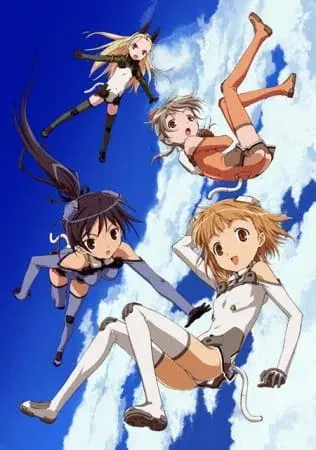
Strike Witches
ストライクウィッチーズ
- Action
- Ecchi
- Sci-Fi
- Military
- Episodes
- 12
- Duration
- 24 min per ep
- Aired
- Jul 4, 2008 to Sep 19, 2008
- Status
- Finished Airing
Synopsis
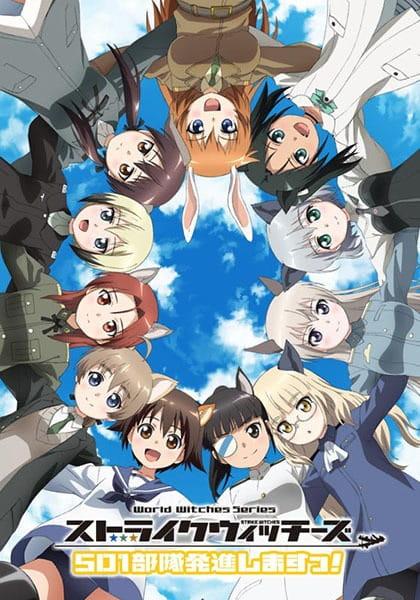
In 1939, Earth is pushed to the brink when the mysterious alien Neuroi descend, tearing through nations and overwhelming conventional armies with superior technology. In response, the world’s powers unite to develop the Striker Unit, a breakthrough device designed to match the invaders. Girls able to wield these units—known as Witches—become humanity’s most effective defenders, combining heightened magical ability with firepower no ordinary soldier could handle.
By 1944, teenage Yoshika Miyafuji chooses to enlist in the 501st Joint Fighter Wing, the famed “Strike Witches.” Lacking formal training, she must learn quickly—both how to fight and how to work alongside a squad of seasoned Witches—as the battle against the Neuroi continues.
Otaku Consensus
Strike Witches earns its cult reputation on the back of Kazuhiro Takamura’s brisk direction, Gonzo’s energetic aerial staging, and a 12-episode pace that keeps the squad moving from banter to dogfight without much dead air. Critics and fans most consistently praise the fast, readable combat sequences, occasional tactical choreography, and character chemistry, while the recurring criticism is that the storytelling remains thinner than its military-sci-fi setup and heavy ecchi presentation invite.
Why You Should Watch
Watch Strike Witches if you want WWII-flavored aerial combat, squad-room chemistry, and cute-girl military energy without dense mecha lore or grimdark war misery. It scratches a similar itch to Girls und Panzer in the way it turns martial hardware into team personality, while its airborne action has the clean, pilot-centric appeal that aviation fans look for in sci-fi combat anime. The hook is not complex geopolitics; it is the rhythm of a compact Gonzo TV season where a heavily female cast, kemonomimi magic, and gun-platform dogfights collide with unapologetic late-2000s ecchi. Viewers who can accept the fanservice as part of the franchise’s identity get a surprisingly watchable mix of tactical sorties, archetypal but memorable squad dynamics, and a final stretch often singled out as the show’s strongest action material.
Key Characters
- YYoshika Miyafuji
Yoshika anchors the series as the earnest newcomer whose healing instincts and discomfort with militarism give the squad’s combat-heavy routine a softer moral center.
- MMio Sakamoto
Mio is remembered as the veteran mentor figure, bringing drill-sergeant confidence, swordfighter flair, and a sharper military edge to the ensemble.
- LLynette Bishop
Lynette gives the cast its gentle marksman archetype, pairing nervous warmth with the kind of battlefield focus that makes her popular among fans of quieter support characters.
- PPerrine H. Clostermann
Perrine supplies the prickly aristocratic tension in the team dynamic, a tsundere-leaning ace whose pride makes her stand out in an already personality-driven unit.
What Makes It Stand Out
- 1
Gonzo’s dogfights are the production’s calling card: reviews specifically praised the aerial battles as fast-paced, well-animated, and sometimes built around actual tactics rather than simple beam-spam spectacle.
- 2
Kazuhiro Takamura served as both director and character designer, giving the season a unified visual identity instead of splitting the combat direction and character appeal across unrelated creative hands.
- 3
Fumikane Shimada’s original character designs are central to the franchise’s identity, combining military hardware cues, kemonomimi traits, and ecchi uniform logic into a style instantly recognizable even outside the show.
- 4
The 12-episode structure makes the season unusually compact for a team-based military anime, with little room for extended world-building and a stronger emphasis on sortie rhythm, cast bonding, and escalation toward the finale.
- 5
Seikou Nagaoka’s score and Youko Ishida’s theme performance help sell the show’s tonal balancing act, moving between bright squad energy and straight-faced military urgency without abandoning the series’ pop-anime accessibility.
Fun Facts & Trivia
- Fun fact 1
- The series aired from July 4 to September 19, 2008, making it a late-2000s Gonzo TV production released at a time when CGI-assisted action and moe ensemble formats were rapidly becoming more common in broadcast anime.
- Fun fact 2
- The English dub scripts were split between Chuck Huber and Leah Clark, with Huber credited on episodes 1, 2, 3, 6, 7, 8, 9, and 11, and Clark credited on episodes 3, 4, 5, 10, and 12.
- Fun fact 3
- AniList’s tag spread captures why the show is so polarizing: Kemonomimi, Military, Aviation, Magic, War, Yuri, Nudity, Cute Girls Doing Cute Things, and CGI all rank prominently in its metadata.
- Fun fact 4
- Its reception numbers show a clear cult-profile pattern rather than universal acclaim: MAL lists it at 6.94 from 71,920 votes, while AniList places it at 66/100 with 474 favourites.
- Fun fact 5
- The credited creative chain is unusually clear for the show’s visual identity: Fumikane Shimada provided the original character designs, while Kazuhiro Takamura adapted them for animation in addition to directing the season.
Studios
- Gonzo