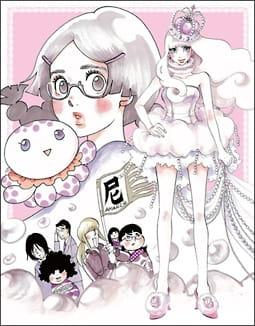
Princess Jellyfish
海月姫 (Kuragehime)
- Comedy
- Adult Cast
- Crossdressing
- Visual Arts
- Episodes
- 11
- Duration
- 22 min per ep
- Aired
- Oct 15, 2010 to Dec 31, 2010
- Status
- Finished Airing
Synopsis
Childhood trips to the aquarium left Tsukimi Kurashita captivated by jellyfish, their drifting tentacles reminding her of a princess’s gown. At 19, she lives quietly with five other jobless otaku women, keeping to the fringes of society while nurturing her dream of becoming an illustrator.
That routine is shaken when a strikingly stylish stranger helps her rescue a jellyfish at a local pet shop. The visitor soon starts dropping by their women-only residence, bringing a confidence and fashion sense that clashes with everything Tsukimi and her housemates are used to. Before long, Tsukimi learns the newcomer’s biggest secret: the elegant “girl” is actually Kuranosuke Koibuchi, a wealthy male college student who crossdresses.
Otaku Consensus
Takahiro Oomori’s film-conscious direction and Jukki Hanada’s brisk ensemble scripting make Princess Jellyfish unusually sharp at shifting between slapstick, social discomfort, and sincere character intimacy, with Brain’s Base giving its fashion and otaku-culture clashes a strong visual identity. Its chief weakness is adaptation closure: the 11 episodes stop mid-manga, leaving romantic threads and much of the supporting cast’s promised development unresolved, while the abrasive ensemble humor can test viewers who do not warm to the residents.
Why You Should Watch
Choose Princess Jellyfish if you want josei comedy about adult women whose obsessions are treated as both ridiculous and genuinely sustaining, without another high-school club setup. Its best material comes from collision: deadpan shut-in rituals meet Kuranosuke’s theatrical confidence, fashion and makeup become tools of social strategy, and slapstick repeatedly gives way to observations about beauty, employability, class, and belonging. It scratches some of the same itch as Ouran High School Host Club’s gender-play comedy, but swaps the academy fantasy for a more precarious adult found family and a distinctly female-otaku point of view. Brain’s Base keeps the 11 episodes brisk, colorful, and densely character-driven, favoring conversational ensemble comedy over elaborate plot machinery. One caveat: treat it as an enticing first movement rather than a complete adaptation, and not as straightforward queer representation.
Key Characters
- TTsukimi Kurashita(VA: Kana Hanazawa)
Tsukimi’s appeal lies in the precision of her social anxiety: her artistic eye gives the comedy an observant emotional center rather than reducing her to a makeover project.
- KKuranosuke Koibuchi(VA: Mitsuki Saiga)
Kuranosuke is less a disguise-based punchline than a forceful stylist and social improviser, with his wealth and effortless confidence creating productive friction with the ensemble.
What Makes It Stand Out
- 1
The episode titles parody live-action film titles, reinforcing the cinematic influence that reviewers have identified in the series rather than following a conventional anime naming scheme.
- 2
Its central ensemble consists primarily of adult female otaku, allowing the comedy to address unemployment, isolation, found family, and niche fixation outside the standard school-club framework.
- 3
Fashion and makeup function as social language and strategy, not merely decorative transformation; that emphasis connects Kenji Hayama’s character designs with Ritsuko Utagawa’s color design.
- 4
Takahiro Oomori served as both director and sound director, while Makoto Yoshimori composed the music, giving the series unusually direct top-level coordination between comic staging and audio presentation.
- 5
The anime is a compact 11-episode adaptation that ends before the source material’s larger character and romantic trajectories are resolved, the most consistent reservation across positive reviews.
Fun Facts & Trivia
- Fun fact 1
- Princess Jellyfish was created by Akiko Higashimura, with Jukki Hanada handling series composition for the television adaptation and Brain’s Base producing the animation.
- Fun fact 2
- Director Takahiro Oomori also personally filled the sound-director role, rather than leaving the series’ vocal and audio staging to a separately credited lead.
- Fun fact 3
- The visual department divided its identity among Kenji Hayama’s character design, Mio Isshiki’s art direction, Ritsuko Utagawa’s color design, and Hitoshi Tamura’s photography.
- Fun fact 4
- All 11 episodes aired within a single autumn 2010 cour, from October 15 through December 31.
- Fun fact 5
- The series holds an 8.11 MyAnimeList score from 121,400 votes and a 78/100 AniList score, with 2,636 AniList users listing it among their favorites.
Studios
- Brain's Base