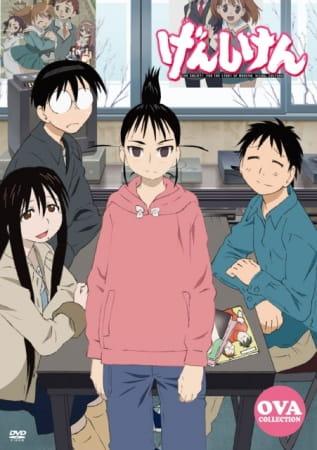
Genshiken
げんしけん
- Comedy
- Adult Cast
- Otaku Culture
- Parody
- Episodes
- 12
- Duration
- 25 min per ep
- Aired
- Oct 11, 2004 to Dec 27, 2004
- Status
- Finished Airing
Synopsis
Kanji Sasahara, a shy college freshman searching for somewhere he belongs, wanders into the Society for the Study of Modern Visual Culture—better known as Genshiken, a club that gathers students across the otaku spectrum. His first visit goes poorly after an encounter with upperclassman Harunobu Madarame leaves him embarrassed and insisting he’s not one of them. Things shift when he befriends Makoto Kousaka, whose polished appearance hides a seriously dedicated otaku, and Sasahara begins tagging along more often.
As Sasahara gets pulled into club life—debating beloved anime, poring over doujinshi, and heading to conventions—he also meets Kousaka’s girlfriend, Saki Kasukabe, an outspoken non-otaku determined to make her boyfriend more “normal.” Between Saki’s bafflement and the club’s unapologetic enthusiasm, Sasahara slowly drops his defenses and starts to embrace the interests he tried to deny.
Otaku Consensus
Genshiken endures because director Takashi Ikehata and series composer Michiko Yokote treat otaku life as social behavior rather than a punchline, letting the clubroom conversations, convention trips, and fandom rituals build character development at an intentionally slow pace. Critics and fans consistently praise its even-handed otakudom, rewatchable ensemble comedy, and unexpectedly relatable adult-cast dynamics, while the most common complaint is Palm Studio’s plain, sometimes outright unattractive art and limited animation.
Why You Should Watch
Watch Genshiken if you want otaku comedy without wish-fulfillment gloss: it is less about being rewarded for fandom than about the awkward etiquette, gatekeeping, denial, spending habits, and tiny social victories that come with it. It scratches a similar itch to Wotakoi’s adult-fandom angle, but with a drier, more anthropological college-club texture; it also shares Welcome to the NHK’s interest in otaku insecurity without turning into psychological collapse. The appeal is in the specificity: doujinshi browsing, cosplay discomfort, video-game talk, parody debates, and the way a room full of obsessive people negotiates status. If slow hangout pacing and socially precise comedy sound more valuable than polished animation, this is one of the key 2000s seinen titles to know.
Key Characters
- KKanji Sasahara
Sasahara is memorable because his arc is less about discovering a hobby than about admitting how much social shame has shaped the hobbies he already has.
- HHarunobu Madarame
Madarame embodies the club’s most visibly intense strain of otaku identity, making him both a comic pressure point and one of the show’s sharpest studies in fandom as self-defense.
- MMakoto Kousaka
Kousaka stands out as a deliberate inversion of the stereotypical otaku image: polished, socially functional, and still fully committed to games and fandom.
- SSaki Kasukabe
Saki gives the series its crucial outsider perspective, challenging the club’s habits without reducing its members to caricatures.
What Makes It Stand Out
- 1
The series is built around a college club rather than a high-school club, giving its otaku culture a more adult texture of disposable income, autonomy, embarrassment, and social self-definition.
- 2
Its structure is unusually committed to the clubroom hangout: web critics have noted that the show rarely bothers with classes or broad campus life, keeping the focus on how this specific subculture talks to itself.
- 3
Palm Studio’s production favors subdued, functional presentation over spectacle; that plainness became part of the show’s critical split, with praise for the writing and frequent criticism of the art and animation as visually unattractive.
- 4
The comedy works through meta-fandom detail rather than gag escalation, covering anime, manga, video games, doujinshi, cosplay, parody, and convention culture as everyday behavior instead of exotic set dressing.
- 5
The pacing is deliberately slow for a 12-episode TV comedy, which is why fans who value incremental character development often rate it highly while action-oriented viewers may bounce off early.
Fun Facts & Trivia
- Fun fact 1
- Genshiken aired as a 12-episode TV anime from October 11, 2004 to December 27, 2004, produced by Palm Studio.
- Fun fact 2
- The anime adapts the work of original creator Shimoku Kio, with Takashi Ikehata directing and Michiko Yokote handling series composition.
- Fun fact 3
- Its production credits include Hirotaka Kinoshita on character design, Shin Okui as art director, Hiroshi Izumi on art design, and Kayoko Nishi on color design.
- Fun fact 4
- Reception remains steady across major databases: it holds a 7.63/10 MAL score from 74,872 votes and a 74/100 AniList score, with 631 AniList favourites.
- Fun fact 5
- THEM Anime Reviews gave it a 4.0 and singled it out as an even-handed treatment of otakudom, while also bluntly criticizing the visuals as ugly and ineffective.
Studios
- Palm Studio