Amagami SS
アマガミSS
- Romance
- School
- Episodes
- 25
- Duration
- 24 min per ep
- Aired
- Jul 2, 2010 to Dec 24, 2010
- Status
- Finished Airing
Synopsis
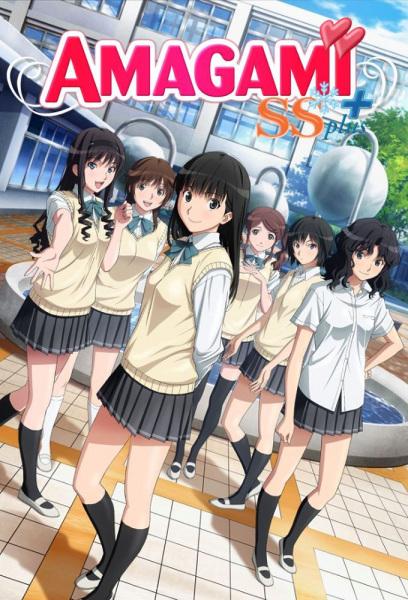
Two years after being stood up on Christmas Eve, Junichi Tachibana still struggles to be honest about his feelings, wary of being hurt again. As the holiday season returns, he finds himself drawn into new possibilities at school—each encounter offering a different path toward the kind of connection he’s been missing.
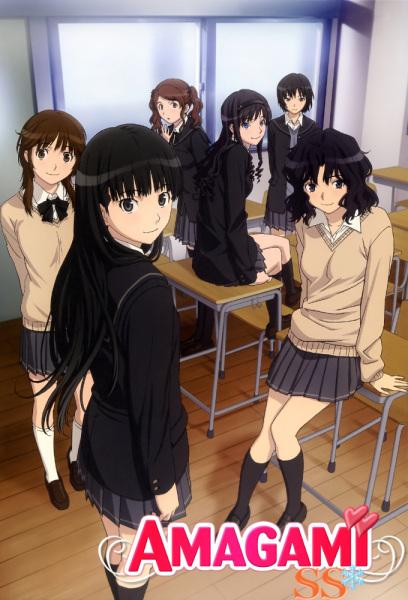
Junichi’s attention turns to several girls: Haruka Morishima, a lively and well-liked upperclassman who adores cute things; Kaoru Tanamachi, a childhood friend quietly carrying deeper feelings; Sae Nakata, a timid transfer student uneasy around men; Ai Nanasaki, a swim team member whose first impression of him is far from warm; Rihoko Sakurai, another childhood friend with a sweet tooth; and Tsukasa Ayatsuji, a seemingly flawless class representative with a darker side beneath her polished image. With Christmas Eve drawing near, Junichi hopes he can finally spend it with someone he truly loves.
Otaku Consensus
Amagami SS remains one of the cleaner dating-sim adaptations because Yoshimasa Hiraike’s dual role as director and series composer gives its omnibus structure a disciplined rhythm: each heroine route is brisk, self-contained, and allowed a real ending. Critics and fans consistently praise the likable cast, AIC’s polished 2010 TV presentation, and the satisfying route-by-route pacing, while the main weakness is just as consistent: the romance beats are formulaic and rarely challenge high-school romance convention.
Why You Should Watch
Watch Amagami SS if you want romance routes with closure instead of a single harem treadmill where every confession is postponed until the finale. Its appeal is closer to a dating-sim anthology than to a linear drama: the show resets its emotional board, lets one heroine take focus, and gives that pairing enough room to land. That makes it a strong pick for viewers who like the warmth of school romances such as KimiKiss or the compact relationship payoffs of Tsuredure Children, but want a more structured heroine-by-heroine format. It also avoids the infamous “which girl wins?” frustration by turning that question into the entire design. The result is comfort-food romance with an editor’s sense of route management.
Key Characters
- JJunichi Tachibana(VA: Tomoaki Maeno)
Junichi works better than many dating-sim leads because his awkwardness and fear of rejection give the route resets a consistent emotional baseline rather than making him feel like a blank cursor.
- HHaruka Morishima(VA: Shizuka Ito)
Haruka is the show’s high-energy senpai archetype, remembered for how her confidence and eccentric fondness for cute things push the series toward playful romantic comedy.
- AAi Nanasaki(VA: Yukana)
Ai brings the clearest kuudere flavor to the cast, with her swim-team discipline and cool first impression giving her route a different temperature from the more openly affectionate heroines.
- TTsukasa Ayatsuji(VA: Kaori Nazuka)
Tsukasa is the character fans often single out for contrast, since her polished class-representative image is built around tension rather than simple sweetness.
What Makes It Stand Out
- 1
The series uses a true omnibus-route structure: six short heroine stories plus a special episode across a 25-episode run. That makes it structurally closer to a visual novel adaptation that preserves routes than to a conventional love-triangle anime.
- 2
AIC’s adaptation does not force the Enterbrain source into one winning-couple timeline. The AniList tags “Alternate Universe” and “Time Manipulation” reflect the show’s route-reset design rather than a science-fiction premise.
- 3
Yoshimasa Hiraike handled both direction and series composition, which helps explain the show’s unusually tidy segmentation for a multi-heroine romance. The format lives or dies on pacing, and Amagami SS is built around keeping each route compact.
- 4
The ending-theme strategy is character-branded: credited theme performers include Kaori Nazuka, Yukana, and Ryouko Shintani, all associated with major heroines. Instead of one generic closer, the music reinforces the route currently in focus.
- 5
Hiroaki Gouda’s character designs provide a unified visual identity across very different heroine archetypes, from senpai comedy to kuudere restraint to class-rep duality. That consistency is important because the show repeatedly changes romantic center without changing school setting.
Fun Facts & Trivia
- Fun fact 1
- Enterbrain is credited as the original creator, and the anime’s route-by-route layout reflects its dating-sim source logic more directly than many romance-game adaptations that collapse the cast into one continuity.
- Fun fact 2
- The broadcast ran from July 2, 2010 to December 24, 2010, meaning the TV airing ended on Christmas Eve, the same holiday that frames the series’ emotional stakes.
- Fun fact 3
- Its reception is notably stable across databases: MAL lists it at 7.27 from 168,331 votes, while AniList has it at 69/100 with 1,129 favourites. That points to a broadly liked niche title rather than a polarizing cult object.
- Fun fact 4
- AniList’s unusually specific tag mix includes School at 88%, Ensemble Cast at 86%, Alternate Universe at 64%, and Time Manipulation at 40%, which neatly captures how database communities classify the route-reset format.
- Fun fact 5
- The most repeated outside criticism is not that the show mishandles romance, but that it is predictable. Reviews commonly frame it as competent, likable, and satisfying for high-school romance fans, while noting that the genre beats are familiar.
Studios
- AIC