Kizumonogatari Part 1: Iron-Blooded
傷物語〈Ⅰ鉄血篇〉 (Kizumonogatari I: Tekketsu-hen)
- Action
- Mystery
- Supernatural
- Vampire
- Episodes
- 1
- Duration
- 1 hr 3 min
- Aired
- Jan 8, 2016
- Status
- Finished Airing
Synopsis
In his second year at Naoetsu Private High School, Koyomi Araragi crosses paths with Tsubasa Hanekawa, the class’s top student, and the two strike up an unexpected conversation. Hanekawa brings up an unsettling rumor making the rounds: a vampire with striking blonde hair and ice-cold eyes has been spotted somewhere in town.
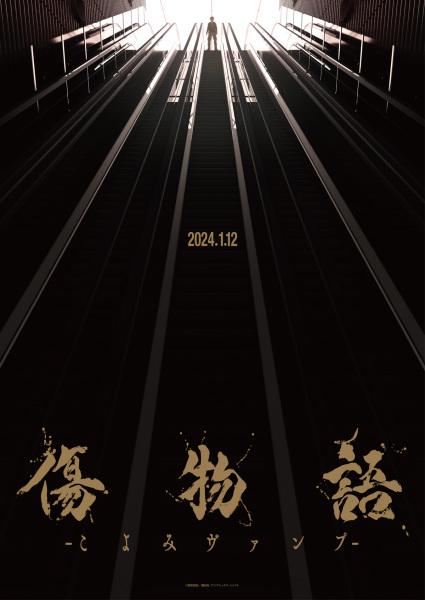
Araragi dismisses it at first and continues on with his evening, until he notices blood smeared along the stairs leading down to the subway. Drawn by uneasy curiosity, he follows the trail into the station’s depths—only to come face-to-face with the source: the very vampire from the rumor, found grotesquely dismembered. When she begs for help, Araragi is forced to choose whether to intervene, a decision that could alter the course of his life.
Otaku Consensus
Kizumonogatari I: Tekketsu-hen earns its reputation through Tatsuya Oishi and Shaft’s hyper-controlled direction: noir framing, rotoscoped physicality, CGI-assisted spaces, and body-horror imagery carry emotional information that many anime would explain through monologue. Critics and fans praise it as a visually forceful, character-focused adaptation that gives Koyomi Araragi and Tsubasa Hanekawa unusually subtle early texture, while the recurring complaint is that this first film feels like a deliberately slow prologue with a thin standalone plot.
Why You Should Watch
Watch Tekketsu-hen if you want vampire fiction filtered through arthouse urban fantasy rather than monster-of-the-week action. It scratches the same Shaft itch as Madoka Magica and Mekaku City Actors: empty city spaces, graphic design as mood, and conversations staged like psychological duels. The draw is not plot density; it is seeing Koyomi Araragi’s identity crisis rendered through blood, silence, awkward body language, and visual exaggeration. Viewers who like anime that trusts images more than internal narration will get the most from it, especially if body horror, noir lighting, and a deliberately theatrical sense of space sound more exciting than conventional exposition. If you want Monogatari’s verbal games with a heavier cinematic pulse, this is the clean entry point.
Key Characters
- KKoyomi Araragi
Araragi is compelling here because the film frames him less as a witty narrator and more as a physically vulnerable teenager whose choices are communicated through posture, silence, and panic.
- TTsubasa Hanekawa
Hanekawa stands out as more than the model-student archetype, with fans often pointing to her early conversations with Araragi as the film’s clearest example of subtle Monogatari character writing.
What Makes It Stand Out
- 1
Shaft’s production emphasizes visual storytelling over inner monologue, a choice specifically noted by reviewers as central to how the film communicates character experience.
- 2
The AniList tag profile is unusually extreme for a mainstream franchise entry: Vampire at 97%, Urban Fantasy at 88%, Rotoscoping at 87%, Body Horror at 71%, Gore at 70%, Noir at 60%, and CGI at 56%.
- 3
Tatsuya Oishi directs under chief director Akiyuki Shinbou, giving this installment a more theatrical, filmic identity than a standard TV-series continuation.
- 4
The film functions as a slow-burn first movement rather than a self-contained climax, which is why praise for its atmosphere often comes paired with criticism of its thin plot.
- 5
Its character work is frequently described as subtle and pervasive, with change occurring through staging and conversational rhythm rather than obvious dramatic declarations.
Fun Facts & Trivia
- Fun fact 1
- The film adapts NISIOISIN’s Monogatari source material with original character concepts by VOFAN, then translates them into animation through character designers Akio Watanabe and Hideyuki Morioka.
- Fun fact 2
- Akiyuki Shinbou, closely associated with Shaft’s signature style, is credited as chief director, while Tatsuya Oishi is the credited director for this installment.
- Fun fact 3
- The main animation credits list Yoshio Kozakai, Ryou Imamura, Yuuya Geshi, and Genichirou Abe, reflecting the film’s heavy emphasis on controlled physical movement and stylized body language.
- Fun fact 4
- It opened on January 8, 2016 as a single theatrical episode and holds a strong cross-platform reputation: 8.36 on MyAnimeList from 314,939 votes and 83/100 on AniList.
- Fun fact 5
- Its database footprint shows both prestige and reach: MyAnimeList ranks it at #275 with popularity at #434, while AniList records 4,533 favourites.
Studios
- Shaft