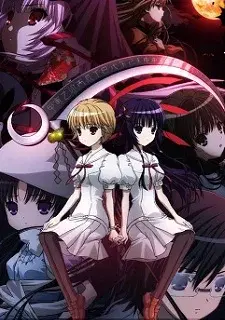
Higurashi: When They Cry
ひぐらしのなく頃に (Higurashi no Naku Koro ni)
- Horror
- Mystery
- Suspense
- Gore
- Psychological
- Episodes
- 26
- Duration
- 24 min per ep
- Aired
- Apr 5, 2006 to Sep 27, 2006
- Status
- Finished Airing
Synopsis
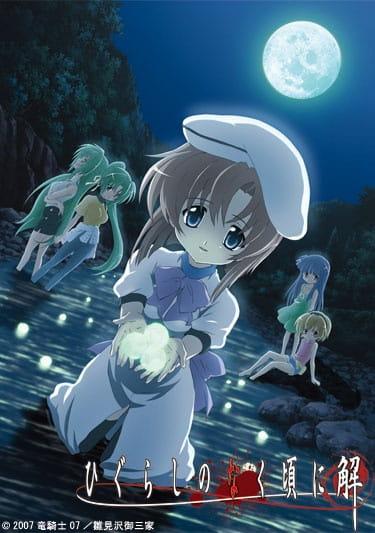
Keiichi Maebara arrives in the rural village of Hinamizawa in the summer of 1983 and quickly settles into a close-knit circle with classmates Rena Ryuuguu, Mion Sonozaki, Satoko Houjou, and Rika Furude. The days seem peaceful at first, but an unsettling undercurrent begins to seep into their small-town routine.
As preparations build for Hinamizawa’s annual festival, Keiichi hears whispers of local lore tied to the village’s patron deity, Oyashiro. He soon learns that a string of recent murders and disappearances may be connected to the festival, and his attempts to question his friends are met with uneasy silence. With strange incidents piling up and doubt taking hold, trust fractures and paranoia deepens—unfolding across multiple arcs that piece together the mystery behind Hinamizawa’s darkness.
Otaku Consensus
Higurashi: When They Cry endures because Chiaki Kon’s direction and Toshifumi Kawase’s structure preserve the visual novel’s trapdoor effect: cute club comedy, rural folklore, and denpa paranoia keep recontextualizing each other instead of resolving into a standard slasher mystery. The 2006 Studio Deen adaptation is widely treated as an essential horror gateway, with the two answer-style “eye-opening” arcs often cited as the point where its design starts paying off. Its most consistent criticism is adaptation compression: six dense visual-novel arcs in 26 episodes can feel both slow in the daily-life stretches and abrupt when the psychological machinery accelerates.
Why You Should Watch
Watch Higurashi if you want a horror mystery that weaponizes anime cuteness instead of discarding it. It scratches the same itch as Shiki’s isolated-village dread and Steins;Gate’s recontextualizing structure, but with more gore, less techno-thriller logic, and a far nastier interest in how suspicion spreads inside a closed community. The draw is not just “who did it,” but how each arc trains you to distrust framing, tone, and even genre labels: school-club comedy, shrine mythology, tragedy, and psychological breakdown all occupy the same space. Viewers who need immediate answers may bounce off the pacing; viewers who enjoy assembling meaning from repeated contradictions will find why this remains one of anime horror’s reference points.
Key Characters
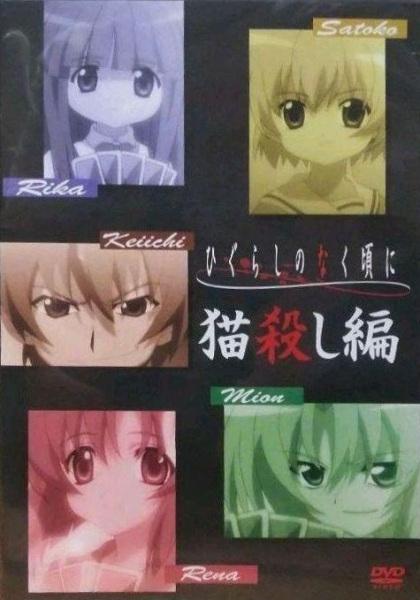
- KKeiichi Maebara
Keiichi works because he is not a cool detective figure; his value to the series is how quickly curiosity, pride, and social pressure can turn a protagonist’s perspective into unreliable evidence.
- RRena Ryuuguu
Rena is one of the show’s defining tonal pivots, remembered by fans for making cute mannerisms and genuine menace feel like two readings of the same person rather than separate modes.
- MMion Sonozaki
Mion gives the ensemble its club-room momentum, and her confidence makes the series’ trust games sharper because she often feels like the person most capable of controlling the room.
- RRika Furude
Rika anchors the shrine-maiden and mythology side of the story, standing out because her small presence carries an unusual amount of symbolic weight in the show’s larger structure.
What Makes It Stand Out
- 1
The series uses an achronological arc structure rather than a straight clue-by-clue investigation, a choice reflected in AniList’s high Achronological Order and Time Loop tags. That structure is the reason the first season can feel contradictory by design instead of merely withholding answers.
- 2
Studio Deen’s adaptation leans into sharp tonal contrast: Kyuuta Sakai’s rounded character designs and chibi-adjacent expressions sit directly beside gore and psychological collapse. The result is visually uneven at times, but the cute-to-cruel whiplash became part of the show’s identity.
- 3
Kenji Kawai’s score is a major part of the series’ atmosphere, using sparse, ominous cues to make silence and ordinary village spaces feel accusatory. His music helps bridge the gap between slice-of-life club scenes and the horror material without needing constant visual escalation.
- 4
The first 2006 season compresses multiple visual-novel arcs into 26 episodes, including the early question material and later answer-oriented material. That compression is why anime-only viewers often report that the full design does not become clear until well into the follow-up season.
- 5
AniList’s tag profile is unusually specific for a horror title: Denpa at 98%, Ensemble Cast at 94%, Rural at 86%, Gore at 84%, and Time Loop at 83%. Those tags capture why Higurashi is discussed less as a simple murder mystery and more as a structural paranoia machine.
Fun Facts & Trivia
- Fun fact 1
- Higurashi began with Ryukishi07 as original creator, and the anime’s reputation is inseparable from its visual-novel source; fan discussion commonly notes that the game gives more space to the character interaction and mystery logic than the compressed TV version.
- Fun fact 2
- Chiaki Kon is credited not only as director but also for key animation, while Kyuuta Sakai handled both character design and chief animation direction. That dual credit helps explain why the first season’s identity is tied so strongly to its character faces and tonal extremes.
- Fun fact 3
- The 2006 TV anime aired from April 5 to September 27, 2006, finishing at 26 episodes under Studio Deen. Its long-tail popularity is measurable: MAL lists it at 7.87 from over 417,000 votes with a popularity rank of #255, while AniList records 5,945 favourites.
- Fun fact 4
- Several episode-level animation credits stand out in the staff list: Ryousuke Kimiya contributed key animation on episodes 5 and 21, Akiko Kumada on episode 3, and Akio Watanabe on episode 23. Those credits are notable because Higurashi’s production is often discussed through individual cuts and expressions as much as through polished action.
- Fun fact 5
- Fan recommendations frequently warn that the first season is not the whole answer key; one common viewing response is that the broader mystery only starts fully clicking around the second season. That reputation has shaped Higurashi into a commitment series rather than a one-cour horror binge.
Studios
- Studio Deen