Drifters
DRIFTERS
- Action
- Adventure
- Comedy
- Fantasy
- Isekai
- Adult Cast
- Gore
- Military
- Samurai
- Episodes
- 12
- Duration
- 24 min per ep
- Aired
- Oct 7, 2016 to Dec 23, 2016
- Status
- Finished Airing
Synopsis
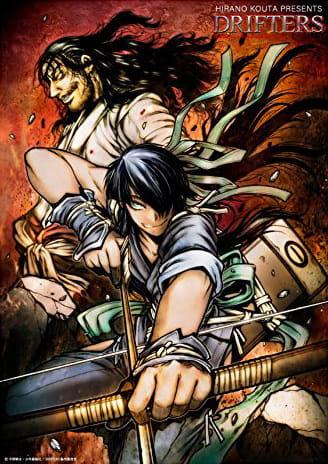
At the Battle of Sekigahara in 1600, samurai Toyohisa Shimazu stays behind to cover his comrades’ retreat. Mortally wounded, he abruptly wakes in a pristine, modern corridor lined with countless doors, watched over by a silent man named Murasaki. Before he can make sense of it, Toyohisa is drawn through one of the doors and cast into a world far removed from his own.
That land teems with fantastical races and with legendary fighters pulled from different periods of history—people who should have died long ago. Toyohisa soon joins forces with the feared Nobunaga Oda and the famed archer Yoichi Suketaka Nasu, only to find a continent strained by political turmoil. Branded “Drifters,” they’re thrust into a brutal conflict against the “Ends,” the architects behind the Orte Empire who seek to wipe the Drifters out. As the Ends’ influence swells and the Empire tightens its persecution of elves and other demihumans, Toyohisa and his unlikely allies are forced into a new kind of war—one that will decide who truly claims the world.
Otaku Consensus
Drifters earns its strong fan standing, reflected in a 7.88 MAL score and 75/100 AniList score, by turning Kouta Hirano’s violent historical crossover into a lean, high-momentum war anime rather than a lore dump. Kenichi Suzuki’s direction, Hideyuki Kurata’s composition, and Ryouji Nakamori’s character designs preserve the manga’s savage comedy, thick-lined expressions, and tactical brutality, with the elf-and-Orte material giving the season its sharpest military payoff. The lasting complaint is not the concept but the delivery ceiling: the 12-episode run ends feeling like a campaign opening salvo, and the abrupt tonal lunges into gag comedy can undercut the blood-soaked seriousness.
Why You Should Watch
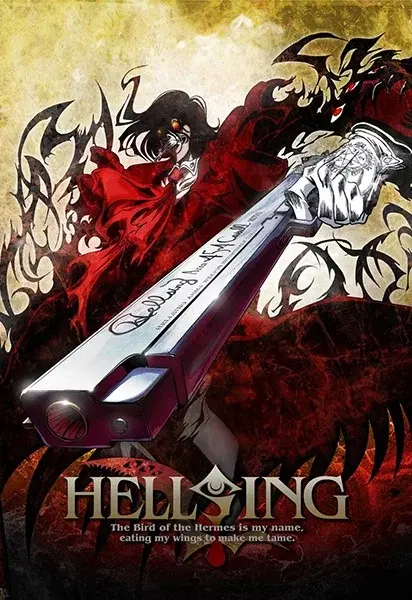
Watch Drifters if you want the historical-legend chaos of Fate filtered through the gore, sneering humor, and ink-black facial exaggeration associated with Kouta Hirano’s Hellsing, but without tournament structure or clean heroic morality. It is built for viewers who like adult casts, battlefield improvisation, and commanders solving fantasy problems with samurai violence, gunpowder logic, and political cruelty. The appeal is not power fantasy wish fulfillment; it is watching dead-serious war minds from incompatible eras collide with elves, empires, and language barriers that actually matter. At 12 episodes, it moves like a raid: fast, bloody, profane, and constantly escalating. If you want isekai with military consequences instead of comfort-food reincarnation routines, this is the sharper blade.
Key Characters
- TToyohisa Shimazu(VA: Yuichi Nakamura)
Toyohisa stands out because he is written less as a noble samurai icon than as a feral battlefield pragmatist whose honor and brutality are inseparable.
- NNobunaga Oda(VA: Naoya Uchida)
Nobunaga is the show’s strategic engine, a weary warlord-brain who treats fantasy politics as another board to burn, exploit, and reorganize.
- YYoichi Suketaka Nasu(VA: Mitsuki Saiga)
Yoichi gives the main trio a cooler, more elegant rhythm, balancing Toyohisa’s headlong violence and Nobunaga’s scheming with precision and restraint.
- MMurasaki(VA: Mitsuru Miyamoto)
Murasaki’s sterile, bureaucratic presence turns the isekai mechanism into something colder and stranger than a divine blessing or game-system gimmick.
What Makes It Stand Out
- 1
Hoods Entertainment’s adaptation leans into Ryouji Nakamori’s dual role as character designer and chief animation director, keeping Hirano’s jagged silhouettes, manic grins, and grotesque reaction faces intact rather than smoothing them into conventional fantasy polish.
- 2
The series treats the language barrier as a functional obstacle, not a one-scene novelty; AniList’s 68% language-barrier tag reflects how communication, translation, and misunderstanding shape the early power dynamics.
- 3
Hideyuki Kurata’s 12-episode structure prioritizes campaign momentum over encyclopedic history lessons, which makes the season fast and violent but also explains why many viewers remember the ending as more of a launch point than a full resolution.
- 4
The soundtrack credits both Hayato Matsuo and Yasushi Ishii, matching the anime’s split personality: martial fantasy scale on one side, grimy rock and violent eccentricity on the other.
- 5
Its anachronism is not decorative cosplay; with AniList tags for Anachronism at 80% and Guns at 57%, the series repeatedly frames old-world legends through mismatched military technologies and tactics.
Fun Facts & Trivia
- Fun fact 1
- Drifters comes from Kouta Hirano, the original creator of Hellsing, which helps explain the shared appetite for gore, black comedy, monstrous charisma, and characters who seem designed in heavy ink rather than soft linework.
- Fun fact 2
- Ryouji Nakamori is credited twice in the key staff list, as both character designer and chief animation director, making him central to how the anime translates Hirano’s exaggerated manga art into motion.
- Fun fact 3
- The TV anime aired as a compact fall 2016 run from October 7 to December 23, finishing at 12 episodes rather than stretching the material into a longer continuous adaptation.
- Fun fact 4
- Maon Kurosaki performed the ending theme, adding a notable anisong presence to a staff list already heavy on genre specialists like director Kenichi Suzuki and sound director Youta Tsuruoka.
- Fun fact 5
- Its database footprint is unusually strong for a bloody seinen war fantasy: MAL lists it at popularity rank #404 with 292,994 votes, while AniList records 2,617 favourites.
Studios
- Hoods Entertainment