Boogiepop and Others
ブギーポップは笑わない (Boogiepop wa Warawanai (2019))
- Avant Garde
- Drama
- Horror
- Mystery
- Supernatural
- Suspense
- Psychological
- Episodes
- 18
- Duration
- 23 min per ep
- Aired
- Jan 4, 2019 to Mar 29, 2019
- Status
- Finished Airing
Synopsis
Whispers drift through the halls of Shinyo Academy about Boogiepop, an elusive Shinigami said to take people at the peak of their beauty. Behind the rumor lies a stranger truth: Boogiepop is a protector that surfaces from dormancy as the alternate persona of Touka Miyashita, appearing only when something threatening “the enemies of the world” draws near.
When a wave of disappearances is dismissed by the school as simple runaways, Boogiepop awakens—and the unease around campus sharpens. As an unseen presence waits for the right moment to strike, the story threads mystery and psychological tension through its characters’ tangled bonds, memories, and emotions, while quietly reflecting on how people experience time.
Otaku Consensus
Boogiepop and Others earns its cult-leaning reputation when Shingo Natsume’s direction and Tomohiro Suzuki’s series composition turn achronological fragments into psychological horror rather than simple puzzle-box plotting; the later story arcs are where many reviewers found the interconnected structure most rewarding. Its 7.07 MAL score and 68 AniList score fit the reception: respected for its denpa mood, philosophical bite, and humanistic character studies, but held back by uneven pacing and divisive art direction that critics often found too rushed, too slow, or visually mismatched.
Why You Should Watch
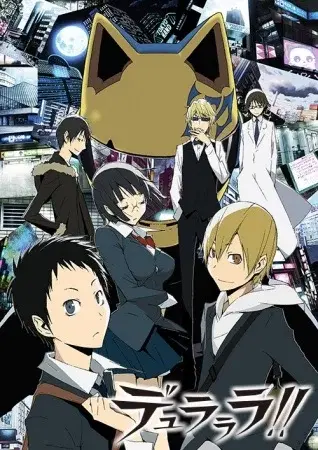
Watch Boogiepop and Others if you want the fractured urban paranoia of Durarara!! and the time-conscious unease of Steins;Gate without their warmer comedy or tidy exposition. This is a show for viewers who enjoy assembling motive, identity, and causality from partial testimony: crime, body swapping, dissociative identities, alien influence, drugs, and school rumor all circulate through the same cold ecosystem. Madhouse’s 2019 version is best approached as an arc-based psychological file, not a conventional supernatural thriller, and it rewards binge viewing because each block reframes information you thought was settled. If your ideal horror is less jump-scare and more “why did that person remember the event differently?”, this scratches a specific, cerebral itch.
Key Characters
- BBoogiepop(VA: Aoi Yuuki)
Boogiepop’s agender, kuudere-coded presence gives the series its eerie tonal anchor, with Aoi Yuuki delivering the character as calm judgment rather than theatrical menace.
- NNagi Kirima(VA: Saori Oonishi)
Nagi Kirima is the hard-edged active force in a cast often trapped by memory and perception, which makes her a fan-favorite counterweight to the show’s passivity and abstraction.
- TTouka Miyashita(VA: Aoi Yuuki)
Touka Miyashita is fascinating for how the performance contrast with Boogiepop turns a single voice actor’s range into part of the show’s identity puzzle.
What Makes It Stand Out
- 1
The series uses achronological order as a core viewing mechanic, not a garnish; AniList’s 84% Achronological Order tag reflects how often scenes are designed to be understood only after later context rearranges them.
- 2
Madhouse’s adaptation runs 18 episodes, an unusual count for a late-night TV anime, and aired in a compressed January 4 to March 29, 2019 window that gave it more room than a single-cour 12 or 13 episode version without turning it into a full two-cour production.
- 3
Its genre blend is unusually specific: urban fantasy, denpa, crime, philosophy, psychological suspense, gore, aliens, drugs, and school drama all appear in the tag profile rather than being isolated one-off elements.
- 4
The show’s reception is shaped by structure as much as content: critics praised the cryptic interconnectedness and later stories, while the most repeated complaint was that individual arcs could feel rushed in one stretch and sluggish in the next.
- 5
The visual direction is part of the controversy around the 2019 version; at least one critic singled out the art direction as failing to capture the right look for the material, even while acknowledging the strength of the stories underneath.
Fun Facts & Trivia
- Fun fact 1
- The anime adapts material from Kouhei Kadono’s Boogiepop novels, with Kouji Ogata credited for the original character designs and Hidehiko Sawada redesigning the cast for animation.
- Fun fact 2
- Aoi Yuuki voices both Boogiepop and Touka Miyashita, making the central identity contrast audible through changes in delivery rather than casting separation.
- Fun fact 3
- The production’s core direction team paired director Shingo Natsume with assistant director Yousuke Hatta, while Tomohiro Suzuki handled series composition for the fragmented arc structure.
- Fun fact 4
- The background art was led by two art directors, Shigemi Ikeda and Yukiko Maruyama, a notable credit given how much the show’s atmosphere depends on institutional interiors, urban spaces, and sterile unease.
- Fun fact 5
- Fan discussion often recommends watching it in batches because the anime is broken into arcs based roughly on the novels they came from, which makes the delayed-context storytelling easier to track.
Studios
- Madhouse