Haven't You Heard? I'm Sakamoto
坂本ですが? (Sakamoto desu ga?)
- Comedy
- Gag Humor
- School
- Episodes
- 12
- Duration
- 24 min per ep
- Aired
- Apr 8, 2016 to Jul 1, 2016
- Status
- Finished Airing
Synopsis
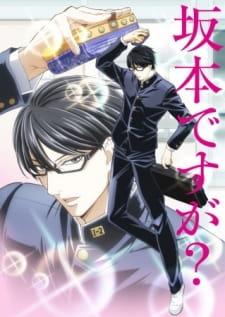
Sakamoto arrives for his very first day of high school already carrying an air of effortless perfection: impeccably stylish, sharp-minded, and unfailingly composed. His presence immediately turns heads—classmates admire him, others seethe with jealousy—and every hallway moment seems to become a stage for his calm, flawless execution.
No matter what pranks or petty schemes are thrown his way, Sakamoto sidesteps them with cool confidence and quick thinking, making even trouble look elegant. As his classmates and teachers watch, challenge, and occasionally try to outdo him, the gap between ordinary and “Sakamoto-level” only grows—though a few may pick up something along the way.
Otaku Consensus
Under Shinji Takamatsu's unusually centralized control as director, scriptwriter, and sound director, Haven't You Heard? I'm Sakamoto turns Nami Sano's high-concept gag manga into tightly timed, surreal school sketches that landed strongly with 2016 comedy viewers. Studio Deen's theatrical staging and the episodic structure make the early run especially bingeable, while the most common criticism is that the central comic format begins to feel stretched by the final episode.
Why You Should Watch
Watch this if you want joke escalation and deadpan absurdism without romance melodrama, club-room sentimentality, or lore homework. Sakamoto scratches the same sketch-comedy itch as Daily Lives of High School Boys and the social-chaos side of The Disastrous Life of Saiki K., but with a cleaner central gimmick: every scene is staged like a prestige advertisement for one impossible teenager. The pleasure is in the execution: camera-ready poses, over-serious music cues from Yasuhiko Fukuda, and Shinji Takamatsu’s instinct for letting a ridiculous beat hang half a second longer than expected. Because the series is episodic, it works as a 12-episode palate cleanser between heavier shows, and its seinen edge keeps the school setting sharper than a standard club comedy.
Key Characters
- SSakamoto
Sakamoto functions less like a conventional protagonist than a deadpan comic device: his unbroken composure turns every social trap, petty rivalry, and hallway incident into a test of visual timing.
What Makes It Stand Out
- 1
Shinji Takamatsu is credited as director, scriptwriter, and sound director, giving the anime a unusually unified sense of comic rhythm across staging, dialogue timing, and reaction beats.
- 2
Studio Deen produced the series as a compact 12-episode TV run airing from April 8 to July 1, 2016, which suits its sketch-driven structure better than a long-running school comedy format.
- 3
The production split chief animation direction by episode parity: Atsuko Nakajima handled episodes 1, 3, 5, 7, 9, and 11, while Tomomi Kimura handled episodes 2, 4, 6, 8, 10, and 12.
- 4
AniList’s tag profile captures the show’s specific identity: Surreal Comedy at 96%, School at 90%, and Episodic at 85%, with Delinquents and Bullying also present enough to give the gags a sharper social edge.
- 5
Yasuhiko Fukuda’s music is used as part of the joke machinery, treating minor school incidents with exaggerated seriousness so the soundscape inflates the absurdity rather than merely decorating it.
Fun Facts & Trivia
- Fun fact 1
- Nami Sano is credited as the original creator, while the anime adaptation was handled by Studio Deen rather than an in-house manga publisher production unit.
- Fun fact 2
- The series has an unusually high visibility-to-rank contrast on MyAnimeList: 416,694 votes and Popularity #271, but a Rank of #2060 with a 7.53 score, suggesting a widely sampled comedy with more divided staying power than its meme presence implies.
- Fun fact 3
- On AniList, the show holds a 73/100 score and 2,781 favourites, closely mirroring its MyAnimeList reception as a broadly liked but not universally elevated gag series.
- Fun fact 4
- Atsuko Nakajima served in two major visual roles at once: character designer and chief animation director for the odd-numbered episodes.
- Fun fact 5
- Web reception consistently singles out bingeability and immediate laughs, while the recurring negative note is structural fatigue: reviewers praised the early comic impact but questioned whether the premise could sustain itself to the end.
Studios
- Studio Deen